

How long it takes the average South African business to pay its taxes


The World Bank and PwC has released a new report detailing how the use of technology, by business and government, has changed the amount of time it takes for a company to become tax compliant.
It did this by modelling business taxation in each economy using a medium-sized domestic case study company across 190 economies.
According to the report, the global average on “time to comply” declined by 5 hours to 240 hours while the total amount of payments made to the taxman declined by one to 24.
The time needed to comply with labour and profit taxes fell by 2 hours (to 61 hours for profit taxes and 87 hours for labour taxes), compared to last year, with labour taxes showing the greatest reduction over the life of the study.
The global movement in the Total Tax and Contribution Rate (TTCR) is virtually flat, increasing by just 0.1 percentage points, to 40.5%; with some increases in corporate income taxes and turnover taxes.
More economies showed an increase in TTCR than a reduction – 52 compared to 36. For the first time since 2004, the TTCR for taxes other than labour and profit taxes increased.
Technology continues to be the major driver of reductions in the time it takes to comply and in the number of tax payments made, the report said.
South Africa
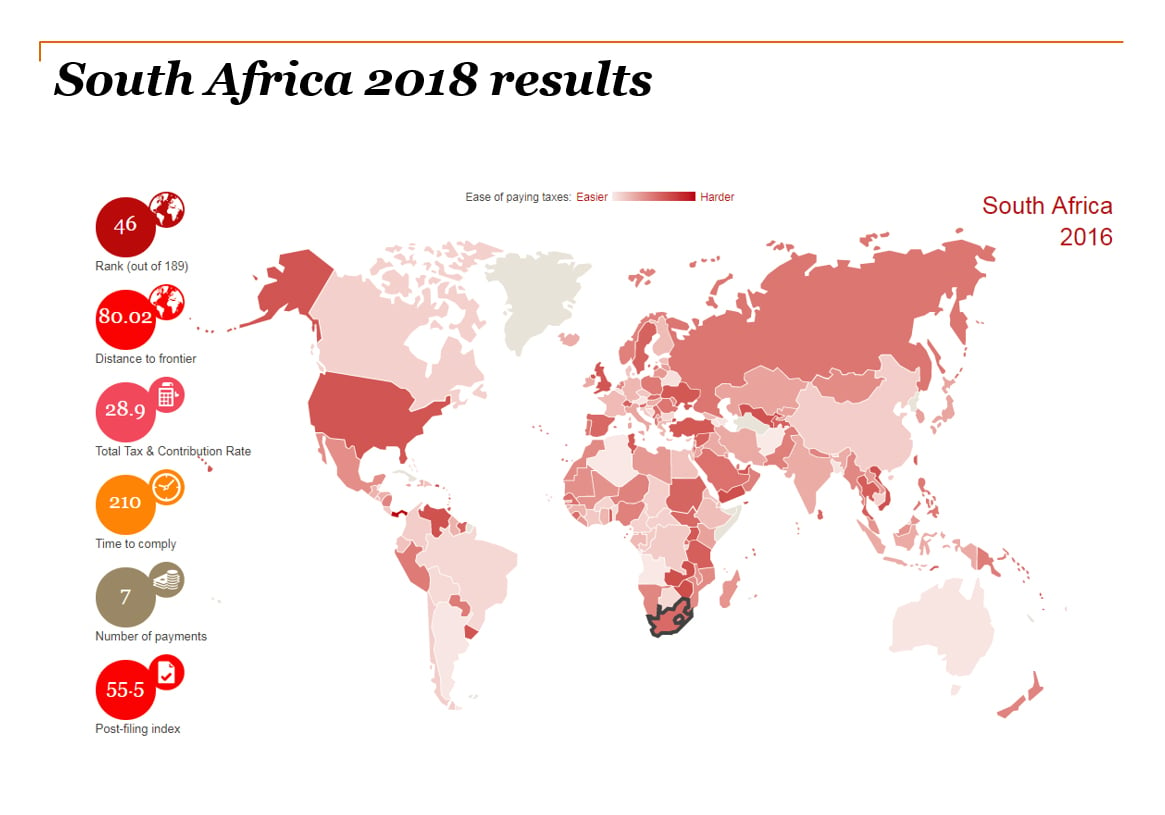

South Africa performed reasonably well in the rankings at 46th, having moved up one place from 2017.
The report also found that South Africa is a leader when it comes to the number of payments due to the widespread use of electronic payment systems – ranked 14th.
“This sub-indicator is primary major reason for South Africa’s good overall ranking,” said Kyle Mandy, Tax Policy Leader for PwC.
“It also represents a risk to South Africa’s future overall ranking as more countries introduce electronic filing and payment systems and catch up with the leaders,”
South Africa takes 210 hours to comply with filing tax returns and paying taxes, compared to the world average of 240 hours and across Africa 285 hours. However, its ranking in this regard is overall relatively poor at 99th.
“Our assessment of the time it takes to comply is slightly better than that of the survey results at 200 hours,” said Mandy.
“The majority of time spent on compliance is in the preparation phase. The primary area where improvement could be made is on corporate income tax where South Africa’s time to comply (96 hours) is above the world (61 hours) and Africa averages (77 hours),” he said.
South Africa’s TTCR (28.9%) compares favourably with global and regional averages where it is ranked 42nd out of 189 countries. However, it ranks behind some of its regional neighbours such as Zambia, Namibia, Mauritius and Botswana.
This is because South Africa makes relatively low use of labour and other taxes compared to other countries, the report found.
However, the country has a relatively high rate of profit taxes of 21.7% which is well above the global and Africa averages of 16.3% and 18.3% respectively.
There is a risk that the total tax rate will increase in future as pressure mounts to introduce new taxes on business to fund increasing spending pressures such as social security reform, NHI and education, the report said.
VAT
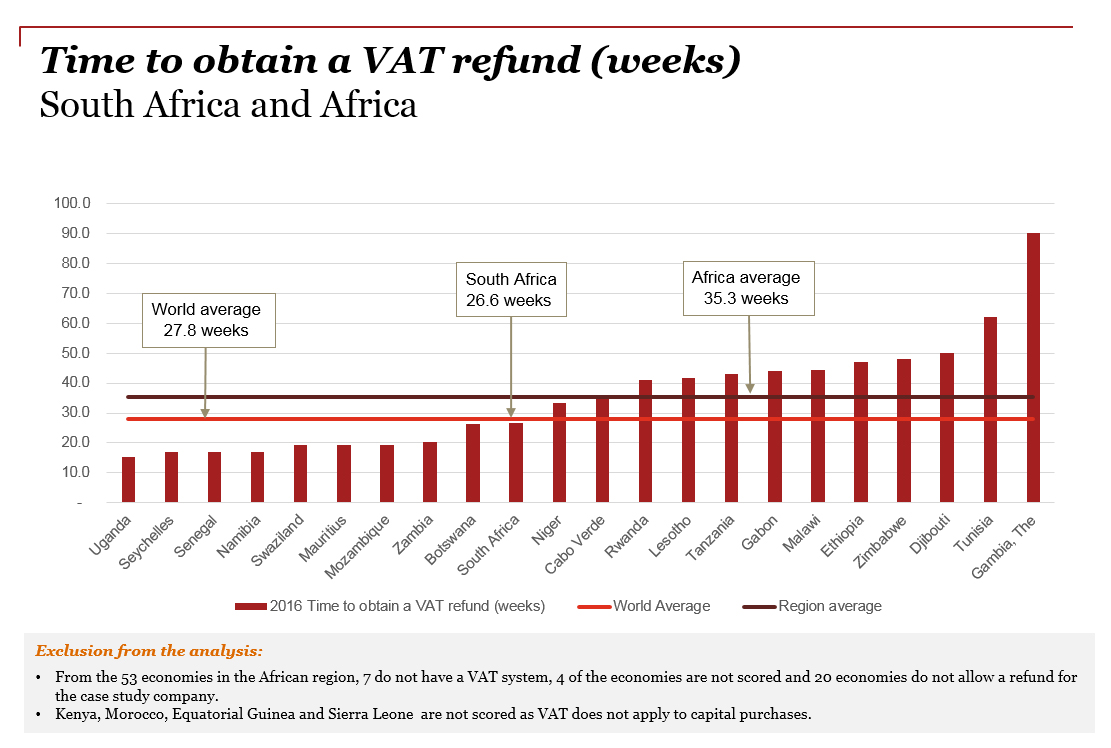
The post-filing process for VAT and corporate income tax (CIT) returns, which are considered in the study for the second year, can be amongst the most challenging and lengthy processes for businesses to comply with.
In some instances, the length of the processes can create cash flow and administrative delays for companies of more than a year.
South Africa performs relatively poorly on the time it takes to get a VAT refund (26.6 weeks).
Mandy, however, pointed out that we differ quite significantly with the results of the survey based on an analysis of our own data as to the time refunds generally take.
“We found that for a company of this nature a VAT refund will generally take far less than the time published,” he said.
“The reason for this disparity of our conclusions and what it is published by the World Bank, is due to the fact that PwC is not the only company that contributes to the survey.”
Read: SARS accused of withholding tax refunds to boost collection numbers


















 Loading ...