

Lending to SA SMEs limited: World Bank


While competition for retail lending has increased markedly in South Africa in recent years – partly because of new banks entering that space – lending to SMEs remains limited, according to the World Bank.
This was part of the findings from a new paper research paper titled Bank Financing of SMEs in Five Sub-Saharan African Countries: The Role of Competition, Innovation, and the Government.
The financial institution admitted that, while cross-country evidence on the drivers of bank financing for SMEs is extensive, detailed information for Sub-Saharan Africa remains limited.
It used data from bank surveys for a total of 62 commercial banks in four countries: Kenya, Nigeria, Rwanda, and South Africa. Aggregate data was collected and bank interviews were also held in Tanzania.
All surveys were completed between 2010 and 2012.
The analysis showed that the share of SME lending in the overall loan portfolios of banks varies between 5% and 20%, with banks in Kenya, Rwanda, and Tanzania being more involved with SMEs in terms of the share of their loan book going to SMEs than banks in South Africa and Nigeria.
The research showed that SME’s share of total bank lending in Kenya represented 17.4%, while in Rwanda it was 17.0%. In Tanzania it was 14% and in South Africa it represented 8.0%. Nigeria was last out of the five countries at 5.0%.
“The evidence suggests that competition, especially as introduced by innovators, is important to encourage banks to venture into the SME space and to move them out of their comfort zone,” The World Bank said.
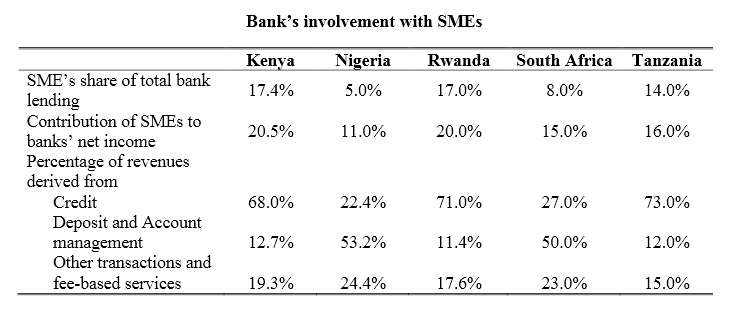
Bank involvement with SMEs
World Bank noted that competition in the SME market segment is strongest in Kenya where a large number of commercial banks are targeting different market segments.
“The difference between Kenya and most other Sub-Saharan African countries in that regard is that innovation started through a combination of microfinance-rooted institutions scaling up to becoming commercial banks and innovation with lending models and technology in the retail banking segment by other institutions,” it said.
In Nigeria and South Africa such competition through innovation has still not taken place, World Bank argued.
In South Africa, the major private sector commercial banks were interviewed in 2010, as
well as niche banks focused on the SME sector and other institutions with broader development mandates.
In total, eight institutions were surveyed, including four commercial banks, representing about 90% of banking sector assets.
The extent to which commercial banks lend to SMEs depends on a range of country- and
bank-specific factors, World Bank said.
According to the World Bank, among the main factors impacting bank financing for SMEs are, inter alia:
- The macroeconomic environment;
- The legal and regulatory framework;
- The state of the financial sector infrastructure;
- Bank-internal limitations in terms of capacity and technology;
- and SME specific factors, particularly the SME landscape in terms of number, size, and focus of operation, as well as the opaqueness of information.
More on SA banks
Banks to reduce branches by a fifth?

















 Loading ...