

Storm clouds burst for South Africa


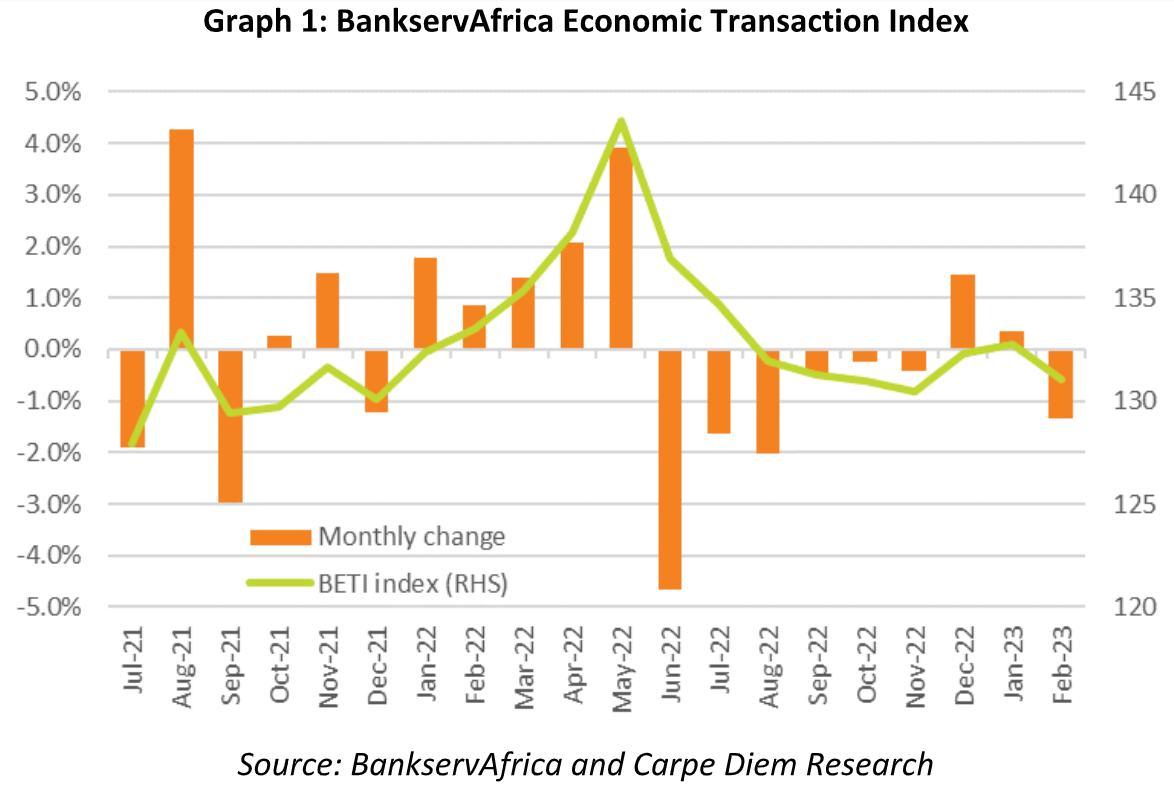
After two consecutive months of encouraging growth, the BankservAfrica Economic Transactions Index (BETI) fell in February 2023, signalling the country’s deteriorating economic activity.
The country is now seeing the clouds burst after warnings of storms ahead in previous months.
“At an index level of 131, the BETI for February slipped to October’s level and declined by 1.3% on a monthly basis, unlike the increases of 1.4% and 0.4% experienced in December 2022 and January 2023,” said Shergeran Naidoo, BankservAfrica’s Head of Stakeholder Engagements.
The February BETI was 1.9% lower than a year ago.
This notable moderation in the BETI reflects the pressures that businesses in the country’s main economic sectors are experiencing from the prevailing dismal economic context.
This includes continuing load shedding, interest rates and inflation remaining at elevated levels, and the global economic slowdown, said independent economist Elize Kruger.
Evidence of the impact and cost of load shedding is shown in the Stats SA data indicating the economy contracted by 1.3% in Q4 2022, on a quarterly seasonally adjusted basis.
Retailers have also shared their predicted losses and costs stemming from business-as-usual during the severe load shedding. These cost increases are either likely to be passed onto the end product price, fuelling consumer inflation, or leading to lower margins.
The other nowcast indicators recorded mixed performances in February.
After moving sideways in January 2023 and December 2022, the Absa Purchasing Managers’ Index plummeted in February to 48.8 index points, while the sub-index measuring expected business conditions in six months fell to its lowest since May 2020.
On the other hand, the S&P Global South Africa Purchasing Managers Index signalled that economic activity in the private sector stabilised in February, after contracting for five months in a row as firms reported a slight recovery in purchasing levels, though input cost inflation accelerated to a seven-month high.
The pace of vehicle sales growth moderated further in February but remained 2.8% higher compared to a year earlier.
Globally, the manufacturing downturn showed signs of easing at the start of 2023, according to the latest J.P. Morgan Global Manufacturing PMI. Rates of contraction in output and new orders both slowed, while employment posted a slight increase.
Economic activity during February was also mixed, according to the BankservAfrica data.
“During the month, the value of standardised nominal value of transactions was R1.17 trillion in February, a growth from the R1.04 trillion in January. However, the volume of transactions slowed to 133.0 million during the month compared to the 135.7 million tracked in January,” Naidoo said.
According to Kruger, the renewed moderation in the BETI, after only two months of marginal improvement, confirms that the economic environment remains challenging and that the economy remains in a ‘muddle-along-little-thriving’ narrative.
“While actions were recently taken and projects have been announced in the energy and transport sectors of the economy, little reprieve can be expected in the short term,” she said.
Read: Big risks ahead for businesses in South Africa – including riots, blackouts and bad weather

















 Loading ...