

Rent is going up again – here’s how much people are paying across South Africa


Property management company PayProp’s latest market report for the first quarter of the year shows how much renters are paying each month across the country.
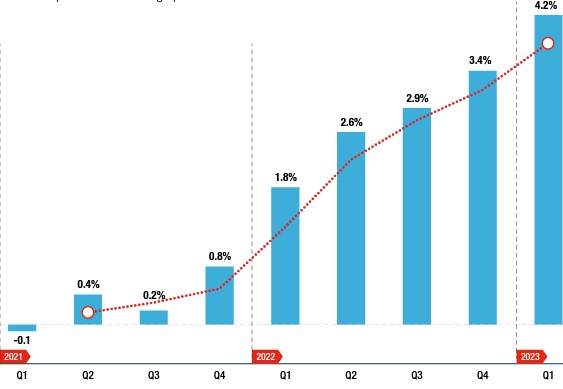
“The average national rent rose by 4.2% from Q1 2022 to Q1 2023, the strongest year-on-year (YoY) figure since Q4 2017. In cash terms, this was an increase of R336 to R8,294,” said PayProp.
Over the first three months, rental growth of 3.9%, 4.6% and 4.0% was recorded in January, February and March, respectively. Inflation remained stubbornly high at 6.9%, 7.0% and 7.1% during the same period, reported PayProp.
As a result of high-interest rates that are struggling to cool off inflation, rising prices and more expensive debt repayments are putting continued pressure on tenant affordability.
The graph below shows the quarterly rental growth rate with a moving average trendline:
The table provided below shows the average rent in each province over the first quarter of this year compared to the first quarter of 2022:
| Province | Average rent | Yearly change |
|---|---|---|
| Western Cape | R9 872 | +5.0% |
| Northern Cape | R9 248 | +10.2% |
| KwaZulu-Natal | R8 801 | +5.0% |
| Gauteng | R8 641 | +3.1% |
| Mpumalanga | R8 268 | +5.1% |
| Limpopo | R7 657 | +6.5% |
| Eastern Cape | R6 650 | +4.5% |
| Free State | R6 348 | -1.1% |
| North West | R5 738 | +3.9% |
A further illustration of the dire rental situation people are finding themselves in is that nationally, according to PayProp, tenants spend 28.8% of their income on rent, this being up from 28.3%.
“Only the lowest income tenants spent a smaller share of income on rent than in 2022,” it added.
PayProp said that the percentage of tenants in arrears has risen from 18.1% to 18.3% compared to the previous quarter, while the average amount owed as a percentage of the average monthly rent in their province is also worse than in Q4 2022.
Despite this, the property firm noted that six out of nine provinces have fewer tenants in arrears than last quarter.
“The 18.3% of tenants in arrears is still well below pandemic levels and in line with the percentages recorded throughout 2022.”
PayProp said the overall national rise was predominately driven by both the Free State, where arrears increased from 22.3% to 26.7%, and the North West, where arrears increase from 16.30% to 22.80%.
Eastern Cape
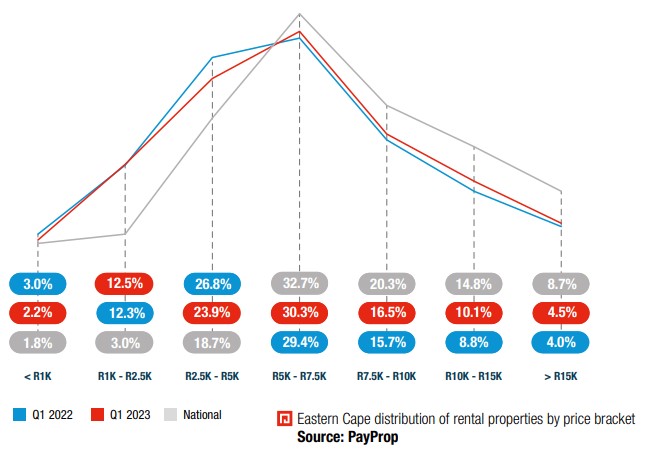
The Eastern Cape saw an above-average year-on-year growth of 4.5%, with an average rent of R6,650.
Regarding the distribution of rent, the Eastern Cape skews cheaper than average, despite the number of properties in the most expensive brackets rising since quarter one the year prior.
The province has a high percentage of rents under R2,500.
Free State
This was the only province that had a decline in rental growth. Rents fell by 1.1% compared to the year prior to R6,358.
“Year-on-year growth has now been negative for three successive quarters, and the province still has the second-lowest rents in the country,” said PayProp.
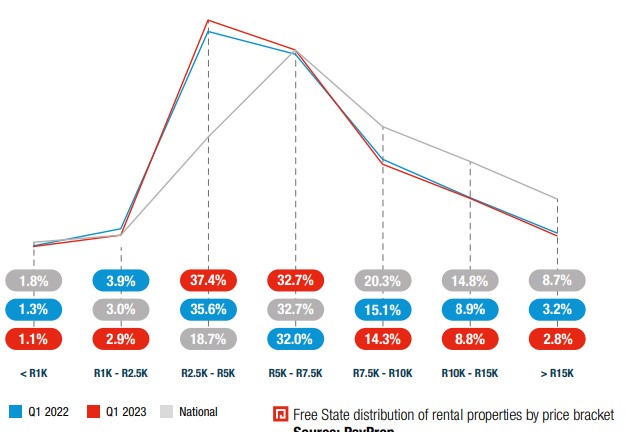
In terms of rental distribution, the largest portion (37.4%) of the rentals is between R2,500 and R5,000 a month, with the upper, more expensive brackets not being nearly as popular.
Gauteng
The economic hub of South Africa had one of the slower st rental growth in South Africa, at 3.1% – up to R8,641 on average.
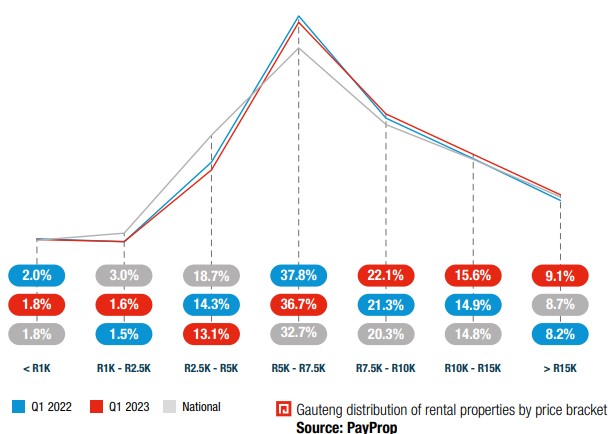
Gauteng has a significantly high number of expensive properties when compared to the national average.
According to PayProp, more than 36% of rentals cost between R5,000 and R7,500.
KwaZulu-Natal
The coastal province of KZN became one of the top three most expensive provinces last year.
Rental growth over this quarter was 5.0% compared to last year and now stands at R8,801, said PayProp.
“KwaZulu-Natal’s distribution of rental prices is almost exactly in line with the national average. This position also changed very little between Q1 2022 and Q1 2023. However, there
was some growth in the bracket above R15 000, which now contains more than 10% of KZN rentals,” PayProp said.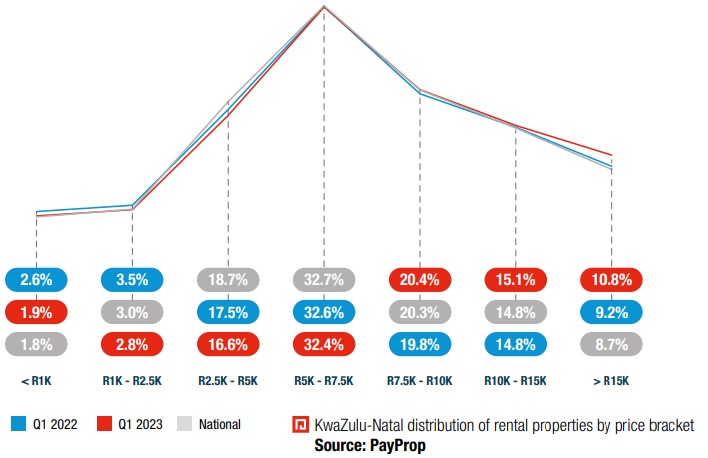
Limpopo
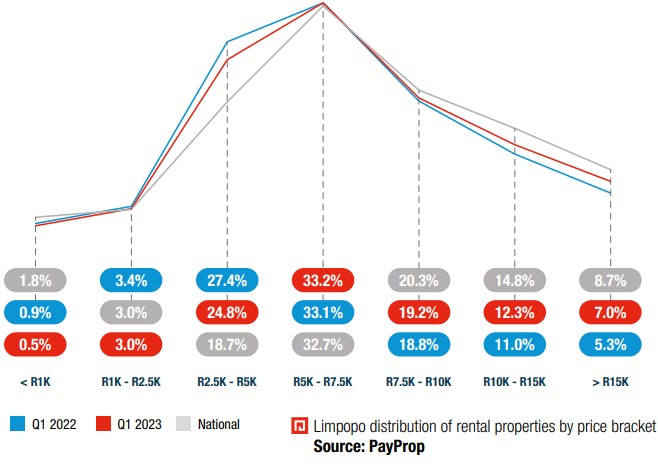
Rent surged to R7 657 in the first quarter of 2023, giving it the second strongest year-on-year rental growth of any province at 6.5%, and continuing a trend of above-average growth that
lasted throughout 2022.
“Despite that, Limpopo is still only the sixth most expensive province for renters, with an average rent more than R600 cheaper than Mpumalanga.”
The majority of properties were between R5,000 and R7,500 a month.
Mpumalanga
In this province, rents rose by an above-average 5.1% year on year in Q1 2023.
Mpumalanga enjoyed the third-fastest rental growth in Q1 after two-quarters of sluggish performances. Rental professionals will hope that the return to form continues, said PayProp.
On top of this, in terms of rental distribution, 34.5% of properties were between R5,000 and R7,500.

North West
The North West posted the third-slowest rental growth of the quarter.
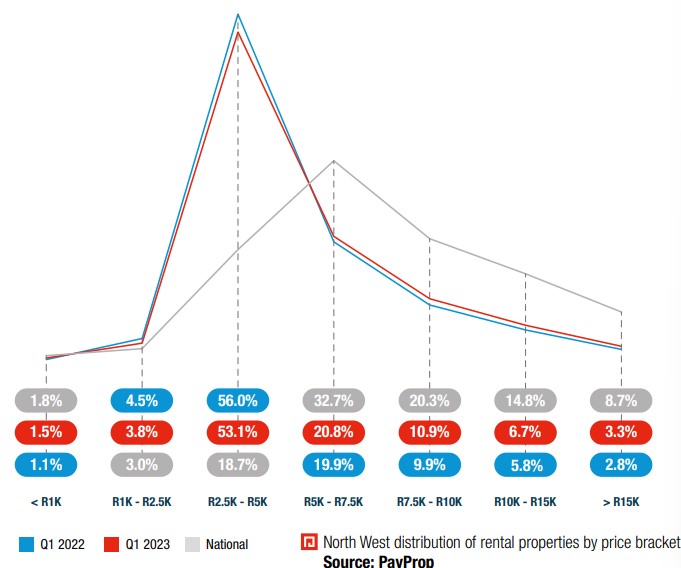
“While the rate of 3.9% was close to the national average, this did nothing to lift it from being the cheapest province for renters – more than R600 lower than the next cheapest province. After four quarters of above-average rental growth, this marks a surprising slowdown.”
In terms of rental distribution, more than half of all rentals in the province fall into the R1,000 – R2,500 bracket.
As in almost every other province, the upper brackets are getting more populous as average rents rise, PayProp added.
Northern Cape
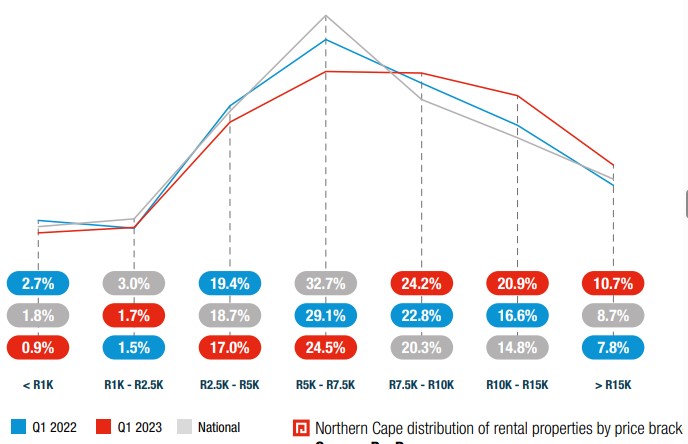
This quarter marked the fourth consecutive period of the Northern Cape being the fastest-growing province in terms of average rent.
PayProp reported that average rent has now reached above R9,000 for the first time – at R9,248.
The North West trends towards the upper brackets. 10.7% of rentals cost R15 000 or more, the third highest share in the country.
At the opposite end, the province has the lowest share of rentals below R1 000 at just 0.9%, said PayProp.
Western Cape
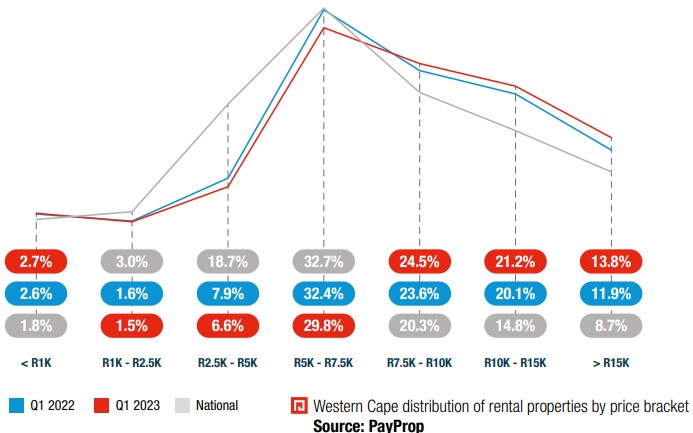
The Western Cape still has the highest average rent at R9,872. PayProp said that over the course of the last year, the average rent increased by 5.0%.
“If that continues, average rents there could well reach five figures this year,” PayProp said.
“The Western Cape is also home to a lot of high-priced properties, and for the same reasons. In this province, 13.8% of rentals cost over R15 000, the highest share of this bracket in the country, and the other R7,500+ brackets are also well above the national average.”
















 Loading ...