

Allan Gray’s message about tax-free investments in South Africa



Allan Gray has explained the potential tax benefits of long-term investment options in South Africa, with the government recently increasing tax-free limits.
Allan Gray has explained the benefits of tax-free investments and retirement funds in South Africa, adding that investing earlier is better.
In the 2026 National Budget, Finance Minister Enoch Godongwana announced that the annual limit for tax-free investments (TFIs) would be increased from R36,000 to R46,000 per year.
Although the lifetime contribution limit remains R500,000, the ability to exceed it earlier allows investors to benefit from higher returns.
Shaun Duddy, head of Product Development at Allan Gray, said that the real benefit is that the increased limit can improve long-term outcomes, along with the tax benefit.
“Contributions made earlier allow capital to benefit from tax-efficient compounding for longer,” Duddy explains.
The increase in the annual contribution limit for TFIs is the first since 2021
Duddy says the increase in the annual contribution limit for TFIs from R36 000 to R46 000 is the first adjustment since 2021.
“As the lifetime limit has not been adjusted, the increased annual TFI contribution limit means that you are able to invest more every year and reach your lifetime limit around three years earlier,” said Duddy.
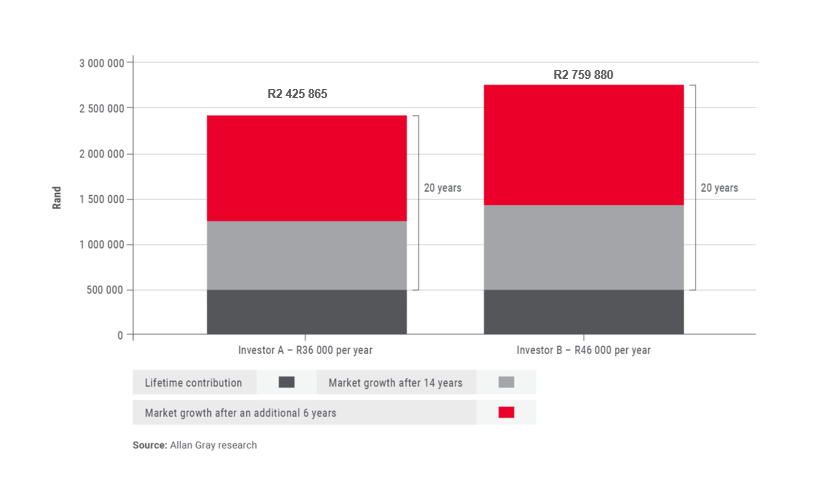
For example, he said there are two investors who invest up to the R500 000 lifetime limit and earn the same annual return of 11.6%.
Investor A invests R36,000 per year and reaches the limit after just under 14 years, while Investor B invests R46 000 and reaches the limit after just under 11 years.
Despite both investing the same total amount, investor B ends up with more as they invest more money earlier. After 14 years, investor B’s portfolio is about 13.8% larger.
“Over 20 years, the absolute gap grows even more, simply because of the benefits of earlier compounding,” said Duddy.
“The difference arises not from how much is invested, but from when it is invested.”
Retirement funds also get a boost
Investors can also now enjoy an additional tax break on retirement fund contributions, with the annual cap increasing from R350,000 to R430,000.
Contributions to pension, provident and retirement annuity (RA) funds are tax-deductible. You can deduct up to 27.5% of your annual taxable income from your tax, up to the new R430,000 limit.
“This makes them a compelling proposition for long-term investors, and the new contribution caps are especially appealing for high-income earners,” said Duddy.
However, he noted that, just like TFIs, timing is important. For instance, an investor who contributes R430,000 per year would see R80,000 treated as an excess contribution under the old limit.
This R80,000 would then be taxed. However, under the new limit, the R430,000 is deductible in the same tax year.
“While deferred tax relief is not lost, its real value will likely erode over time due to inflation,” said Duddy.
“Assuming an annual inflation rate of 5%, an excess contribution of R80,000 used only after 10 years would be worth just R49,113 in today’s terms. Accessing tax relief sooner preserves its real value.”
Duddy further explained that tax on investors can erode the amount available for reinvestment over time, leading to very different outcomes.
For instance, an investment of R10,000 in the Allan Gray Balanced Fund at the end of 2005 would have grown to R89,587 (11.6% annual return) by 2025 before tax.
For an investor in the lowest marginal tax bracket (18%), the investment would have grown at approximately 10.7% per year to around R76,490 after applicable taxes.
For an investor in the highest marginal tax bracket (45%), the same investment would have grown to only R65,487 over the same period, 9.8% annual return. This is an overall reduction of 26.9%.
“Tax-efficient investment structures, such as TFIs and retirement funds, are designed to reduce or eliminate this drag, allowing a greater proportion of returns to remain invested and compound over time,” he said


















 Loading ...