

Two growing holes in South Africa’s economy to keep an eye on


Despite decreased load shedding and improved sentiment amongst South African manufacturers, South Africa recorded a trade balance deficit of R3.5 billion in June 2023.
The South African Revenue Service (SARS) said that the deficit was due to exports of R167.6 billion and imports of R171.1 billion – including trade with Botswana, Eswatini, Lesotho and Namibia (BELN).
SARS added that the year-to-date preliminary trade balance surplus of R5.6 billion is a substantial decline from the R129.6 billion trade balance surplus from the comparable period in 2022.
Export flows declined by 8.3% from R182.9 billion in June 2022 to R167.6 billion in June 2023.
Moreover, import flows jumped 6.5% from R160.7 billion in June 2022 to R171.1 billion in June 2023.
On a month-to-month basis, exports dropped by 8.6% from R183.4 billion in May to R167.6 billion in June.
Imports declined by 1.6% from R173.9 billion in May to R171.1 billion in June.
The decline in export flows was driven by declines in Ores and concentrates, Vehicles (Goods) and vehicles for passengers.
Following ongoing Vouchers of Correction (VOC), the preliminary trade balance surplus of R10.2 billion announced for May 2023 was revised downwards to R9.6 billion.
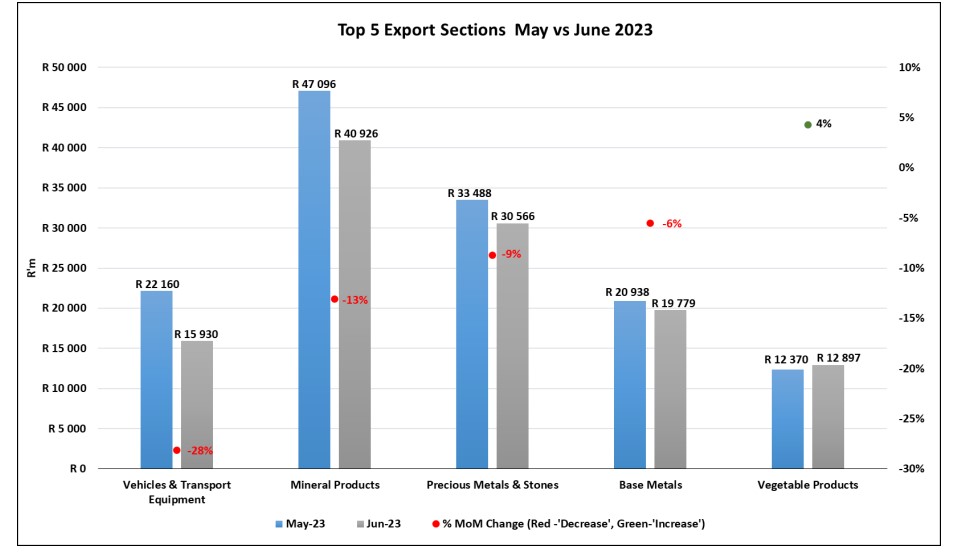
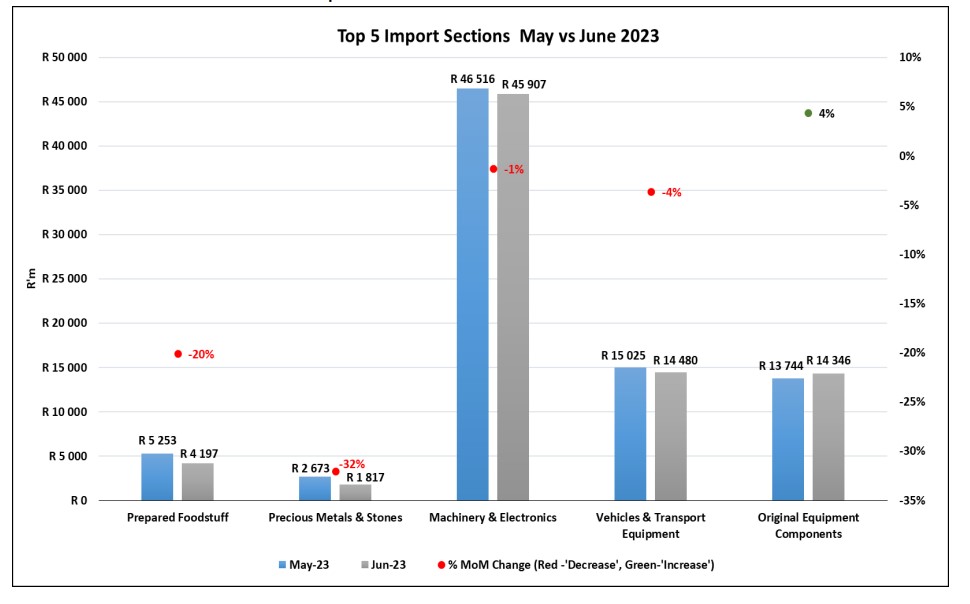
South Africa’s five biggest exporting partners were:
- China (12.0%)
- United States (7.4%)
- United Kingdom (6.0%)
- Japan (5.6%)
- Mozambique (5.6%)
Whilst the top 5 countries South Africa imported from were:
- China (23.3%)
- United States (8.5%)
- Germany (7.7%)
- India (6.3%)
- United Arab Emirates (4.5%)
The trade deficit worsens when BELN is excluded, rising to a R14.7 billion deficit, with export flows at R151.6 billion, and import flows at R166.3 billion.
The preliminary cumulative trade balance has also dropped from a R72.6 billion trade balance surplus in 2022 to a trade balance deficit of R54.4 billion in 2023.
Month-on-month, exports decreased by 9.4% (R15.7 billion), while imports declined by 1.4% (R2.4 billion) over the same period.
Budget hole
The significant decline in South Africa’s trade surplus comes amid warnings that the country’s overall budget deficit for 2023/24 is likely to be far bigger than projections by National Treasury in February 2023.
According to the Bureau for Economic Research (BER), while the country’s monthly budget balance surprised on the upside in June 2023 – recording a much larger-than-expected surplus of R36.6 billion – this is substantially lower than the surplus of R73.8 billion in the same month last year.
The BER noted that the glaring hole comes from gross tax revenue, which was down by 1.4% year-on-year during the first three months of fiscal 2023/24 (April-June 2023) compared to the same period last year.
“Not unexpectedly, the revenue decline was driven by lower corporate tax receipts, which tanked by 20.5% year-on-year during April to June,” the BER said.
“At the same time, main budget expenditure was up by 9.9% year-on-year over the same period.”
The economists said that the bottom line is that government revenue is underperforming the February budget expectation at this early stage of the 2023/24 fiscal year, while expenditure growth is exceeding the Treasury’s projection.
“This supports our view that the main budget shortfall in 2023/24 will handsomely exceed the February budget projection of 3.9% of GDP,” it said.
Read: South Africans turning to credit cards – as other options dry up














 Loading ...