

Storm clouds burst for South Africa


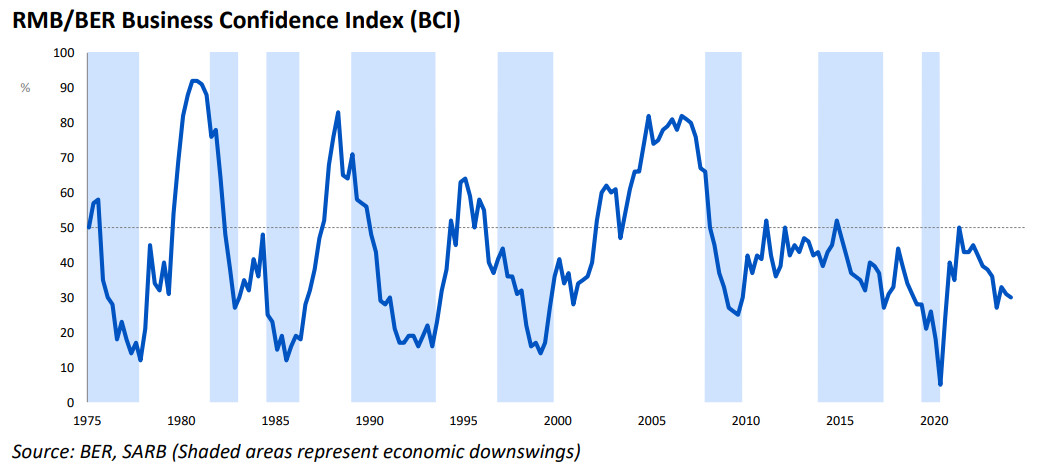
Following a two-point decline in the fourth quarter of 2023, the RMB/BER Business Confidence Index (BCI) ticked down by another point to reach 30 in the first quarter of 2024.
According to the Bureau for Economic Research (BER), this means that seven out of ten survey respondents are unsatisfied with prevailing business conditions in the country.
The situation is bleak when taking a longer view, as fewer than four out of ten survey respondents have been satisfied with prevailing business conditions for seven consecutive quarters.
Business confidence was largely unchanged among building contractors and wholesalers.
Declines in sentiment in the retail and manufacturing sectors outweighed a ten-point improvement among new vehicle dealers.
“Broadly speaking, business activity remained poor while business conditions deteriorated further,” the BER said.
“As was the case in the fourth quarter of 2023, this result went against survey respondents’
expectations for an improvement.”
Remarks about the negative impact of load-shedding, the state of the local ports, crime, and political uncertainty featured prominently in the feedback from survey participants.
“Another noteworthy development was an acceleration in selling price inflation across the board. Except for retail, the increases were relatively muted, but it does signal that there is an upside risk to the inflation outlook,” the BER said.
Sector breakdown
- Building contractors were the least pessimistic of all sectors surveyed, with business confidence ticking up by one index point to 42.
“Main contractor activity was somewhat better than in the fourth quarter of last year. That said, the underlying data does suggest that, following a shortlived surge in activity from the third quarter of 2022 onwards, growth in building activity normalised from the end of 2023 into the first quarter of 2024,” the BER noted.
- Wholesale confidence nudged up by one index point to 37, which is equal to the average reading seen in the second half of 2023.
Sales volumes of consumer goods looked significantly better this quarter.
- New vehicle dealers saw confidence jump up by ten points to 16, but this was not enough to reverse the 24-point decline in Q4.
“Indeed, new vehicle dealers remain the most depressed of all sectors surveyed, indicating a consumer squeeze from high interest rates,” the group said.
- Retail confidence experienced a 13-point decline, which countered the improvements in wholesale and new vehicle dealers.
“Total sales volumes were better in the first quarter on the back of significantly less negative non-durable goods sales and a surprisingly solid uptick in semi-durable goods sales volumes,” the BER noted.
“However, durable goods sales deteriorated once more – particularly on the hardware side. Overall profitability also came under pressure which likely weighed on confidence.”
- Manufacturers saw confidence fall by five points to 21, which is equal to the average confidence reading of 2023.
“A weakening in activity as well as both domestic and export demand explains the deterioration in confidence. Worryingly, respondents turned even more downbeat about investment and business conditions going forward.”
Bleak outlook
The BER noted that even though South Africa managed to narrowly escape a technical recession in the final quarter of the year, annual growth of 0.6% and projections barely over 1% for 2024 paint a grim picture.
“While the economy escaped slipping into a technical recession, the performance remains uninspiring,” it said. “Unfortunately, the RMB/BER BCI results do not signal an improvement at the start of this year.”
On the contrary, business conditions deteriorated further in the first quarter, it said, citing the same supply constraints, including load-shedding, logistical challenges, and heightened global and domestic
policy uncertainty that has kept South African businesses in a stranglehold.
Another drag comes from lacklustre demand, which is insufficient to sustain production and trade sales volumes at a higher level. A temporary surge in building activity also seems to be fading, it said.
Looking further ahead, the expectation of moderating inflation – albeit with the survey showing some near-term upside risks – and possibly lower borrowing costs due to an expected shallow cutting cycle of the policy interest rate may help with local consumer demand in the second half of the year.
“While there has been some positive movement on alleviating some supply-side pressures, particularly energy due to private sector investments, much more needs to be done in implementing economic reforms that can generate the kind of economic growth that can pull along non-energy investment, lift sentiment and generate employment,” the BER said.
Read: Big change for employees in South Africa now earning more than R21,200 a month

















 Loading ...