

The most popular messaging platforms


Popular messaging platform WhatsApp has revealed its latest user numbers – and it may have just taken the lead as the world’s biggest messaging platform.
Posting on a Facebook blog, WhatsApp CEO Jan Koum announced that the platform had just reached 700 million monthly active users, with over 30 billion messages sent every day.
A monthly user base of 700 million is no small number, and has pushed the platform ahead of widely popular Skype competitor, Viber, which boasts 608 million users.
Tencent messaging app QQ actually boasts the most users in the world with 820 million monthly active users; however, ‘only’ 542 million of these are on smart devices, putting it behind both WhatsApp, Viber and Line.
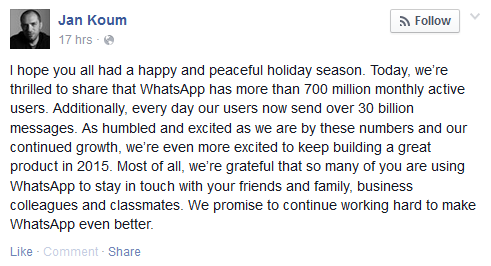
WhatsApp user numbers
Other popular messaging platforms include Facebook Messenger, which hit 500 million users in November, as well as another Tencent platform, WeChat, which is also close to the half a billion mark (100 million outside of China).
Send and self-destruct platform, SnapChat, has also gained in popularity, with comments from its CEO alluding to monthly active user numbers reaching far higher than – if not double – the 100 million reported in August 2014.
Interestingly, the much talked-about acquisition of WhatsApp by Facebook in 2014 did wonders for another messaging app, Telegram, which saw its user numbers shoot to 50 million by the end of the year.
Telegram added 34 million users in 2014 – with 8 million users joining the fold just days after the announcement of the acquisition.
“We spent USD$0.00 on advertising Telegram and trusted you – our users – to spread the word. The results are amazing and are entirely your achievement,” Telegram wrote in a Blog Post.
Most popular messaging apps by monthly active users (MAU)
| Platform | MAU |
As of |
| 700 million | January 2015 | |
| Viber | 608 million | August 2014 |
| Line | 580 million | October 2014 |
| 542 million* | November 2014 | |
| Facebook Messenger | 500 million | November 2014 |
| 438 million** | August 2014 | |
| Skype | 300 million | September 2013 |
| Tango | 250 million | November 2014 |
| Kik | 185 million | November 2014 |
| Kakao | 154 million | September 2014 |
| SnapChat | 100 million | August 2014 |
| BBM | 100 million | October 2014 |
| Telegram | 50 million | December 2014 |
* Smartphone users
** 100 million outside China
Missing in action
Two companies absent from the listing above, which have been notoriously silent when it comes to boasting user numbers about their chat platforms, are Google and Apple.
Apple’s iMessage and Google’s Hangouts are default ecosystem-specific applications used for messaging (as well as video and voice messaging) on iOS and Android devices, respectively.
Presumably, then, it would be fair to assume that there are as many platform users as there are users of Android and iOS devices – but without official numbers from the companies, it would simply be speculation.
Additionally, Google Hangouts is multi-platform, and can be installed on many other devices – including iOS devices – making it even more difficult to pin a reasonable range.
In 2014, Apple CEO Tim cook boasted that Apple had sold 800 million iOS devices, while total Android devices sold have been pegged at around 1 billion.
However, one should keep in mind that iMessage and Hangouts were not always the default messaging services for their respective platforms, and older devices should be excluded from total sales to get a more accurate number.
The Google Play store also notes that the Hangouts app has been installed between 500 million and 1 billion times.
It should also be noted that while these figures are not necessarily reflective of active users on the respective messaging platforms, they do give an idea of scale.
More on messaging
Google to launch new mobile messaging app?
Intel has a new take on instant messaging


















 Loading ...