

South Africa needs trillions of rands – and the private sector has the cash


Trillions of rands are needed to shift South Africa’s energy generation to renewables, and private credit can play a significant role in hitting this goal.
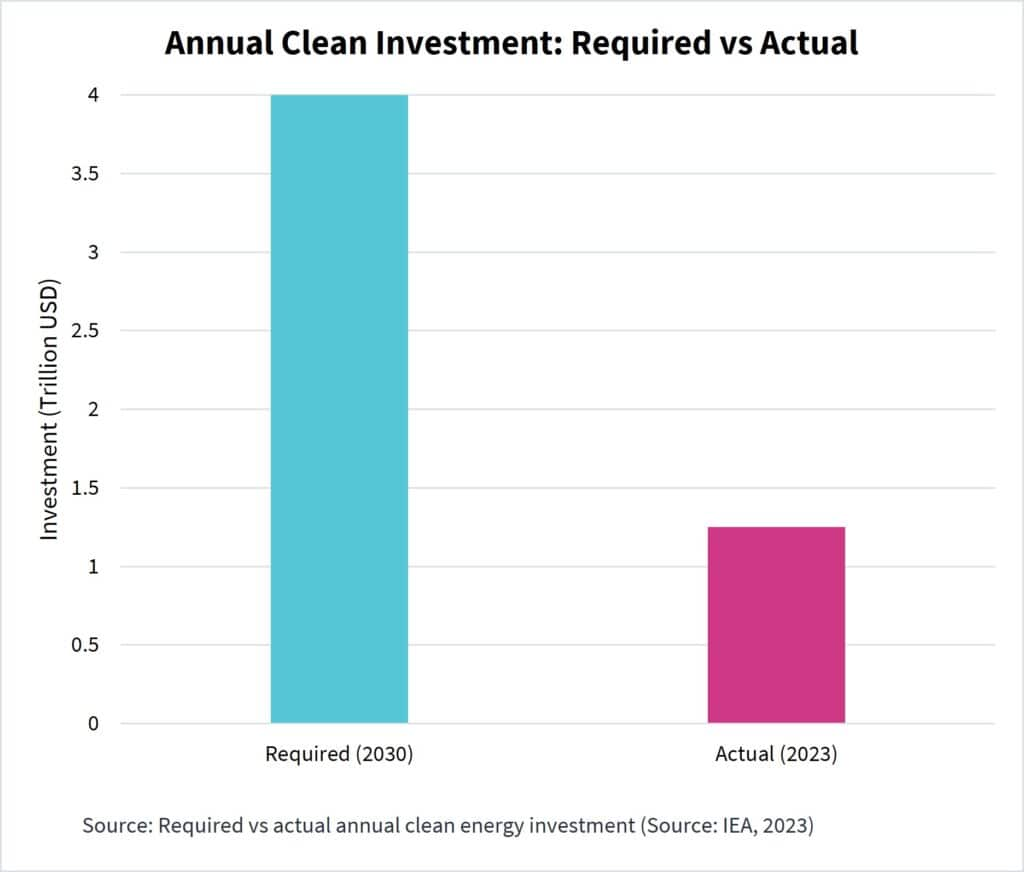
The International Energy Agency (IEA) said that achieving net-zero emissions by 2050 will require over $4 trillion (R70 trillion) in annual clean energy investment by 2030, three times the current budget.
In South Africa, former Minister of Forestry, Fisheries, and the Environment Barbara Creecy said R1.5 trillion would be needed by 2027 to hit required levels for the Just Energy Transition Investment Plan (JET IP).
Stanlib’s Johan Marnewick, Portfolio Manager for the STANLIB Khanyisa Energy Transition Fund, said that public funding alone cannot meet the demand for net-zero emissions amid the nation’s debt struggles.
He said that the private sector will be required to step up, with private sector credit a strong avenue to bridge the financing gap.
Private credit refers to non-bank, non-public lending and has seen massive growth in recent years as investors are attracted to the yield, diversification, and inflation protection.
The JSE All Bond Index is dominated by eight issuers, mostly sovereign and state-owned entities, and accounts for 95% of the market.
This concentration creates a bottleneck in capital allocation, limiting the diversity of investment opportunities available to institutional investors.
Private credit, on the other hand, offers a broader and more diversified set of borrowers, including infrastructure and renewable energy projects.
Realistically, South Africa has the potential to generate up to 49% of its electricity from renewable sources by 2030, which highlights the need for financing in the sector.
“The energy transition is capital-intensive and long-term, two characteristics that align well with private credit,” said Marnewick.
“Institutional investors like pension funds and insurers, with liabilities stretching 20 to 70 years, are ideally positioned to provide the patient capital needed for infrastructure and clean energy projects.”
On a technical side, private credit offers low correlation with public markets, which can help diversify investment portfolios.
Its floating-rate structures can hedge against inflation and interest rate volatility, offering attractive risk-adjusted returns and an illiquidity premium.
Partnerships are key
Private credit is not the only way to incorporate the private sector in the energy transition, with many calling for private-public partnerships.
This was outlined by The RE100, a global corporate renewable energy initiative whose members include several large businesses committed to using 100% renewable electricity by 2050.
Over 100 member companies have operations in South Africa, including Apple, KIA, Microsoft, Meta, Nike, Samsung, Starbucks and Investec.
The RE100 noted that public-private partnerships are essential in driving positive policy change and would increase access to affordable, reliable, renewable electricity for all consumers in the country.
It added that speeding up the rollout of renewable energy is essential for energy security, economic growth, competitiveness, and achieving the nation’s climate goals.
It called on the government to accelerate electricity market reforms and set clear renewable energy goals. Its policy recommendations include:
- Accelerate electricity market reform to enable competitive renewables procurement.
- Strengthen integrated planning and renewable energy-based electricity targets to guide investment.
- Enable and scale direct corporate procurement through wheeling and standardised Power Purchase Agreements (PPAs).
- Fast-track the roll-out of transmission infrastructure and grid connections and streamline project approvals.
- Expand voluntary green power options.
It noted that policy changes are essential to increase corporate investment in the country and drive the energy transition.
Although 80% of the nation’s electricity comes from coal and the private sector is the largest consumer, recent polls show that 95% of business leaders support a switch away.
80% would also prefer the government investment in renewables over fossil fuel infrastructure.


















 Loading ...