

Things are looking up for South Africa – even with the Trump tariff knocking


South Africa’s economy will take a hit from the United States’ upcoming tariffs, but the overall picture for the economy remains promising.
US President Donald Trump announced that the United States will impose tariffs of 30% on South Africa on 1 August 2025 as per his “America First” strategy.
The tariffs are set to limit South Africa’s exports to the US, one of the nation’s largest trading partners.
However, Old Mutual Chief Economist Johann Els said South Africa’s economy should still improve in the coming months and years.
He noted that the US economy will likely enter recessionary conditions later this year, but China and the Eurozone are set to remain strong, with both key trading partners for South Africa.
Global free trade will also likely continue across the rest of the world outside of the USA, as consumers will continue to demand cheaper prices.
Moreover, less than 8% of South Africa’s exports go to the USA. This is a relatively small amount and is also unlikely to drop to 0% overnight, with several exemptions expected.
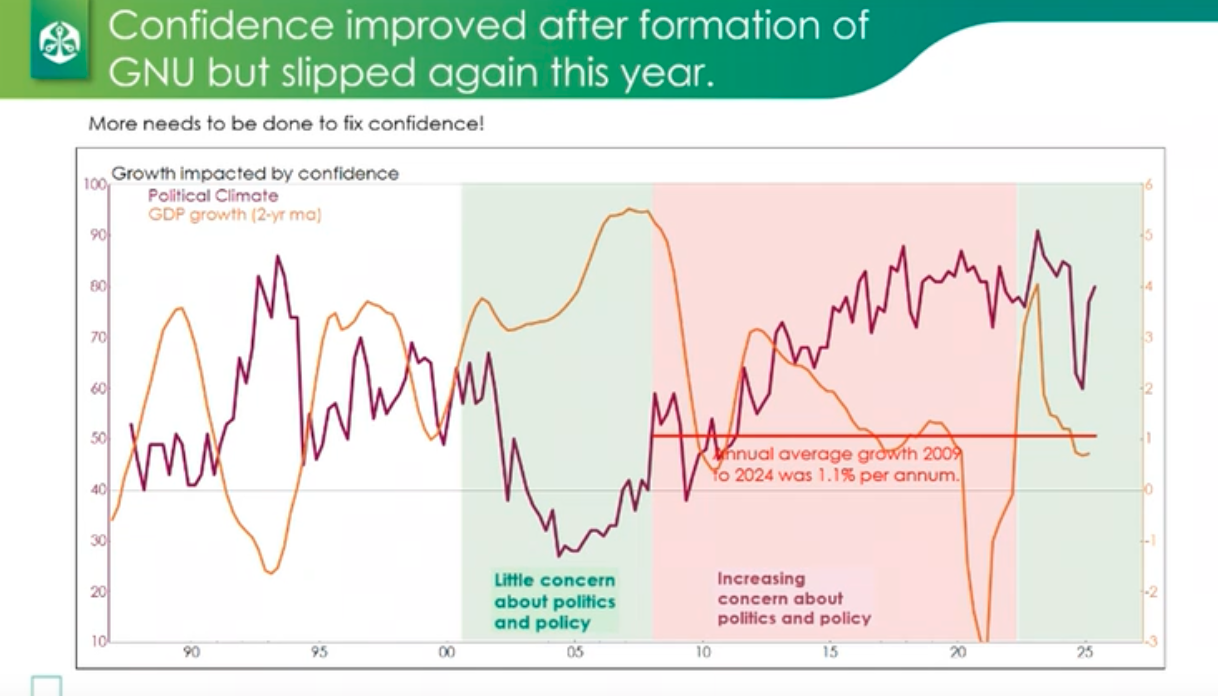
Els also expects South Africa’s GDP growth to improve from the average of 1.1% over the last 15 years to roughly 2.5% in the medium term.
This will come from increased private sector involvement in the economy, with particular focus on the electricity and water sectors.
He added that Operation Vulindleala, a joint initiative between the National Treasury and the Presidency, is progressing in addressing the nation’s most significant structural constraints.
International investment is also expected to increase as investors take a risk-on approach amid serious questions over the US economy’s future.
Investors will be attracted to South Africa’s strong institutions, robust financial sector, relative political stability, and high-growth environment, Els said.
The growing confidence following the formation of the Government of National Unity (GNU) is also expected to help the economy, as improved sentiment is often linked with improved growth.
Regarding the government, the National Treasury has also done well in keeping debt-to-GDP from reaching high levels.
The current debt figure stands at around 70% of GDP, which is well below Old Mutual’s 2020 prediction of 95%.
With these economic improvements, Els expects South Africa to see a ratings upgrade in the coming years.
What to expect for the rest of 2025

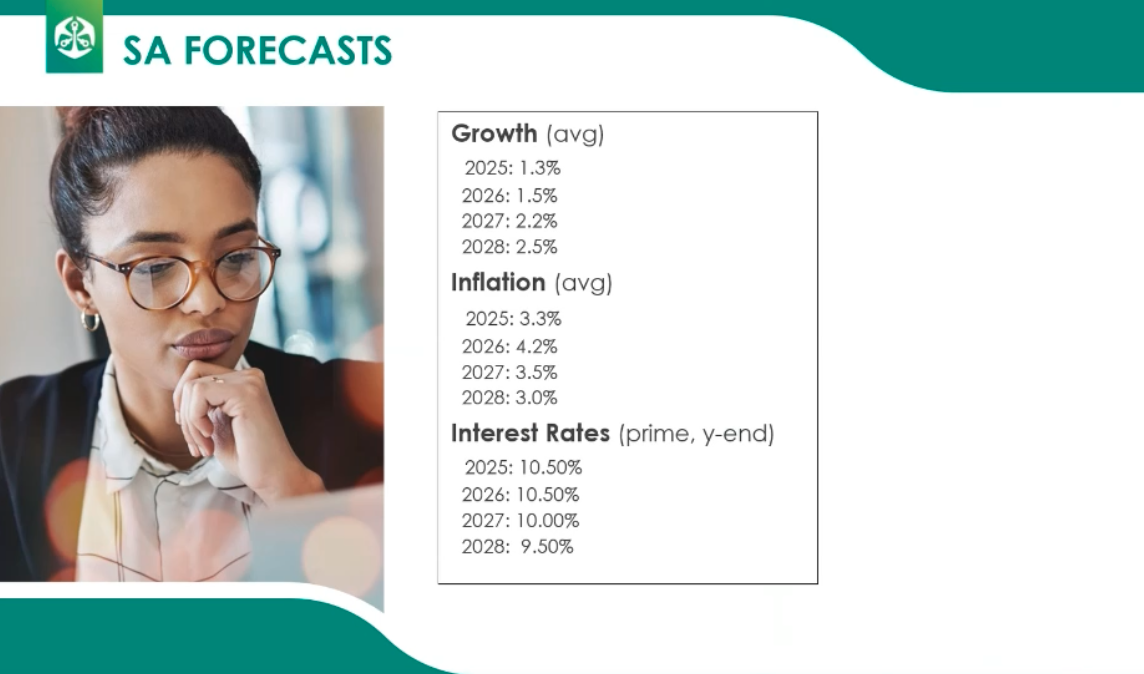
Looking at the rest of 2025, Els said that growth should improve on the back of higher consumer spending. Second-half growth will likely be better.
Regarding interest rates, he expects a cut in the July MPC meeting in two weeks’ time.
However, this is expected to be the last cut of 2025, and the Reserve Bank will likely have a less dovish tone than previous meetings amid the heightened global uncertainty.
Els’ forecasts also assume a lower inflation target will be announced before the end of 2025.
The Reserve Bank has been pushing for a new target, claiming that its current 3% to 6% target range makes the country uncompetitive.
Els thinks that the lower inflation target will result in lower interest rates by the end of 2028, but this will likely lead to higher interest rates in the short- to medium-term.
This will see South Africa sacrifice some growth in 2026, which will only improve from 2025’s expected 1.3% to 1.6%.
More positively, growth will then improve in 2027 to 2.2% and then reach 2.5% in 2028.
Although the growth picture is improving, Els said that it is still far off the 5% that South Africa desperately needs to address its most significant problems.
This 5% is improbable given South Africa’s constrained labour market, skills shortfall and the global economic environment.













 Loading ...