

Capitec could be a game changer for Cell C


Flagship Asset Management Global Portfolio Manager Philip Short believes Cell C and Blue Label Telecoms will benefit from the major restructuring planned for the business—and that Capitec could be a big game changer for the group.
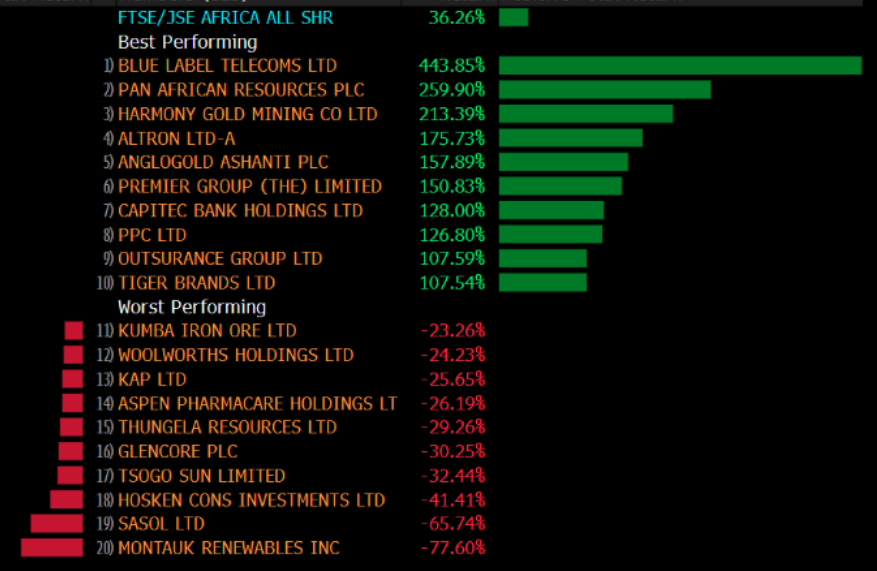
Blue Label Telecoms has been the best-performing stock since September 2023, with gains of over 400%.
Short said the company could potentially double it value as it prepares to restructure Cell C over the next six months.
The restructuring includes a debt-for-equity swap and a planned IPO. Short believes this could unlock R27 billion in value, up from its current R13 billion market capitalisation.
Blue Label predominantly distributes digital tokens, such as prepaid airtime and electricity. It acquired a large stake in the embattled Cell C in 2017, which caused its share price to nosedive.
“Despite significant challenges, including poor capital allocations, high debt, and complex accounting structures, it was trading at compelling valuations for those willing to look past the complications,” said Short.
“The upcoming restructuring presents significant value-unlocking potential.”
In May, Blue Label said it plans a debt-for-equity swap to eliminate Cell C’s debt and increase its stake to nearly 90%. This would be followed by a Cell C IPO later in the year.
“Through smart corporate finance activity, BLT now owns approximately 90% of the debt on Cell C’s balance sheet and 80% of the equity,” said Short.
“Essentially, BLT owes the money to itself, setting up the debt-for-equity conversion.”
Short said that a major area that Cell C could benefit from is its partnership with Capitec to create Capitec Connect.
Capitec was processing 30% of all prepaid airtime in South Africa via Cell C’s channels by 2022, with Blue Label facilitating the prepaid engine in the background.
Capitec then launched Capitec Connect, a Mobile Virtual Network Operator (MVNO) roaming off Cell C’s network.
Capitec Connect has seen massive growth, reaching 1.5 million subscribers by the end of 2024, with a current run rate of 180,000 monthly subscribers.
Short said that this benefits Cell C, as every Capitec Connect subscriber becomes a Cell C subscriber.
“With Capitec’s 22 million banking customers as a potential subscriber base, the growth runway is substantial.”
Cell C now supports 13+ MVNOs, including major brands like Shoprite, FNB, and Standard Bank.
MVNOs can be attractive for operators, as another party handles the marketing and customer acquisition, resulting in lower operating costs.
Cell C also benefits from network share agreements with MTN and Vodacom, while maintaining its own spectrum. This allows strong network quality without capital-intensive infrastructure.
Short also noted that management quality at Cell C has improved significantly in recent years, with six of the eleven C-suite executives—including the CEO—joining from Vodacom in the last 20 months.
Strong future

Blue Label’s core digital token business generates R800 million profit annually and remains cash generative.
Although the complex accounting structure for the recapitalisation of Cell C in 2022 deterred many investors, Smith said it created opportunities.
Cell C has negative equity, meaning its profits cannot be recognised in Blue Label’s financials. As the turnaround continues, this will change.
Following the restructuring, Cell C is estimated to generate R2.5 billion EBITDA with roughly R2 billion net profit, benefitting from R28 billion in tax losses over the next five to ten years and no long-term debt.
“For a debt-free company with double-digit earnings growth, an asset-light business model, and likely dividend payments being initiated, applying a conservative 10x P/E multiple suggests Cell C could be valued at R20 billion,” Smith said.
Blue Label without Cell C generates R700 billion in net profit, and is worth roughly R7 billion using similar multiples.
The combined sum-of-parts valuation reaches R27 billion compared to Blue Label’s current R13 billion market cap.

















 Loading ...