

One week to disaster for South Africa


South Africa is seven days away from being hit with a 30% tariff on exports to the United States, and President Cyril Ramaphosa says talks with the Trump administration are ongoing.
Speaking to journalists on the impending tariffs, Ramaphosa said they pose a significant threat to South African industries, but the country is doing what it can to mitigate the looming disaster.
“The tariffs from the US obviously have turned the world upside down, and are a huge threat to us because we export a lot of products to the United States,” he said.
Key industries in the country stand to be hit hard by the tariffs, including vehicle producers, those selling agricultural products and even mining products, he said.
“The imposition of those tariffs will have a negative impact on us, and our producers are already feeling the pressure that is coming.”
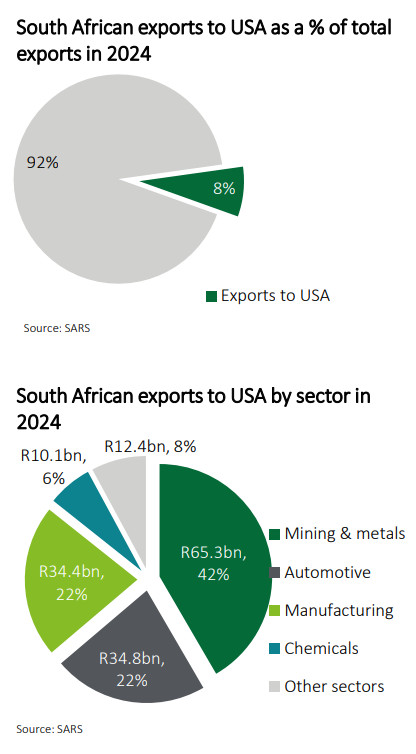
According to data from SARS, about 8% of South Africa’s total exports in 2024 were to the United States. While this may seem small in the grand scheme, it still reflects about R157 billion in trade.
Of this amount, around 22% or R34.8 billion is attributed to the automotive sector, which is already under severe pressure from existing tariffs, the incoming tariff threat, and the probably loss of AGOA access later this year.
The disaster has been brewing for months, and at this stage, it would be difficult to argue that affected industries have been blindsided.
The tariffs were first announced on 2 April as part of US President Donald Trump’s “Liberation Day” announcements. He initially set the launch day as 9 April, but hit pause for 90 days to give room for negotiations to take place.
This prompted a high-level delegation led by Ramaphosa and key ministers and representatives to make their way to meet with Trump in May.
Ramaphosa said that this visit was for South Africa to “open the door for engagement” with the Trump administration, which he says is what the country is doing now.
“We are engaging with the US, we are in discussions with them,” he said.
However, the last official communication on trade negotiations came from the Department of Trade and Industry (DTIC), which is leading the talks, when it presented a new “package” of proposals to the US.
Reports have pointed to the South African negotiation team being left on hold. Ramaphosa said this is not so.
“We are talking to them and they’re talking to us. We are exchanging a whole lot of ideas and proposals, and we are hoping that those negotiations will bear fruit in the coming days,” he said.
But the president acknowledged that time is running out amid doubts from experts that anything can be done in the mad dash to the deadline.
“Time is of the essence as far as this is concerned. A lot of work is underway by our officials and ministers. We are engaged in discussions,” Ramaphosa said.
South Africa needs a plan B
Ramaphosa said that even with ongoing attempts to win the United States over, the government is looking to mitigate the potential fallout of the tariffs if they go ahead.
Business leaders have called for plans to be put in place to help distressed industries.
Business Leadership South Africa CEO Busi Mavuso suggested Covid-19-era interventions like loan schemes and Temporary Employer/Employee Relief Scheme (TERS) be considered again.
The government should also immediately establish a tariff impact fund to support viable companies through the transition period. she said.
At the same time, the state should work with affected industries to identify and develop alternative markets, the business lead said.
Over the long term, economists and analysts say the government should redouble efforts to forge new trade agreements and tap into new markets for South African products.
This includes mass markets like India and China for agriculture and minerals. To this end, Ramaphosa said that South Africa is definitely looking for other markets to sell its wares.
One key avenue is here in Africa, with the president noting that “we have a very big tariff-free opportunity (in Africa)”.
He said that officials and ministers have been travelling around the world with trade at the forefront of their minds.
“As people see us hopping on and off planes, we are searching and looking for markets for our products so that we can employ more people and grow our economy,” he said.


















 Loading ...