

R33 billion plan to fix Joburg’s water crisis as it ‘throws away’ one-third of supply


The City of Johannesburg’s water utility Joburg Water has outlined its R33 billion plan to steer the city away from its current water crisis, where one-third (33%) of its water supply is lost to poor infrastructure.
The utility presented its plan to the Portfolio Committee on Water and Sanitation on Friday (19 September) amid widespread water outages and growing unrest among residents.
In an embarrassing indictment on the city’s management, mayor Dada Morero was hauled before the committee to explain the crisis and what was being done.
Johannesburg Water Managing Director Ntshavheni Mukwevho was also present to account. The blame has been placed on high demand from residents, poor and deteroriating infrastructure, and historic neglect in maintaining it.
According to Joburg Water, demand for water services in the city currently sits at 1,726 megalitres per day (Ml/d), where it needs to be at 1,550 Ml/d to be in line with the temporary licence apportionment.
Excessive demand by Gauteng metros has been repeatedly flagged by Rand Water, which maintains that it supplies enough water in the province for the cities to meet their needs.
The Department of Water and Sanitation pointed out that Rand Water supplies sufficient water to Gauteng, but this would only work if the cities reduced leaks in their distribution systems and invested more in their distribution infrastructure, including storage and pumping capacity.
Notably, it pointed specifically to physical losses in Joburg of 33%.
“This means that the municipality is literally throwing away a third of the water they obtain from Rand Water,” the department said.
To reduce the leaks, the department said that Joburg—and other municipalities—must properly resource and improve the performance of their leak repair teams, so that there is a quick turnaround times for fixing leaks.
The city should also peplace old leaking pipes and implement pressure management programmes, including installation of pressure reduction valves.
“Gauteng municipalities have been neglecting investment in their distribution infrastructure for decades. In many areas, the infrastructure is very old, and the municipalities have failed to renew their aged infrastructure timeously,” the department said.
In the City of Joburg specifically, 44 reservoirs are old and leaking and require refurbishment.
“While the demand on the municipal distribution systems has grown markedly, the systems have not been adequately upgraded to cater for the increased demand.”
We need R33 billion to fix the problem

Joburg Water acknowledged the problems with maintenance, but pointed out that it has an infrastructure renewal backlog of about R27 billion.
Meanwhile, it also faced demand-side pressure from illegal connections, particularly near critical infrastructure, mainly from informal settlements, resulting in very low levels of available water to nearby reservoirs.
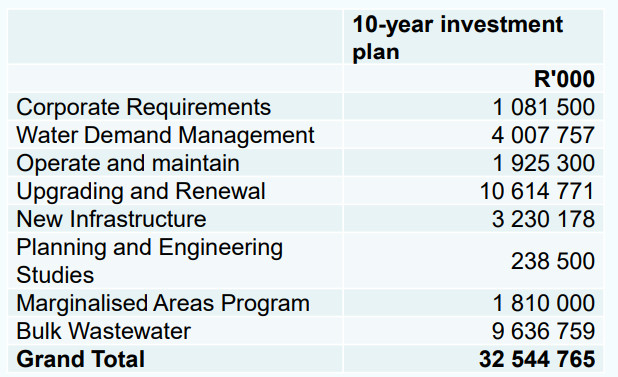
Factoring in the the renewal backlog, and expansion plans, the group said that it requires an annualised investment of R3.25 billion per year for the next 10 years to resolve and avoid crisis.
Joburg Water said that the key focus areas for the next 10 years will be the upgrading and renewal of infrastructure as well as investment in treatment plants (30%).
“The renewal of infrastructure will also assist in improving the infrastructure failure rate that has led to high water losses,” it said.
The plan is to allocate R4 billion to support the water demand management strategy of which 64% is to be spent in the first four years.
In the immediate term, ie 2025/26, the city has set a capital budget of R1.7 billion to invest in infrastructure. The budget increased from the 2024/25 budget of R1.29 billion.
The key projects the city is looking to implement include:
- Water demand management programme aimed at infrastructure upgrades (secondary mains), retrofitting of on-property leaking fixtures and STS metering. About R180 million has been budgeted in the current FY.
- Increasing storage capacity by constructing new Reservoirs and Towers. This includes Brixton Reservoir 26Ml and tower nearing completion, and Erand tower 2Ml nearing completion. About R228 million has been budgeted in the current FY.
- Refurbishment of leaking reservoirs with the commencement of phase one (17 reservoir complexes with 22 reservoirs). The contractors have been appointed for two reservoirs (Meadowlands & HH2), and the rest are expected to be awarded by November 2025. About R350 million has been budgeted in the current FY.
The city said it also plans to accelerate its water pipe replacement programme—of which 85km of aged network is targeted—improve efficiency and compliance with its water use licence, and improve its sewer network performance.










 Loading ...