

End of an era for iconic food giant in South Africa


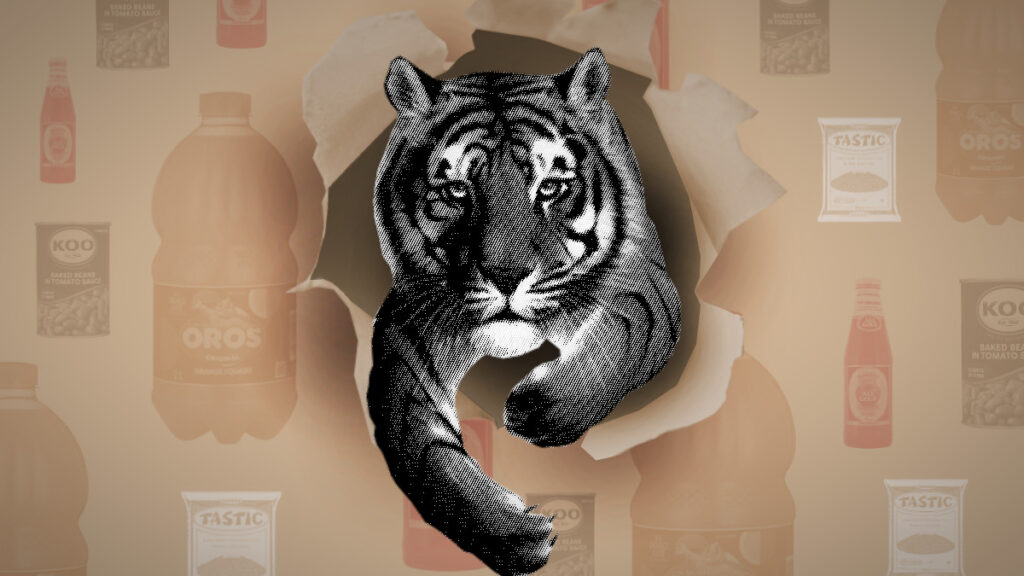
Packaged goods and food producer Tiger Brands has seen a significant increase in its earnings for the 2025 financial year, with the group undertaking a major brand refresh as it signals a new era.
The group said that it delivered strong earnings growth and continued cash generation despite the constrained consumer environment.
“Despite food and non-alcoholic beverages inflation moderating to 4.5% in September, consumers remain under pressure and value-seeking,” said the group.
To address these issues, Tiger Brands’ strategy is underpinned by a focus on providing value for consumers.
Management executed continuous improvement and strategic pricing initiatives in the 2025 financial year.
Overall revenue increased by 2.7% to R34.4 billion, driven by a 3.5% volume growth and a 0.8% price deflation.
Gross margin increased to 31.3% from 29.1% in the prior year, driven by value engineering savings on recipes and packaging and factory efficiencies.
Earnings per share from total operations increased by 30% to 2,482 cents per share.
The group’s headline earnings from total operations increased by 15% to 2,056 cents per share.
The variation between HEPS and EPS mainly relates to profit on the disposal of the non-core Baby Wellbeing division and its Chilean associate, Carozzi.
When examining continuing operations, EPS increased by 50% to 2.662 per share, with HEPS rising by 31% to 2.141 per share.
The group also decided to reduce its dividend cover from 1.75x to 1.25x for the current year and foreseeable future.
This has resulted in the group’s final ordinary dividend increasing by 79.7% to 1,229 cents per share.
This took the company’s total ordinary dividend for the year to 1,644 cents per share, with a total payout of R2.4 billion.
The group also declared special dividends for the 2025 financial year of 3,926 cents per share, totalling R5.8 billion.
The group also returned an extra R1.5 billion to shareholders via a share buyback programme.
| Item | 2025 | 2024 | Change |
|---|---|---|---|
| Revenue | R34.4 billion | R33.5 billion | +2.7% |
| Group operating income | R3.8 billion | R2.8 billion | +35% |
| EPS – Total operations | 2 482 cps | 1 914 cps (restated) | +30% |
| EPS – Continuing operations | 2 662 cps | 1 776 cps (restated) | +50% |
| HEPS – Total operations | 2 056 cps | 1 782 cps (restated) | +15% |
| HEPS – Continuing operations | 2 141 cps | 1 631 cps (restated) | +31% |
| Share buybacks | R1.5 billion | – | – |
| Interim special dividend | 1 216 cps (R1.8 bn) | – | – |
| Dividend cover | 1.25× | 1.75× | Reduced |
| Final ordinary dividend | 1 229 cps | 684 cps | +79.7% |
| Final special dividend | 2 710 cps (R4.0 bn) | – | – |
| Total ordinary dividend (FY25) | 1 644 cps (R2.4 bn) | – | – |
| Total special dividend (FY25) | 3 926 cps (R5.8 bn) | – | – |
Refresh and new era
Tiger Brands is ubiquitous in South Africans’ lives. It owns large and iconic brands like Albany, All Gold, Black Cat, Doom, Energade, Jungle Oats, Mrs H.S. Balls, Oros, Koo, Maynards, and many more.
Despite its brands being found in most South African households, the company faced extreme pressures over the last decade, including unsuccessful forays into Africa and a damaging listeriosis outbreak in 2018.
Under the leadership of CEO Tjaart Kruger, appointed in November 2023, the group has focused inwardly, investing heavily in its plants and automation, while also rationalising its brand portfolio.
Over 25 years, and after changing its company name from Tiger Oats to Tiger Brands, the company is now undergoing a refresh of its corporate brand so that this change reflects outward.
“(The refresh) reflects our commitment to contribute to a healthier, more resilient Southern Africa by bringing affordable, quality foods and essentials to everyone,” it said.
“At Tiger Brands, we hold a fundamental belief: that everyone should have access to good food and quality essentials.”
As part of the refresh, there is a concerted effort by management to recapture market share, and to realign in segments like the personal care category.
At the core of the overhaul is a change in its positioning among consumers, with a focus on bringing value and being a part of every day life for households.
The group recognised that work still needs to be done to fix the issues that many households still face.
It noted that many families still struggle to put nutritious meals on the table or access everyday essentials.
In line with its strategic focus on rejuvenating its brands, it is also exploring ways to bring value to consumers.
Thus, in addition to the refresh, the company stated that it is working on a way to play an active role in creating positive and sustainable outcomes across its value chain.
The company said that its refreshed purpose is to “cultivate and nourish lives every day and every tomorrow.”
When it comes to Tiger Brands’ darker past, the company said that its lead reinsurer, QBE Insurance, is still settling claims linked to a listeriosis outbreak.
The outbreak in 2018 led to the deaths of over 200 people and was caused by ready-to-eat processed meat products at a Tiger Brands facility.
















 Loading ...