

In contemplation of Sapiens – the species and the book


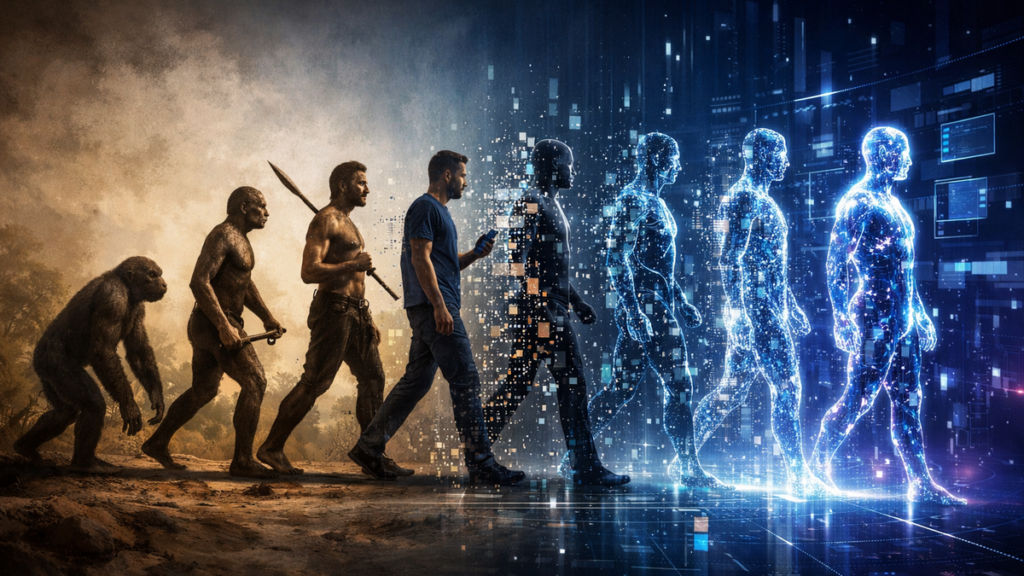
Over the holidays, I had the opportunity to reread Yuval Noah Harari’s much-heralded 2011 book Sapiens: A Brief History of Humankind, which explores how Homo sapiens came to dominate the planet by tracing the cognitive, agricultural, and scientific revolutions that led us to where we are now. I was particularly drawn to the opening section of the book, which examines what Harari calls the “Cognitive Revolution” – the profound shift he dates to around 70,000 years ago, when humans transformed from being a relatively unremarkable species to one capable of complex language, abstract thought, and large-scale cooperation.
It was through this transformation that we acquired a form of consciousness distinct from that of other animals – one marked by reflection, imagination and shared meaning. It was through this transformation that the mind truly came into being.
At the very start of 2026, facing the wave of overwhelmingly optimistic narratives that claim that we are at an inflection point in human history – that we stand on the brink of achieving artificial general intelligence, or perhaps even superintelligence, in which machines truly become conscious – I have found myself wondering how we as human beings ourselves achieved consciousness. Somewhat disappointingly, Harari does not come close to being able to answer this question. In a book that is widely regarded as the most authentic account of how Homo sapiens evolved and came to be so dominant as a species, the most crucial question as to how we developed our unique mental capabilities, is completely glossed over.
Harari only tentatively suggests one possible theory, which is that an accidental genetic mutation may have occurred 70,000 years ago, altering brain functions and giving rise to advanced cognitive processes. In this framing, the critical transformation that the human species underwent to become authentically human was not the inevitable next step in a linear story of biological progress, but rather an extraordinary coincidence. As Harari himself concedes, “Nobody really knows why these changes occurred.”
Given where we believe ourselves to be scientifically as a species, this acknowledgement is, roughly speaking, intellectually unsatisfying. I found solace, however, in another more recent book, published in 2025, called The Emergent Mind by psychology professors Gaurav Suri and Jay McClelland. These authors argue that the mind emerges from countless patterns of activity between the brain’s billions of physical individual neurons. Their proof for this profound insight into the nature of the human mind is that scientists are ever more able to replicate the brain’s capabilities through the use of computer-driven mathematical neural networks. And that, at some point the brain’s capabilities become so advanced that they become indistinguishable from the mind.
This does not mean that thought can simply be explained through a mechanistic mapping of specific neurons to specific mental processes. Instead, their thesis rests on the conviction that a system as a whole can possess properties that none of its individual components exhibit in isolation. In this view, neurons do not produce thought on their own, but their interactions give rise to a larger mental system that is capable of thinking.
To illustrate this, Suri and McClelland draw an analogy with the coordinated flight of a flock of birds. There is no central intelligence directing the flock, nor do the birds collectively decide on their speed or direction. Instead, each bird responds to the movements of its nearest neighbours, and through these local interactions a ripple effect ultimately occurs, producing the flock’s collective motion. Given sufficient neural complexity, the authors argue that consciousness emerges in much the same way.
It is this line of thinking that underlies the AI revolution, at the heart of which lies the belief that the mind can be replicated in non-biological systems by simply recreating the neural architectures and processes that give rise to thought in humans. Proponents of this belief have long argued that it is merely a matter of time before AI systems become conscious by sheer virtue of the complexity of which they will become capable once there exists sufficient processing power and data. It is this narrative that has, until recently, fuelled extraordinary investor confidence in technology stocks and validated the vast amounts of debt being taken on by companies across the AI ecosystem.
The upshot of this is that there now exists a web of interdependent tech-related companies whose fortunes are tied to the question of whether the AI revolution will indeed materialise, and whether it will be as transformative as its acolytes proclaim. For the first time in some years, however, signs of doubt appear to be emerging as investors begin to question if there may, in fact, be significant overinvestment in a technology that may be further away from being realised than its industry leaders have suggested. American business professor Scott Galloway has predicted that the next big government bailout, since the 2008 Financial Crisis, could well be a bailout of the world’s largest AI companies. “[Trump’s] entire presidency and our entire economy is one giant bet on AI,” he states.
In a sense then, we do, in fact, currently stand at an inflection point in history – in that we will likely soon witness the so-called AI revolution either succeed or fail. Setting aside concerns about biased data, intellectual property, market concentration, and the entanglement of technology firms with governments, failure would leave us still grappling with fundamental uncertainty about the nature and origins of the human mind. Success, however, carries an even more unsettling implication, because it would mean that human consciousness really is nothing more than the product of interacting neural systems. If the AI revolution does indeed materialise, it will nullify everything we believe about what it means to be human.
This article is an opinion piece by David Buckham. The views in this article are those of Buckham, and do not represent the views of BusinessTech and its associated companies.
David Buckham is the Founder and CEO of international consultancy Monocle Solutions. He is co-author, alongside Robin Wilkinson, of the bestselling The Spell: A Story of Human Progress and How the West Lost its Soul.


















 Loading ...