

Close to 100 businesses in South Africa shut down at the start of 2026


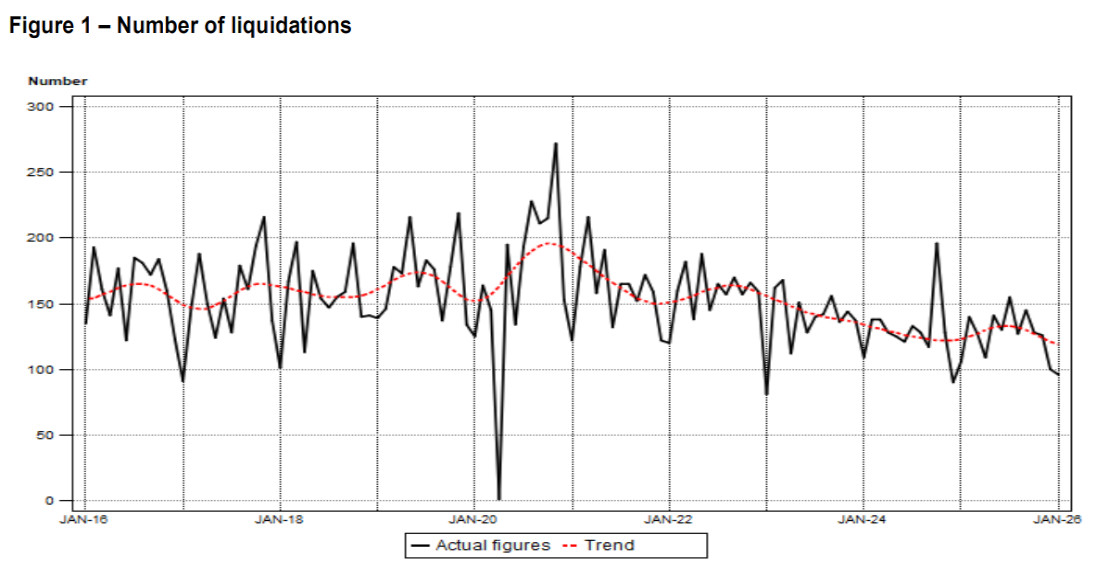
Just under 100 businesses were liquidated in the first month of 2026, with Stats SA recording 96 closures in the first weeks of the new year.
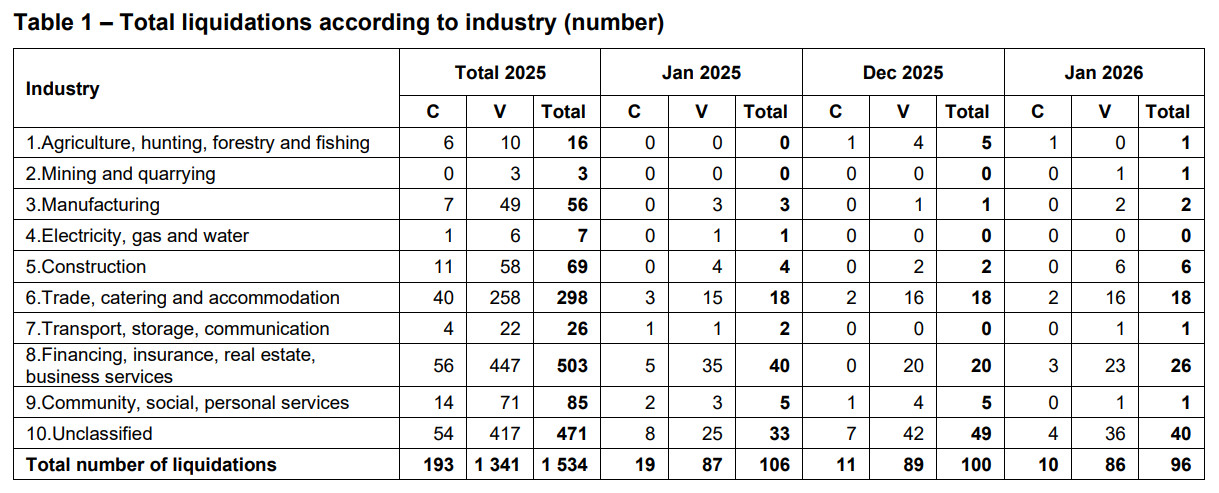
According to the latest liquidation stats, these closures were centred on the finance, insurance, real estate, and business services sector, accounting for a quarter of the liquidations.
This was followed by the trade, catering and accommodation sector.
Notably, the number of liquidations is down 9.4% compared to the start of 2025, though this is off a relatively low base (106 vs 96, ie, 10 fewer liquidations).
A more reflective measure is the three-month running change, where the number of liquidations between November 2025 and January 2026 was 0.6% lower than the same period in 2024/25.
The numbers point to a better start to the year for businesses in the country, though the liquidation data is nuanced and only serves as one data point.
Most notably, liquidation doesn’t necessarily result from insolvency—businesses can be liquidated voluntarily for transactional purposes.
The vast majority of liquidations tracked by Stats SA (circa 85%) are voluntary liquidations, initiated by the operations themselves.
While these might be related to solvency issues, this is not something the Stats SA data explicitly tracks.
A more important measure to track in a troubled business environment is compulsory liquidation, which is often a court-ordered process initiated by shareholders, creditors, or other stakeholders.
These are more directly tied to solvency and operational issues.
For January 2026, voluntary liquidations are relatively flat year-on-year (86 in January 2026 vs 87 in January 2025), with only 10 being compulsory (compared to 19 a year ago).
This could signal a better environment for businesses at the start of the year, which aligns with most economic data indicating improved sentiment in the country.
Changes to data incoming
Aside from the compulsory vs voluntary nuance, the liquidation data is also complicated by the fact that newer processes are in place to save insolvent businesses, such as business rescue.
A lower number of businesses being liquidated in the data could reflect a better environment, or it could mean that there are simply fewer businesses to liquidate, or that more businesses are seeking alternative paths.
Notably, since 2011, companies have been able to enter business rescue as an alternative to straight liquidation.
Business rescue is still a maturing process in South Africa, with more companies adopting the process.
However, data for business rescue is provided by the Companies and Intellectual Property Commission (CIPC).
Stats SA collects administrative information on liquidations from CIPC and the Department of Trade, Industry and Competition (DTIC), sourced from the Master’s Office.
While business rescue can still result in a company being liquidated or wound up, this information may not necessarily be reflected in the liquidation data, as outcomes differ.
According to Stats SA, it is currently working with the CIPC on a revised version of the liquidation stats.
South Africa’s liquidation statistics have undergone significant changes in the past. Previously, the data tracked both liquidations and insolvencies; however, the latter was dropped following disruptions during the COVID-19 pandemic.
For now, the data covers only liquidations, which provides a limited picture of the South African business landscape.

















 Loading ...