

How much money Uber Eats drivers can earn in South Africa


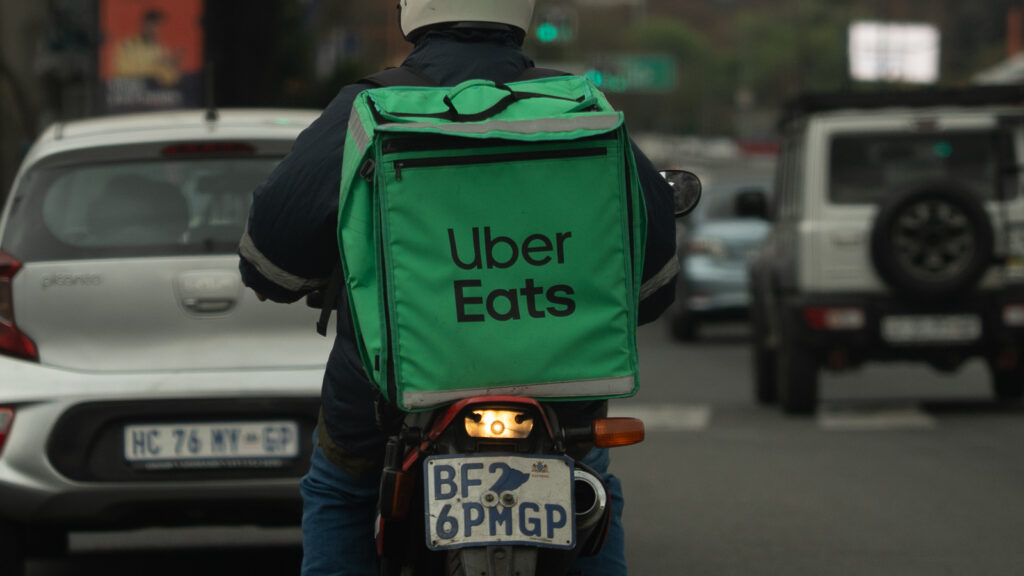
Delivery drivers in South Africa could earn up to R5,000 every week, but the job’s dangers make it a risky source of income.
E-commerce has emerged as a major industry in South Africa, after the COVID-19 pandemic left many people reliant on delivery services.
Companies such as Checkers quickly capitalised on this market, creating a delivery service called Checkers Sixty60.
This service focused on grocery delivery, but other companies, such as MrD and Uber Eats, quickly followed with fast-food delivery services.
These companies all rely predominantly on motorbike riders to improve cost efficiency and ensure deliveries can be made quickly.
An Uber Eats delivery driver and online personality, Gideon Joubert, spoke on CapeTalk about his experiences working in the industry.
He said people driving for Uber Eats can expect to earn up to R5,000 a week if they are willing to work the long hours required.
Uber Eats and many other delivery services do not directly hire their drivers, leaving it up to drivers how many hours they want to work each day.
The Uber Eats app allows drivers to work up to 12 hours at a time, with a mandatory six-hour break between shifts.
Joubert said he spends approximately R650 per week on motorbike rental and roughly R800 per week on petrol.
Many delivery drivers rent their bikes; however, these rental costs are still lower than the cost of renting or owning a car.
Joubert said these bike rental costs also cover regular maintenance, which could pose a challenge for many drivers who plan to buy vehicles in the future.
The fuel costs are also significantly lower when using a delivery bike, which commonly uses around 2-3 litres of fuel per 100 km.
Small hatchbacks use around 5-7 litres per 100 km, which is a significant difference for delivery drivers who are on the road for long periods.
For drivers, using small motorbikes significantly increases their profits on delivery apps such as Uber Eats or MrD.
Drivers for these apps do have the option to use a car, but this significantly affects how much they can earn.
High risks on the road

While working as a delivery driver is an easy way for many South Africans to find employment, the profession carries risks.
Motorbikes are significantly more dangerous than cars, with South Africa’s most recent statistics dating back to 2018.
In 2018, motorcycles made up approximately 2% of vehicles on the road and were involved in 14 accidents per week.
There were also 183 bike driver deaths during the year, and 508 motorcycle accidents, which led to serious injury.
This poses a problem for delivery drivers, the majority of whom rely on motorbikes to make their job affordable.
Delivery drivers also spend a large amount of time on the road and may have to drive in poor weather or at night.
Joubert said delivery drivers face particular challenges when working in the rain, as bikes are prone to losing control due to wet road markings.
He said there is also a serious risk to delivery drivers posed by other road users, who may become disgruntled with them.
He said drivers will often attempt to block or push delivery bikes as they move through traffic and may also not maintain enough following distance.
Delivery drivers also have to account for safety gear, which is often not provided by the services employing them.
Safety equipment, such as helmets, jackets, or gloves, can be a significant expense for people looking to start as delivery drivers.
While all people on a motorbike are required to wear a helmet in South Africa, other safety equipment is not required.
This means drivers may lack adequate protection, increasing the risk of injury or death on the road.
















 Loading ...