

People earning over R600,000 a year are in trouble in South Africa


South Africans earning more than R50,000 a month, or R600,000 a year, are facing significant debt pressure, with their debt repayments now exceeding their monthly income.
This is according to DebtBusters’ second-quarter Debt Index for 2026, which showed a concerning trend among top earners in South Africa.
According to Benay Sager, executive head of DebtBusters, said the data showed a growing divide between higher- and lower-income consumers.
The index tracks consumers who apply for debt counselling with DebtBusters each quarter, examining their income, debt levels, the types of debt they hold and the number of accounts they have.
“We look at the incoming cohort of consumers who applied for debt counselling with DebtBusters, and we look at the debt situation, we look at the income situation,” Sager said.
The latest findings show that consumers earning more than R50,000 a month are under particularly heavy pressure.
Sager said lending to higher-income earners had increased significantly since the Covid-19 pandemic, as lenders viewed them as better prospects for loan repayment.
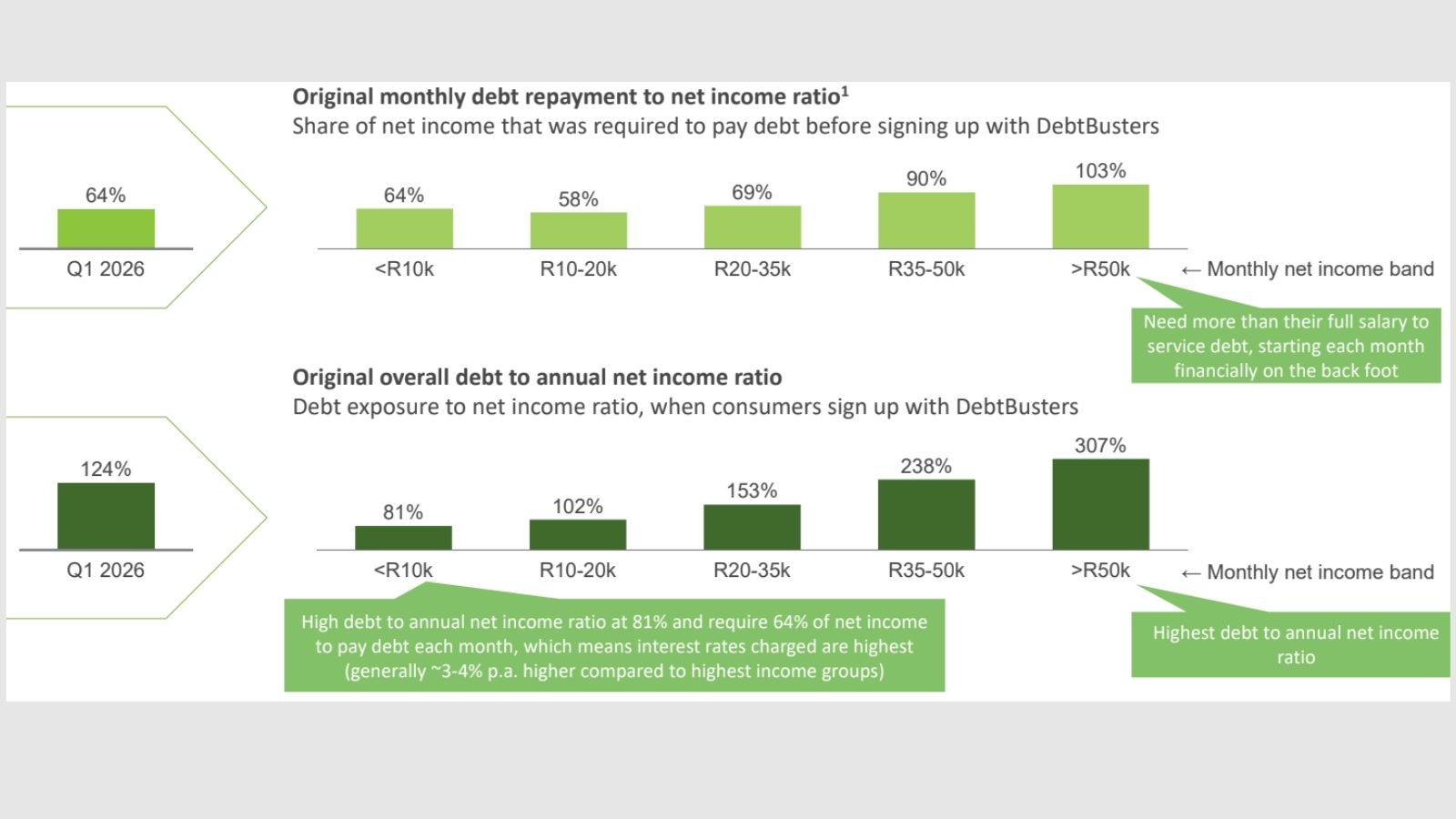
According to the Debt Index, consumers in this income bracket now require 103% of their income to service their debt. This means their average monthly debt repayments exceed their total monthly income.
Sager said the trend had been building for years. Lending to lower-income groups had already started declining around 2017 and 2018, with the decline becoming more pronounced after Covid-19.
Some of this lending was effectively replaced by increased lending to higher-income consumers. At the other end of the income scale, lower-income consumers are facing a different problem.
Sager said their overall debt burden had declined, but this did not necessarily mean they were financially better off.
“Lowest earners are struggling, not necessarily from the burden of debt, but because of primarily inflation over the last few years,” he said.
The situation is particularly difficult for people earning between R10,000 and R20,000 a month, which Sager described as the “backbone” of South Africa’s working population.
Food prices are a concern

Rising food prices have absorbed a growing share of their disposable income, leaving less money available for other essential expenses.
“Food prices have really escalated in the last three to four years. The impact of the food inflation is really, really severe,” Sager said.
Consumers earning less than R10,000 a month are also facing limited access to formal credit.
Recent National Credit Regulator figures showed that around 65% to 66% of loan applications were being declined by the end of the first quarter of 2026, with lower-income consumers accounting for much of this.
Sager warned that this could push some consumers towards informal lenders, where borrowing costs can be substantially higher than those offered by formal financial institutions.
While average interest rates on personal and short-term loans have declined over the past decade, Sager said the informal market presented a significant risk.
“When someone is pushed to the informal economy, that is not 19%, it’s not 20%, it’s 50%, it’s 100%,” he said.
DebtBusters’ data shows that the lowest-income consumers still require about 64% of their take-home pay to service debt. Sager said anything above 30% should be considered unsustainable.
“We think any number above 30% makes it unsustainable, and here we are with almost double that number,” he said.
Despite the pressures, Sager said there was an encouraging trend among younger consumers, who appeared increasingly willing to seek help with their debt earlier in their working lives.
He said this could help prevent debt problems from becoming more severe as consumers grow older.
“The benefit of this is, if you consider that usually the debt levels for those under 30 are about 50% than those over 30,” he said.

















 Loading ...