

Over 220 businesses liquidated in South Africa


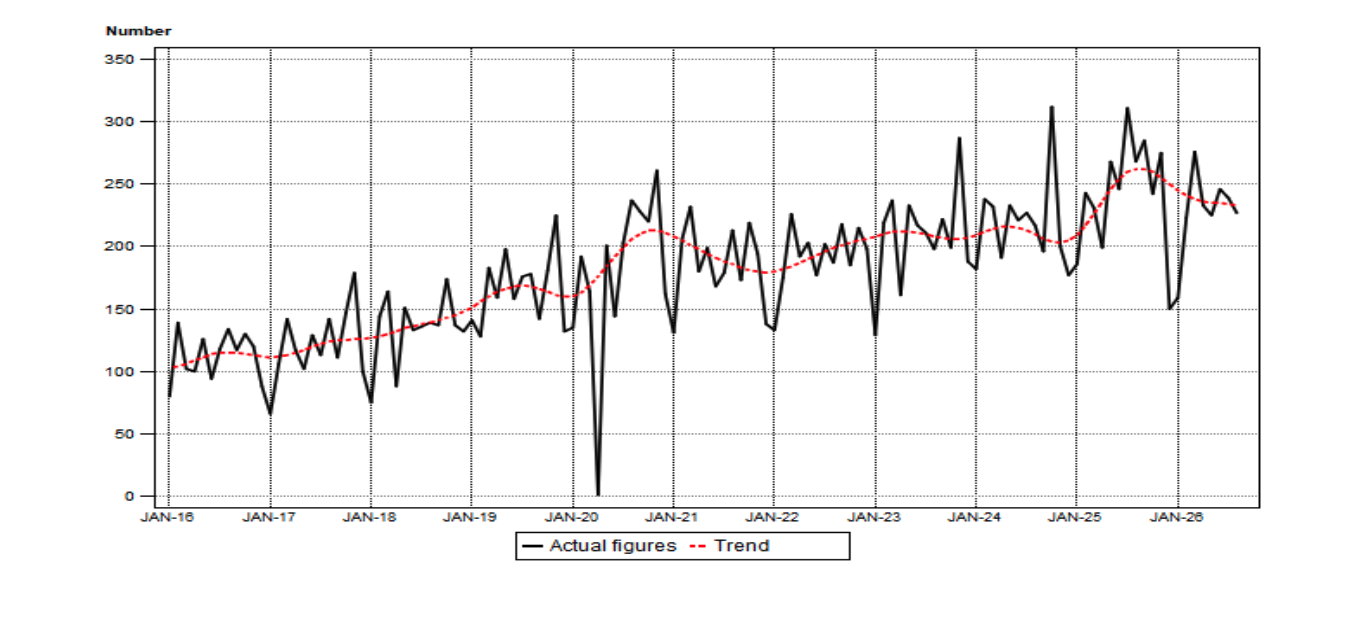
227 businesses were liquidated in South Africa in August, 15.3% fewer than the previous year, bringing the year-to-date total to 1,828.
According to Stats SA, the number has also decreased year-on-year when compared to January 2025 to August 2025, from 1,952 to 1,828.
Over a three-month running period, June to August, there was also a decrease of 13.7%, from 825 to 712.
The data show a notable decline in liquidations in South Africa, with insolvencies following a similar trend.
While liquidations and insolvencies are closely related, they are not the same.
Insolvency refers to a business which is no longer able to pay off its debts, which can be a reason for liquidation.
Liquidation is the process by which a company or closed corporation winds up its affairs when liabilities exceed assets, either voluntarily or by court order.
While Stats SA has consistently tracked liquidation statistics for years, the group stopped releasing insolvency data in 2023 and recently resumed it.
Insolvencies in August reached 114, a 20% month-on-month drop, reflecting a similar trend to liquidation statistics.
South Africa’s insolvencies also saw a year-to-date and year-on-year decline, similar to the drops seen in liquidations.
For liquidations, the sector which was worst affected in August was Financing, insurance, real estate, and business services.
This sector had 42 liquidations, with the second-highest being Trade, catering and accommodation at 14.
Only two sectors classified by Stats SA had no liquidations, being Agriculture, hunting, forestry, and fishing, and Electricity, gas and water.
Combined, these two industries have had only 12 liquidations this year-to-date, accounting for a small share of the 1,828 total.
Of the 227 liquidations in August 2026, only 31 were compulsory, while the remaining 196 were done voluntarily.
| Year | Liquidations | Insolvencies |
| 2023 | 2,501 | 1,883 |
| 2024 | 2,626 | 2,105 |
| 2025 | 2,904 | 1,606 |
| 2026 to August | 1,828 | 1,010 |
Businesses liquidated in South Africa
Statistics still a concern
While both insolvencies and liquidations have declined in August, it is not necessarily a positive for South Africa’s economy.
It is difficult to interpret this data, which can point to a better business environment or an economy where there aren’t many businesses.
Credit risk group CoFace said the two sets of data can be analysed together to review broad economic trends in South Africa.
While liquidations track the end stages of businesses, looking at insolvencies can provide a better overview of the country’s economic outlook.
For this data set, CoFace expects insolvencies to increase in the coming months, driven by higher interest rates.
“With interest rates increasing, we can also expect insolvencies to increase in the coming quarters,” the company said.
This challenge is not unique to South Africa, as the company recently revised its global insolvency forecast upward to 6%.
This global rise has been fuelled by conflicts, particularly the US-Iran war in the Middle East, which has driven up oil prices.
The conflict in the Middle East led to the closure of the Strait of Hormuz, a critical passage for the global oil trade.
CoFace said that, while South Africa’s liquidation and insolvency statistics have been positive in recent months, this trend could shift in the next few quarters.
“While local liquidation and insolvency trends have improved in recent months, companies will feel the impact of deteriorating economic conditions in the coming months, as the impact of price pressures and interest rate hikes generally materialise with a lag,” it said.
The company said that global sectors such as construction, chemicals and textiles would be most likely to be affected by higher insolvency rates.
The higher lending rates would also impact small and medium-sized businesses, CoFace noted.


















 Loading ...