

South Africa’s debit order industry is changing and manual collections are falling behind



Debit orders remain one of the most important ways South African businesses collect recurring payments.
From insurance premiums and memberships to loans, education fees and subscription services, debit orders allow businesses to collect predictable revenue at scale.
But the technology surrounding debit orders is changing.
For many businesses, the traditional process still looks familiar: prepare a collection batch, submit it, wait for the result, export failed transactions, contact customers manually, arrange another payment date and reconcile recovered payments across different systems.
The debit order itself may be automated. The collections operation around it often is not.
Modern payment technology is changing this by turning debit order processing into a broader, automated revenue-management process.
For businesses processing thousands of recurring payments every month, the difference can directly affect collection rates, operational costs, cash flow and the amount of revenue that is eventually recovered.
Collection automation starts before the debit order runs
Revenue recovery should not only begin after a payment fails. The first opportunity is to automate the collection process itself.
Businesses traditionally spend considerable administrative time preparing batches, checking collection dates, identifying which customers should be included and ensuring files are submitted within the required processing windows.
With Kwik Payments, collection batches can be generated automatically according to predefined rules and customer payment dates.
This reduces dependence on employees manually preparing and submitting collection batches every day or month.
Automation can also reduce preventable failures caused by operational mistakes – for example, a customer being omitted from a batch, the wrong collection date being used, or a batch not being prepared in time.
It cannot remove genuine failures such as insufficient funds, but it can reduce the number of failures caused by the collection process itself.
Collection automation also has to operate inside South Africa’s payment-system rules. In September 2026, the payment-system management functions previously performed by PASA transitioned to the South African Reserve Bank (SARB) and PayInc.
The SARB now carries key regulatory, authorisation and standards responsibilities, while PayInc manages relevant payment-clearing-house functions, including EFT debit, Authenticated Collections and Registered Mandate streams.
That matters because a debit order platform cannot simply optimise for speed or collection rate. It also needs to apply the correct mandate, processing, dispute, reversal and unpaid-transaction rules for the payment stream being used.
- Valid mandates and the correct mandate parameters must be maintained for the relevant collection stream.
- Dispute and reversal handling differs between EFT debit orders, Registered Mandate and DebiCheck, so transactions need to follow the rules of the rail on which they were processed.
- Failed or unpaid collections need to be handled according to the applicable stream rules, including when a retry, tracking process or new mandate is appropriate.
- Operational automation should therefore include compliance logic rather than relying on staff to remember every rule manually.
This is another reason automated collection preparation is becoming important: the objective is not only to submit the right transaction at the right time, but to do so consistently within the rules governing that payment stream.
A failed debit order should trigger a process, not a spreadsheet
The biggest change is what happens when a payment fails.
In a traditional collections environment, failed debit orders are often exported into a spreadsheet or collections system before employees begin contacting customers.
By the time the customer is reached, several days may have passed.
Modern collections infrastructure can react as soon as the failure is received.
A failed payment can automatically trigger a predefined revenue-recovery workflow.
- Send the customer a WhatsApp or SMS notification.
- Present a secure payment link or another supported payment method.
- Schedule an appropriate retry or tracking process where the payment rail allows it.
- Offer a new mandate or a different collection date where the existing arrangement is repeatedly failing.
- Escalate the account to a call-centre dialler if automated recovery does not resolve it.
Instead of every failed debit order requiring manual intervention, software can handle the first stages of recovery automatically.
Human intervention is then focused on customers who actually require it.
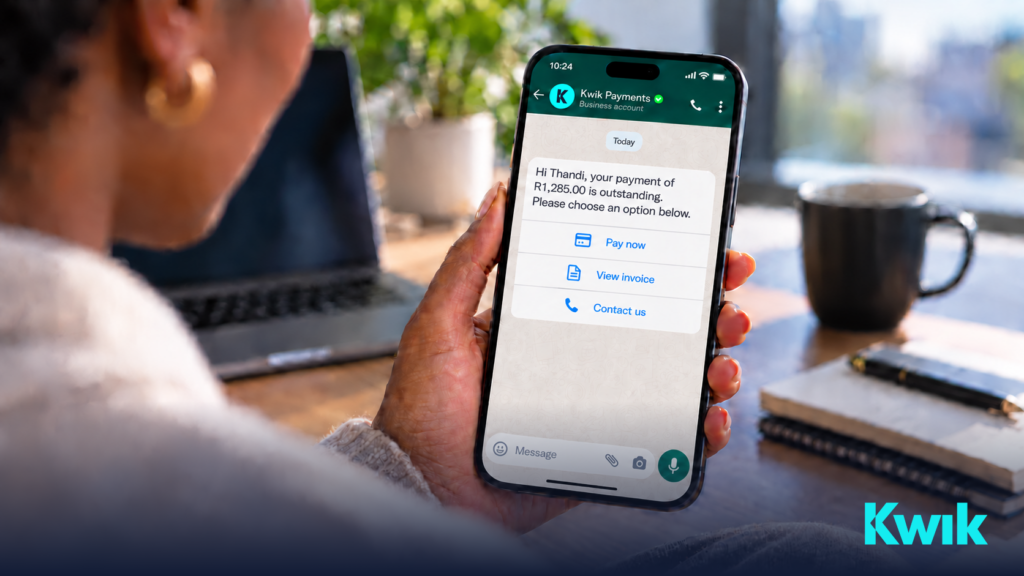
WhatsApp can become part of the collections process
Messaging platforms such as WhatsApp provide businesses with another opportunity to shorten the time between a failed payment and recovery.
A customer whose debit order fails could automatically receive a message explaining that the collection was unsuccessful and providing a secure way to settle the amount.
Rather than waiting for a collections agent to call, the customer can resolve the outstanding payment immediately using another supported payment method.
Importantly, a business does not need to make the recovery conversation feel unfamiliar.
Kwik can integrate collections communication with the business’s own trusted WhatsApp number, allowing customers to receive payment messages from the number and brand they already recognise rather than from an unknown collections sender.
Recovery workflows can then become progressively more sophisticated:
- First contact: an automated WhatsApp message when the debit order fails.
- Follow-up: a reminder after a defined period if no payment has been received.
- Recovery option: a secure payment link or alternative payment method.
- Escalation: move the account to the call centre only if digital recovery has not worked.
This allows businesses to manage larger collections portfolios without necessarily increasing collections staff at the same rate.
Call centres should receive the right customer at the right time
Call-centre technology can form part of the same automated process.
Instead of agents working through static spreadsheets, failed payments can be fed automatically into a dialler or collections queue.
Agents can receive the context they need to resolve the account, including the outstanding amount, previous collection attempts, communication history and available payment options.
Once the customer pays, the account can be removed from subsequent recovery activity so that agents are not calling customers who have already settled.
The objective is not to remove the call centre from collections. It is to reserve human intervention for the accounts where it adds the most value.
The next collection does not have to look like the last one
Revenue recovery also creates an opportunity to fix the underlying problem rather than simply chase the outstanding amount.
If a customer’s existing debit order arrangement is repeatedly failing, the business can use the recovery interaction to establish a new mandate instead of continuing to submit the same instruction under the same conditions.
Depending on the customer’s circumstances and the appropriate payment stream, they can be moved to DebiCheck or Registered Mandate (RM), where mandate registration and tracking capabilities can improve the collection process.
A customer can also be offered a different collection date – often referred to operationally as the strike date – that better matches when funds are normally available in their account.
- Send a new mandate electronically for the customer to complete or authenticate.
- Move an eligible customer to DebiCheck where authenticated mandate controls are appropriate.
- Use RM where appropriate, including its registered-mandate and tracking capabilities.
- Allow the customer to select a more suitable collection date instead of repeatedly collecting on a date that does not match their cash-flow cycle.
Someone paid on the 25th of the month may consistently struggle with a debit order running much later, while another customer may need the collection aligned to a different salary cycle.
Giving the customer a practical way to correct the mandate or collection date can improve the probability of future collections and reduce repeat recovery work.
Recurring card payments provide another recovery path
Debit orders also no longer have to operate in isolation.
Where the business model, customer mandate and applicable payment rules allow it, recurring card payments can provide another way to manage ongoing collections.
A customer whose debit order repeatedly fails could choose to move their recurring payment to a securely tokenised card.
The business can then manage that recurring payment alongside its debit order collections rather than operating two completely separate payment environments.
This becomes increasingly important as customers expect flexibility in how they pay.
One customer may prefer DebiCheck, another a traditional debit order and another a recurring card payment.
The business should not have to build a different operational process around each one.
Recovery becomes more powerful when every payment is in one place
Offering multiple ways to pay solves one problem but can easily create another: reconciliation.
A business using one provider for debit orders, another for cards and another for payment links can end up with payment information spread across several platforms.
Finance teams then have to determine which customer paid, through which channel, for which account and whether the transaction has already been reconciled.
This is where unified payments becomes particularly valuable in a collections environment.
Kwik can bring different payment methods into the same platform, giving businesses a consolidated view of collections and recovered payments.
A debit order that failed yesterday and was subsequently settled by card or payment link should not appear as two unrelated events.
They are two parts of the same customer payment journey.
Collections analytics are becoming just as important as collections processing
Once payment information is consolidated, businesses can analyse the performance of their collections operation rather than only the outcome of the original debit order batch.
A modern collections dashboard should make it possible to answer questions such as:
- How many debit orders succeeded on the first attempt?
- How many collections failed, and what were the main failure reasons?
- How much failed revenue was subsequently recovered?
- Which recovery channel – WhatsApp, call centre, card, payment link or another collection attempt – performed best?
- How quickly are failed payments being recovered?
- Which collection dates produce the highest success rates?
- Which customers repeatedly fail on the same collection date?
- How many customers were successfully moved to a new mandate or collection method?
- How much revenue is being recovered automatically before a call-centre agent becomes involved?
These insights allow businesses to optimise collections using actual payment behaviour rather than assumptions.
Over time, the collections platform becomes more than a mechanism for submitting debit orders. It becomes a source of operational intelligence.
The gap between automated and manual collections is widening
For years, improvements in debit order processing primarily focused on getting transactions into the banking system more efficiently.
The next stage is about what happens before and after that transaction.
- Automated batch creation can reduce avoidable collection errors and ensure collections are prepared consistently. Built-in payment-stream logic can help businesses operate within the applicable mandate, processing and dispute rules.
- Revenue-recovery workflows can react as soon as payments fail.
- WhatsApp and other messaging channels can engage customers immediately from a trusted business identity.
- Call-centre diallers can focus agents on accounts that actually require human intervention.
- New mandates, DebiCheck, RM and customer-selected collection dates can address the reason a payment keeps failing.
- Recurring cards and alternative payment methods can provide additional ways for customers to settle.
- Unified reconciliation and analytics can bring the entire payment lifecycle into a single view.
Businesses continuing to manage these processes manually are not simply using an older way of submitting debit orders.
They are missing the opportunity to automate a significant part of their revenue collection operation.
Kwik Payments brings debit order collections, DebiCheck, recurring card payments, automated revenue recovery, messaging, reconciliation and payment analytics into one platform.
Click here to learn more about automating your collections and revenue recovery.


















 Loading ...