

Interest rate expectations flip-flop for South Africa


Despite inflation expectations in South Africa flipping thanks to much-needed fuel price relief in November, economists still expect an interest rate hike by the Reserve Bank (SARB) next month.
However, other market signals point to a possible hold on rates, with other analysts being less certain about the trajectory.
On the side of interest rate hikes, economists at Nedbank anticipate a 25-basis-point hike at the final Monetary Policy Committee (MPC) meeting of the year.
Nedbank had anticipated the hike ahead of last week’s Medium-Term Budget Policy Statement (MTBPS), following September inflation data of 4.5%.
While the inflation print was cooler than expected—with markets expecting 4.7%-5.0%—inflation was still expected to rise in October and November due to fuel price increases.
At the time, Nedbank anticipated inflation peaking at 6.4% in November, premised on a R1.50-per-litre fuel price hike building for the month.
This was seen as a clear prompt for the SARB MPC to hike rates in November.
The inflation outlook shifted, however, when Finance Minister Enoch Godongwana announced R10 billion in fuel price relief through a R1.50- and R3.00-per-litre cut in fuel taxes for petrol and diesel, respectively.
With the National Treasury relief, fuel prices are now set to be cut in November.
In a post-budget review, Nedbank’s inflation expectations cooled significantly, with the bank now expecting inflation to peak in October at 5.7% and move towards the SARB’s 3% target more rapidly in 2027.
Unfortunately, the November relief isn’t a panacea for higher inflation right now—and as such, the expectation for a rate hike next month hasn’t reversed.
“Looking ahead, the inflation outlook remains uncertain,” Nedbank said.
“Ongoing tensions in the Middle East continue to pose upside risks to global oil prices and domestic fuel costs. Our preliminary estimates suggest that inflation will remain above the 3% SARB target point for an extended period.”
The bank said there is an increased risk of second-round effects emanating from persistently high fuel prices.
“Consequently, we expect the Monetary Policy Committee to raise interest rates by 25 basis points at its November meeting,” it said.
Other signals

Contrary to Nedbank’s view, Investec Chief Economist Annabel Bishop said market indications suggest the SARB won’t hike rates.
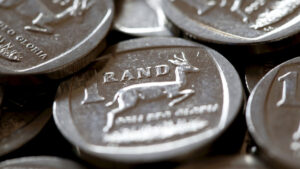
This is evident in the rand’s current weakness.
“With the United States expected to hike interest rates again this year, and South Africa not expected to follow suit, the interest rate differential between SA and the US is expected to narrow,” she noted.
“(This) has resulted in pressure on the rand to depreciate.”
According to Old Mutual Wealth Investment Strategist, Izak Odendaal, there is also little reason for the Reserve Bank to push rates higher.
While inflation is still sitting well above the Reserve Bank’s 3% target—and is likely to remain between 4.5% and 5% over the next few months—it is still seen as temporary.
“By April next year, high fuel prices will be in the base for year-on-year comparisons, and inflation should decline towards a three-handle quickly,” he said.
“This means further rate increases are probably unnecessary and unlikely.”
If inflation eventually anchors on 3%, the Reserve Bank’s policy rate can fall and settle around 5.5% to 6% from the current level of 7.25%.
“The expected convergence of inflation towards 3% should therefore be positive for interest-rate sensitive investments and consumer spending,” Odendaal noted.
The Reserve Bank itself has been mixed in its view.
The forecast from the SARB’s Quarterly Projection Model (QPM) has the policy rate broadly stable through the remainder of the year.
The model shows cuts later in the forecast period, as inflation falls to 3% and the QPM moves toward a more neutral policy stance.
However, the SARB said it does not strictly follow the model, rather basing its decision on a meeting-by-meeting basis, following the latest data.
At its September meeting, it modelled a scenario of higher inflation, international interest rate hikes and entrenched second-round effects of higher fuel prices.
In these scenarios, the SARB modelled tighter policy stances, ranging from another rate hike and a slower path of rate cuts to two rate hikes and holding rates higher for longer.
Nevertheless, the bank said that its approach “is to look through the initial effects of price shocks, while ensuring that they do not entrench higher inflation”.
Should inflation cool off—as it is now expected to do—the case for further rate hikes could soften.
The final SARB MPC briefing will be held on 19 November 2026.











 Loading ...