

Big boost for interest rate cuts in South Africa


South African inflation expectations have reached a record low, but South Africans may need to wait for an interest rate cut.
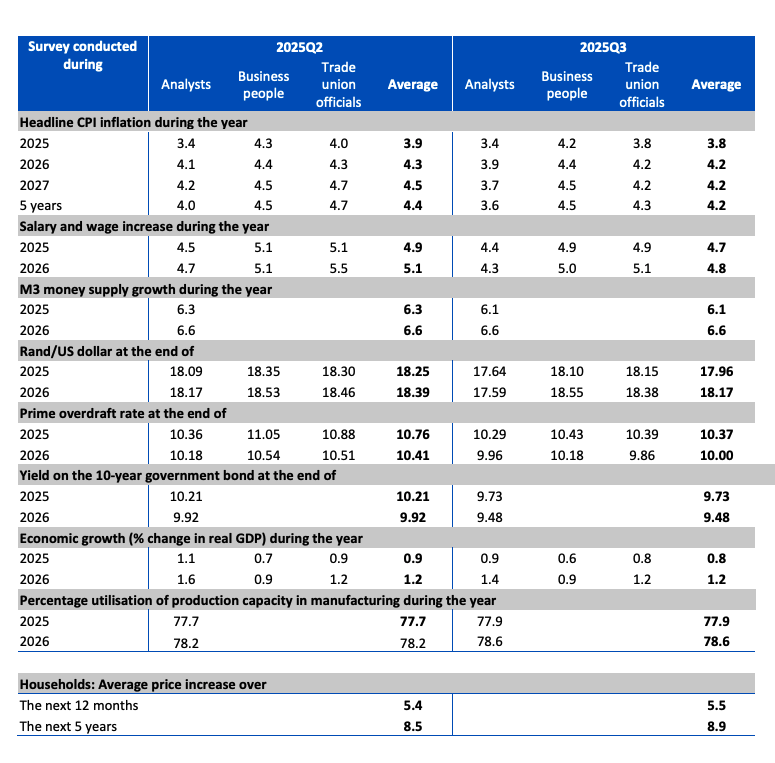
According to the Bureau for Economic Research’s (BER’s) latest inflation expectations survey, analysts, business people, and trade unions lowered their longer-term inflation expectations.
The social groups expect headline inflation in the next five years to average 4.2%, 0.2 percentage points lower than during the second quarter. This is also the lowest rate on record.
They also lowered their expectations for headline inflation in 2027 by 0.3 percentage points to 4.2%, the lowest figure in 20 years.
In the near-term expectations, they lowered their forecast of headline inflation by 0.1 percentage points for both 2025 and 2026, to 3.8% and 4.2% respectively.
The survey results are one of the many factors that the Monetary Policy Committee (MPC) of the South African Reserve Bank (SARB)considers when making its interest rate decisions.
The MPC will be concerned if inflation expectations increase, inflation expectations are significantly above the lower of the inflation target range of 3% to 6% or the other inflation indicators deteriorate, said the BER.
Rising inflation expectations could lead to higher wage demands as workers feel that they need to be compensated for the higher expected inflation in the future.
Businesses could also adjust their price increases upwards if demand is robust enough. The Reserve Bank may be forced to increase the interest rate to prevent higher expectations from becoming a reality.
The opposite happens if inflation expectations and other indicators decline, which is the case per the latest inflation expectations.
The future of South Africa’s interest rate path has, however, become less certain, with the SARB Governor Lesetja Kganyago stating that the MPC wants inflation to hover around 3%.
Although this is still within the current 3% to 6% target range, it is well below the 4.5% midpoint that the SARB used to anchor its interest rate decisions and lower than the latest inflation figure of 3.5% for July.
The power to lower the target lies with the Minister of Finance, Enoch Godongwana, and no official announcement has yet been made on changing the target.
Although the decline in inflation expectations has come around, it remains to be seen if this will be enough for the MPC to lower interest rates when it meets again this week.
The BER noted that long-term inflation expectations have been declining since the start of 2024.
That said, economists from Nedbank and Absa believe that no rate cut is coming this week as the SARB battles rising inflation and the challenges of getting to the 3% target.
Investec Chief Economist Annabel Bishop believes that South Africa could see a cut in September or November this year, as the US Fed undergoes a massive cutting cycle.
Economists do agree that a lower inflation target could result in lower interest rates in the medium- to long-term.
In detail

Looking in more detail, analysts and trade union officials made similar downward revisions among the three social groups.
Analysts expect five-year inflation to average at 3.6%, while trade unionists expect 4.3%.
Business people, however, made no changes to their previous forecast for 2027 or the five-year average and still expect an average of 4.5% for the latter.
Regarding near-term expectations, all three social groups had slight downward revisions, with analysts expecting 3.9% next year, business people 4.4% and trade unions 4.2%.
At 5.5%, the one-year inflation expectations of households were virtually unchanged from Q2 to Q3.
The expectations for the various income groups were very similar, with survey respondents also downwardly revising their forecast of wage increases.
They expect salaries to rise by 4.7% this year and 4.8% next year, compared to 4.9% and 5.1%.
Economic growth expectations also dropped for the three larger social groups, even by a smaller margin than previously.
On average, the three groups expect GDP growth of 0.8% this year, accelerating to 1.2% next year (0.9% and 1.2% previously).















 Loading ...