

More taxes will just push money – and people – to leave South Africa: experts


Finance minister Tito Mboweni’s piggy bank has all but drained, which means the government will have to get creative with its fiscal approach, says accounting and consulting group Mazars.
In a pre-budget note ahead of Mboweni’s Medium Term Budget Policy Statement (MTBPS) scheduled for Wednesday, Mazars said that the presentation comes against a backdrop of a contracting economy and significantly reduced tax revenue – with the government expected to miss its tax target by R300 billion this year.
This has been partly self-inflicted, it said.
“Government cut off the water to its own taps when it banned the sale of alcohol and tobacco during lockdown,” said Bernard Sacks, a tax partner at Mazars in South Africa.
“The excise duties and VAT charged on these products are significant sources of income for the government. I’m not a medical expert, so I can’t say whether it was the right thing to do from a medical perspective, but certainly from a fiscal perspective, it was a disaster.”
Sacks said that Mboweni should reduce government spend and increase income – however, he warned that these are things the ailing economy can ill afford, especially higher taxes.
“At this point, what we really need is a dramatic reduction in government spending, but that’s not going to help us kick start the economy,” said David French, tax consulting director at Mazars.
“Government can essentially turn to two places for income: borrowing or the tax base. We’ve already accumulated eye-watering levels of debt so it doesn’t seem like a good idea to borrow more.
“This leaves the tax base as the most likely place government will try to earn more income from. But the tax base is so stretched that I’m not sure how feasible this is,” he said.
Solidarity tax a possibility – but will push emigration
Mazars said that the MTBPS is not usually the time at which large-scale policy changes are made, as these are normally unveiled at the February budget speech. However, it’s been an unusual year, so unusual measures may be called for..
“The only change we’re likely to see is the introduction of an extraordinary, once-off tax or some sort of levy,” it said. However, the group warned that a solidarity tax on higher earners will likely push more funds – and people – offshore.
This tax could be similar to the so-called “transition tax” – a once-off, 5% wealth tax enacted during South Africa’s transition to democracy on individuals earning more than R50,000, it noted.
“There’s been much speculation in the press that a solidarity type of tax is likely to be introduced. We think this is going to accelerate the emigration we’re already seeing,” it said.
This is a worrying trend that’s being reflected in research like the FNB annual estate agents’ survey, which showed that in the second quarter of 2020, 17% of people who were selling their home for emigration reasons.
Furthermore, in the wealthiest segment – those with home prices of R3.6 million and over – 25% of sellers sold their property to move abroad.
“Anecdotally, we’re seeing this play out at Mazars in South Africa. Our private client business has been inundated with work related to emigration,” it said.
The consultancy said that it believes people are leaving the country partly as a result of deteriorating tax morality. Tax morality is the willingness of individuals to pay their taxes and comply with tax laws.
The less taxpayers trust government authorities to spend their money appropriately, the lower the level of tax morality.
“Taxpayers’ money is disappearing rather than making it into the fiscus,” it said. “Government needs to earn back the trust of the taxpayer before it starts further burdening earners.”
Addressing corruption and regaining taxpayer trust
Mazars said that measures to improve tax morality would be a welcome outcome of the MTBPS. These would help boost much-needed tax collection, trust and confidence in the government.
The same can be said of repossessing wasteful government assets and recovering monies from those who lined their pockets as a result of state capture.
Mazars suggested that, rather than taxing the legitimate but rapidly dwindling tax base for revenue, authorities should be looking to target those with ill-gotten gains.
“Clawback on the ill-gotten gains from officials who used government funds and make those who’ve abused their positions of power for financial gain pay back the money – with interest, not just the tax,” it said.
The tax consultancy highlighted the tax table from the budget review of 2020, taxpayers earning in excess of R1.5 million per year were paying R150 billion out of a total of R560 billion in personal taxes that was collected in the period.
This equates to 27% of the total tax take.
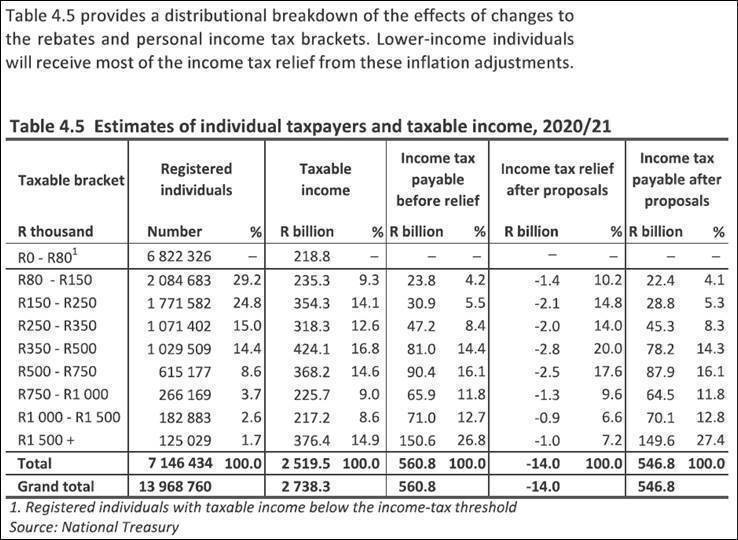
Since there are only 125,000 people in this earnings category, this means that less than 1% of South Africa’s population of 58 million is contributing 27% of the total personal tax take.
“Firstly, we don’t want to chase these taxpayers off our shores – but secondly, slapping a 5% once-off tax on every single taxpayer will see government bringing in only an additional R28 billion,” it said.
“This is a drop in the ocean compared to the R300 billion revenue short-fall the government is up against.”
What other options does Mboweni have?
If the authorities decide not to home in on the direct tax base, they could turn to something like the VAT rate. But a hike here seems unlikely, Mazars said.
The previous one percentage point rise in the VAT rate only managed to generate an extra R20-odd billion, which is a long way off the R300 billion that’s needed.
Mazars estimated that the VAT rate would have to reach close to 30% to close the income gap.
Other concerns are that a VAT change lends itself to fraudulent activity. “Government will need to increase its enforcement to ensure compliance but this would be costly,” it said.
Lower, rather than higher taxes could be a long-term solution
Rather than increasing taxes, government should be looking to reduce them for a better long-term outcome, the experts said.
Lower taxes would take some time to work through the system, but eventually, they would help the private sector spend more and stimulate economic growth.
“It seems counter-intuitive to be dropping the tax rate when tax revenue is dwindling, but now is the time to do it,” it said. “Whether we can afford the time lag is another question though.”
The consultancy pointed out that lowering the corporate tax rate could attract foreign direct investment.
Further, it suggested that the MTBPS could contain measures to support small-to-medium-enterprises (SMEs).
“This could potentially include a further extension of the postponement on the limitations of assessed losses in respect of SMEs.”
“Extending this benefit to SMEs would stimulate the economy far more than incentivising multinational FDI, which is likely to be taken offshore at the first opportunity,” it said.
Read: These charts show South Africa’s debt levels since the ANC took over an almost bankrupt state















 Loading ...