

Bad news for drivers in South Africa


While the 2026 Budget provides some inflationary relief for taxpayers, drivers will once again bear the brunt of revenue collection efforts as the government hikes fuel levies.
In his Budget Speech delivered on Wednesday (25 February), Finance Minister Enoch Godongwana announced that the total increase in fuel levies will be in line with inflation.
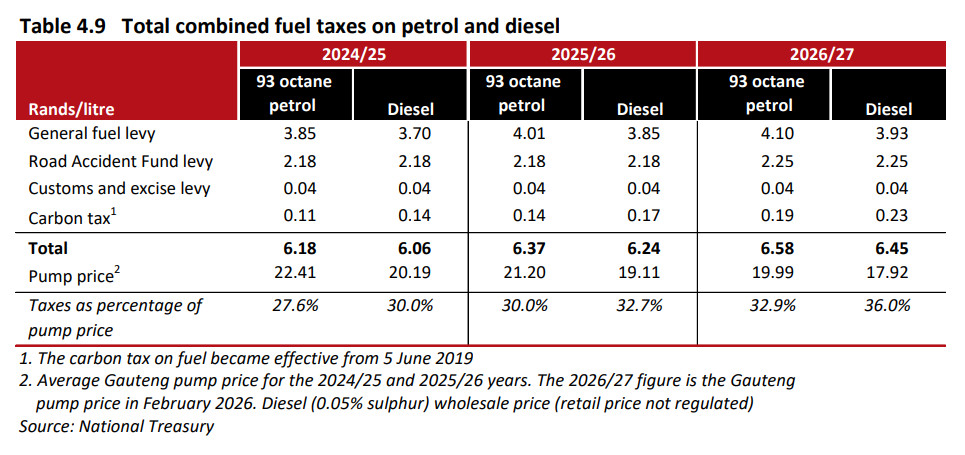
This amounts to a 21-cent per litre increase, broken down as follows:
- The general fuel levy is increasing by 9 cents per litre for petrol and 8 cents per litre for diesel, to R4.10/litre and R3.93/litre, respectively.
- The carbon fuel levy is increasing by 5 cents per litre for petrol and 6 cents per litre for diesel.
- The Road Accident Fund levy is going up by 7 cents per litre to R2.25/litre.
The Treasury noted that the fuel levy increases will help offset lower revenue collections resulting from the withdrawal of R20 billion in additional tax measures, as well as weaker VAT collections.
In combination, the improved outlook for corporate income tax, personal income tax and fuel levies will outweigh the weaker net VAT and customs duties collections relative to the 2025 MTBPS, it said.
Treasury also noted that, from 2015 to 2025, taxes as a percentage of the pump price averaged 33.4% for petrol and 35.7% for diesel.
The tax burden for petrol peaked in 2015/16 at 40.9%, and for diesel in 2020/21 at 45%.
“From 2022/23, the tax burden for petrol and diesel has remained below 35% due to higher fuel prices and because fuel levies were not increased for three years,” it said.
In addition, fuel prices have remained subdued more recently, providing room for increases. Customs and excise levies remain unchanged.
Fuel levies were frozen in April 2022 amid a surge in global fuel costs brought by Russia’s invasion of Ukraine, as well as the impact of the global COVID-19 pandemic.
The 2025 budget had initially intended to give another levy freeze to compensate for the proposed 2 percentage point, then 0.5 percentage point, VAT hike, but this fell away with the proposals.
Like VAT, fuel levies are seen as one of the easiest ‘mass sweeps’ for the government to raise revenue.
The tax hikes will come into effect from 1 April 2026.















 Loading ...