

FNB has good news for South Africa


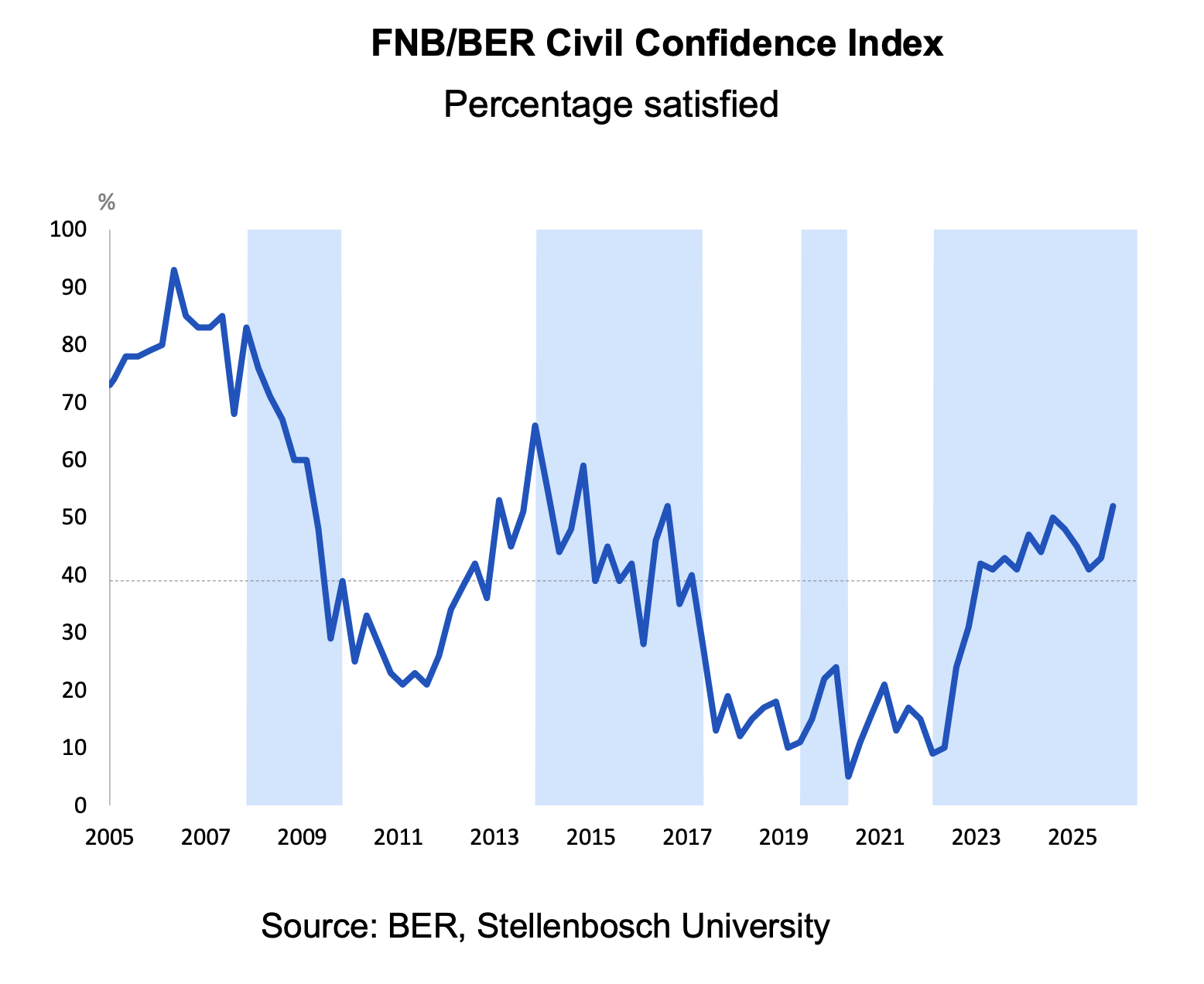
The FNB/BER Civil Confidence Index has reached its highest level in 11 years, with over 50% of those in construction reporting satisfaction with current business conditions.
After a two-index-point rise in 3Q2025, the FNB/BER Civil Confidence Index gained nine index points in 4Q2025 to reach a level of 52.
The current reading means that 52% of respondents were satisfied with prevailing business conditions.
FNB said that supporting the higher sentiment raising was a sharp improvement in activity growth. According to Stats SA, the real value of construction works contracted by 3% year-on-year in 3Q2025
“The survey results point to a much less pronounced decline in activity in 4Q2025 off the back of renewable energy and mining projects,” said Siphamandla Mkhwanazi, Senior Economist at FNB.
In addition to increased productivity, overall profitability also improved. The index measuring growth in overall profitability reached its highest level since the end of 2007.
“It is a stretch to claim that profit margins are as generous as they were in the run-up to the 2010 FIFA World Cup final – when work was much more abundant – but it is clear that civil contractors are enjoying better margins.”
“This undoubtedly contributed to the better business mood,” said Mkhwanazi.
Looking ahead, respondents expect activity to continue its upward trajectory in 1Q2026.
That said, order books, as proxied by the rating of new construction demand as a business constraint, were only slightly better in 4Q2025
Overall, FNB stated that the higher sentiment was in line with increased activity and overall profitability, which suggests a potential rebound in the sector.
Although the forward-looking indicators were mixed, they still suggest that the momentum will likely be maintained over the near term.
“The civil construction survey is the best non-official gauge for infrastructure investment. On that score, the survey results are quite positive,” said Mkhwanazi.
“However, the spread of activity seems to be clustered in renewable energy generation and mining, which is not bad – or even surprising – but does suggest that key reforms in other areas of the economy are still lacking.”












 Loading ...