

What you need to study if you want to be a billionaire


A new study of the world’s top 100 billionaires reveals the university degree and career options of the richest men and women across the globe, before they topped the Forbes Billionaire’s list in 2017.
The world’s top 100 billionaires, as ranked by Forbes, own over $2.3 trillion of the world’s wealth – 1.3% of total world personal wealth ($167 trillion). But how did they get that rich?
The study, conducted by recruitment firm Aaron Wallis, looked at the personal histories of the top 100, including where their wealth is sourced from, who the world’s richest worked for, what they studied, and where they had their first jobs.
Just over half the billionaires assessed (53) started their careers working for other companies, while 17 started their own business. 30 billionaires inherited their wealth.
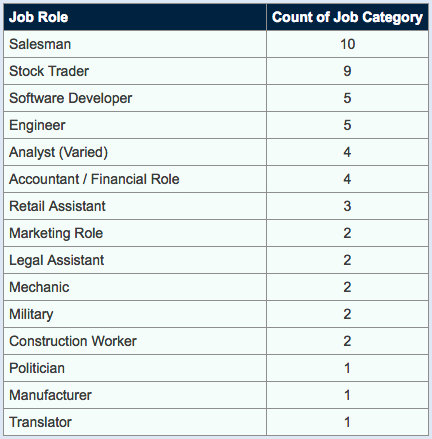
In terms of first jobs, of the 53 billionaires who worked for another company, the most popular starting point was in sales (10), followed by work as a stock trader (9) – though software developers and engineering were also popular starting points (5, each).
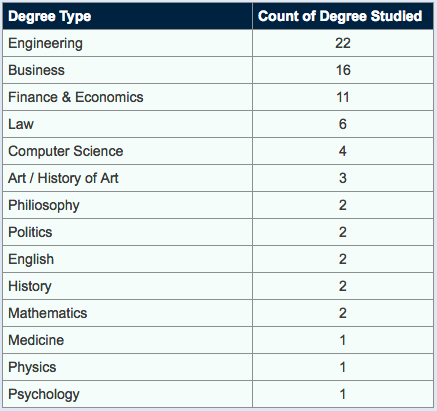
Whether working for someone else or for themselves, the majority of billionaires (75) had a degree or qualification, with Aaron Wallis finding that the biggest billionaire field of study was in engineering, followed by business and finance and economics.
More locally, South Africa’s billionaires also went the degree route, with most starting out with law degrees – though commerce and economics are also prominent. Johann Rupert, who inherited his wealth, did not finish his studies, but was awarded an honorary doctorate in commerce from the Nelson Mandela University (formerly NMMU).
| Name | University | Qualification |
|---|---|---|
| Nicky Oppenheimer | University of ChristChurch & Oxford University | Philosophy, Politics and Economics and Oxford MA |
| Christo Wiese | University of Stellenbosch | BA LLB |
| Johann Rupert | University of Stellenbosch | Did not finish (awarded honorary DCom from NMMU) |
| Koos Bekker | Stellenbosch University & University of the Witwatersrand | BA LLB (Literature) |
| Patrice Motsepe | University of Swaziland & University of the Witwatersrand | BA LLB |
| Stephen Saad | University of Natal | BCom |
| Allan Gray | Rhodes University & Harvard Business School | BAccounting and MBA |
| Jannie Mouton | University of Stellenbosch | BCom |
Data published by salary information group PayScale, largely reflects the findings from Aaron Wallis, in that it ranks engineering degrees as being the most lucrative for those who want to have the highest earning power after graduating.
It’s worth noting that South African data – specifically salary information from CareerJunction – also reflects this, where engineering and financial jobs often pay the most.
According to PayScale, 16 of the top 25 highest-earning degree types are in engineering, with the rest of the top earners coming from the mathematical and scientific fields – all technical fields. The first non-engineering, mathematics, or science based degree listed is in finance.

You can view the full rank here.
Read: South African millionaire explains why you’re never going shopping with Bitcoin

















 Loading ...