

How long young workers in South Africa stay in their jobs


With South Africa facing a youth unemployment crisis, new research from recruitment firm Pnet gives insight into the nation’s youth job market.
South Africa’s youth unemployment has often been flagged by government, business and civil society as a major inhibitor of growth,
According to Stats SA’s employment statistics for Q1 2023, South Africa’s official unemployment rate grew from 32.7% in Q4 2022 to 32.9%.
Over the last ten years, unemployment amongst graduates has jumped significantly from 5.5% recorded in Q1 2013 to 10.6% in Q1 2023.
In addition, other tertiary education unemployment has jumped to 23.5%, nearly doubling from Q1 2013’s 11.9%.
Although unemployment has skyrocketed over the last 10 years from 25% in Q1 2013 to 32.9% in Q1 2023, it is a major concern that unemployment amongst skilled, young South Africans is increasing.
Amidst the youth unemployment crisis, many organisations and experts have tried to explain the phenonium.
A new Pnet snapshot looks at South Africa’s youth jobseeker segment (aged 35 and younger) and is designed to provide recruiters and HR practitioners with insights into the youth job market- between ages 14 and 35 – in South Africa.
One area of the snapshot looks at the average tenure of young employees per sector.
Those in the Admin, Office and Support Sector stay in their roles for the longest average period, totalling 3 Years and 8 Months.
This is followed by Finance (3 years and 4 months) and Building and Construction (3 years and 1 month) sectors.
On the other hand, those in the Travel and Tourism and Sport and Fitness sectors are likely to stay in their roles for less than two years.
The average tenure amongst youth in all sectors is 2 years and 11 months.
| Sector | Average Tenure |
| Admin, Office & Support | 3 Years and 8 Months |
| Finance | 3 Years and 4 Months |
| Building & Construction | 3 Years and 1 Month |
| Medical & Health | 2 Years and 9 Months |
| Marketing | 2 Years and 9 Months |
| Design, Media & Arts | 2 Years and 7 Months |
| Science & Technology | 2 Years and 3 Months |
| Sport & Fitness | 1 Year and 11 Months |
| Travel & Tourism | 1 Year and 6 Months |
| Average | 2 Years and 11 Months |
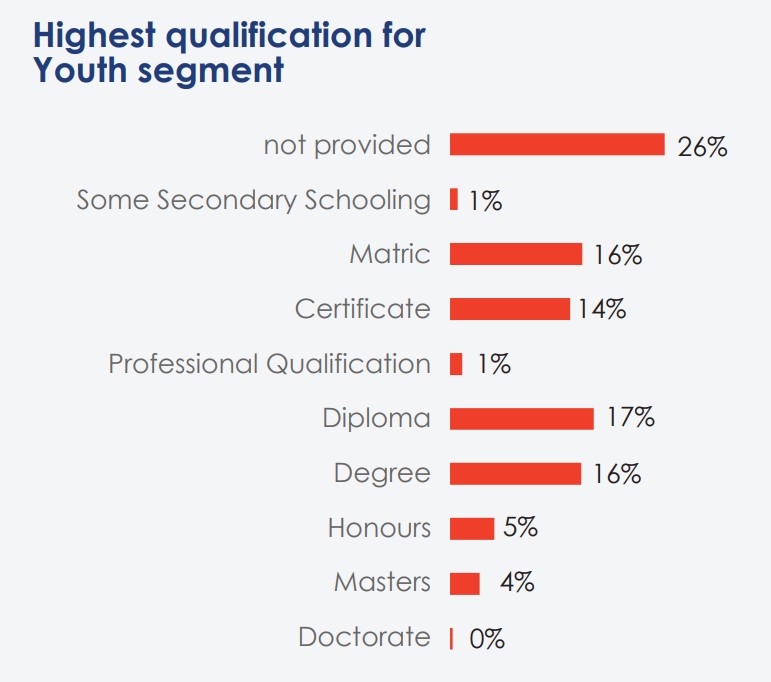
According to the study, the highest provided level of education was a Diploma (17%), followed closely by Matric and a Degree. (both at 16%).
Postgraduate tertiary education levels remained low, with Honours and Master’s degrees at 5% and 4%, respectively – no respondent had a doctorate.
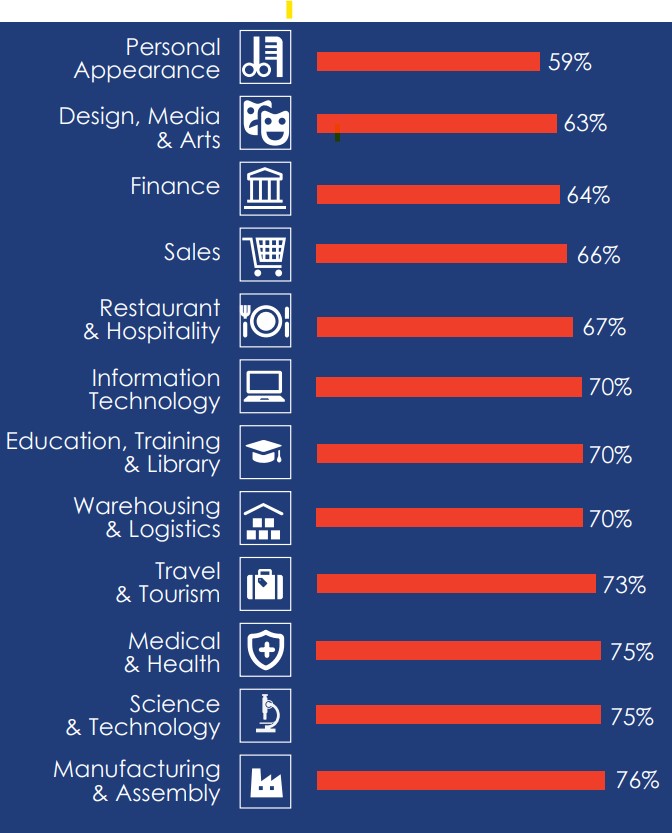
The report also noted that 63% of the youth are willing to relocate for new work opportunities.
Those in the Manufacturing and Assembly sector (76%) are the most likely to relocate, followed by Medical and Health and Travel and Tourism sectors (both 75%).
Those in the Personal Appearance (59%) and Design, Media and Arts sectors (63%) sectors are the least likely to relocate for new job opportunities.
Below is the percentage of youth willing to relocate per sector:
According to Pnet, the majority of youths in the country are located in Gauteng (53%).
This is then followed by KwaZulu-Natal (16%) and the Western Cape (12%).

Interestingly, 1% of South African youths are located internationally.
A recent white paper from payroll services group Playroll, with support from marketplace OfferZen and recruitment firm Aims International, showed that many businesses are losing young, skilled South Africans to emigrants.
80% of surveyed business leaders said that they see emigration of skills as one of the biggest risks to their business, with Playroll noting that those between 25 and 40 are most likely to emigrate.
It added that more than half of all of South Africa’s graduates have the potential to migrate.
Moreover, in 2021, the biggest portion of individuals changing their tax residence status were those between 25 and 32 years old (32%), according to the South African Revenue Service.
Experts at Tax Consulting SA said that younger South Africans are probably relinquishing their tax residency in order to take job opportunities abroad.
Read: Young, middle-class South Africans struggling to make their salary last


















 Loading ...