

Businesses sound the alarm on a load shedding-sized problem


Businesses in South Africa have been hit hard by the nation’s port crisis, with the economy expected to take a hit at the start of 2024.
The S&P Global South Africa Purchasing Managers’ Index (PMI) – a snapshot of operating conditions in the private sector economy – declined from the neutral value of 50.0 in November to 49.0 in December.
This highlighted a renewed deterioration in the health of the private sector due to sharper declines in output, new business, and stocks of purchases.
The Suppliers’ Delivery Times Index – inverted in the headline index calculation – declined to its lowest level since January 2022, indicating a severe decline in vendor performance at the end of the year.
Firms mainly said that this decline was due to the port crisis in Durban, which is leading to shipping congestion and delays of up to several weeks.
Output levels were reduced for the fourth straight month and to the most significant degree since May 2023. The drop was seen across all the sectors monitored, with the largest contraction seen in industry.
“With the decline in supplier performance worsening, the latest survey data suggests that delivery delays are at a level that has been rarely exceeded during pre-COVID times,” David Owen, Senior Economist at S&P Global Market Intelligence, said.
“This indicates that the port gridlock is likely to further dent the economy at the start of 2024 as businesses face greater shortfalls in input supply.”
“Load shedding is also expected to remain an issue after electricity outages reportedly hit output and sales in December.”
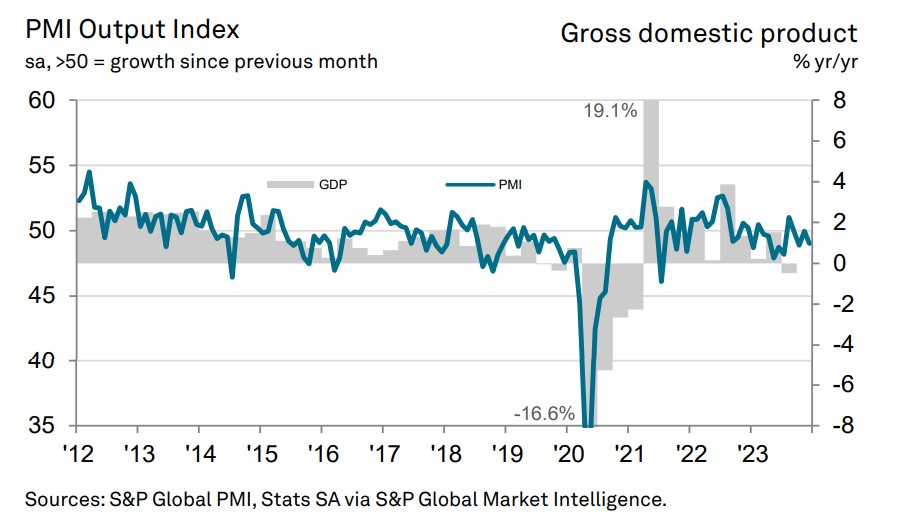
New order inflows decreased in December at the fastest rate over the year, with companies highlighting weak customer spending, supply challenges and load shedding, leading to declining sales.
The volume of inputs bought by companies also dropped for the fourth consecutive month. As firms also faced supply delays, stocks of purchases fell at a sharper rate.
Although the pace of the decline was minimal, employment also dropped for the second month in a row.
“On the plus side, inflationary pressures have appeared to subside, with purchase price inflation falling to the lowest in three years and output price pressures concurrently easing from levels recorded earlier in 2023.
“The slowdown should help to restore a degree of business and consumer confidence as long as the port
gridlock does not cause material prices to rise.”
Although some respondents saw increased transport and energy costs, declining demand pressure and a stable exchange helped counterbalance this.
Overall input price inflation was also unchanged in November despite a faster increase in staff wages.
Output expectations for 2024 dropped for the first time in three months, but firms remained positive to hopes of a rise in new business and the resolution of economic issues.
Read: The financial pain for half of all middle-class South Africans


















 Loading ...