

The company in South Africa where the average employee earns over R2 million per year


The average employee on the Johannesburg Stock Exchange (JSE) earns over R2 million per year, while the lowest-paid employee earns around R435,000.
The JSE was formed in 1887 and is the largest stock market on the continent. It has over 250 listings, which have a combined market cap of over R20 trillion.
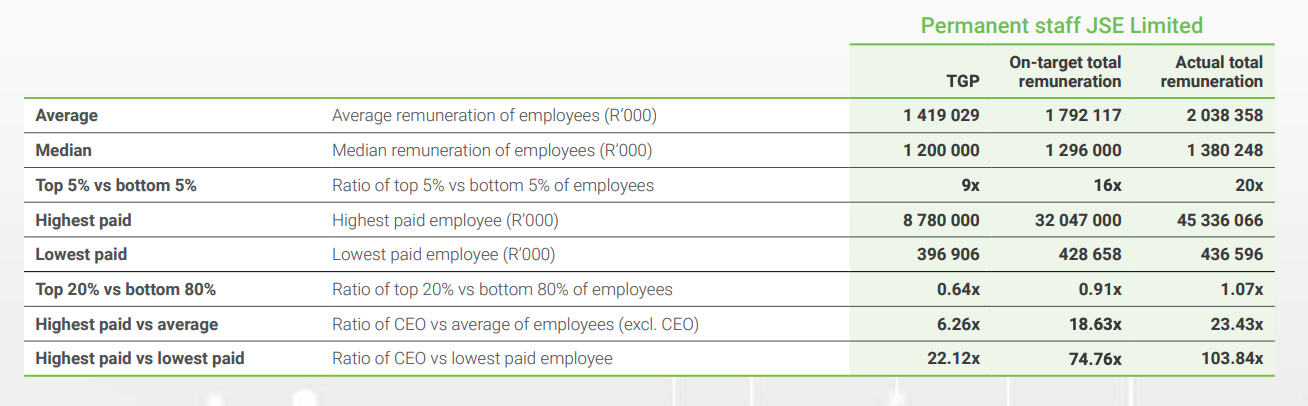
According to its latest remuneration report, the JSE also pays its staff incredibly well. The average staff member earned a total remuneration of just over R2 million in 2025.
While the average is often influenced by the highest earners, the median remains a respectable R1.38 million.
The lowest-paid employee earned R437,000 per year, while outgoing CEO Leila Fourie earned R45.3 million, much of it from short- and long-term incentives.
The ratio of the highest paid employee to the lowest paid stood at 103.84, which was above the company’s target of 74.76.
The ratio of the top 5% of earners compared to the bottom 5% of employees stood at 20, which was again slightly above its target of 16.
The ratio of the 20% to the bottom 80% was better at 1.07, but was still above the target of 0.91.
The 2025 financial year was the final full year of Fourie’s leadership, who will leave her role on 1 April 2026. She was replaced by Valdene Reddy, formerly the Director of Capital Markets.
A record year for the JSE
The high remuneration figures for the JSE follow a record year for the bourse, which reported R1 billion in profit for the first time in its history amid heightened investor interest in South African assets.
The JSE’s results for 2025 showed that Net Profit After Tax (NPAT) increased to 16.7%, to R1,071 million (2024: R918 million).
This results in Headline Earnings Per Share growth of 17.7% to 1,329 cents per share. The group’s operating income grew by 14.2% to R3.5 billion, supported by strong delivery across its main businesses:
- Capital Markets (+18%),
- Post-Trade Services (+18%),
- Information Services (+10%) and,
- JSE Clear (+10%).
The bourse added that the strong performance came amid a renewed national confidence and global interest in South African assets.
Speaking with BusinessTech, Fourie said that non-resident equity ownership on the JSE increased by 29.3% at the start of 2025 to 32.9% by the end.
Fixed income also remained attractive to foreign investors, with net foreign inflows into South African bonds totalling R122 billion (2024: R82 billion).
The group’s cash balance grew by 12.7% to R3.2 billion, which gave it scope to declare an ordinary dividend of 961 cents per share and a special dividend of 100 cents per share.
While 2025 was a strong year, recent weeks have been tough for the bourse due to the effects of the Iran war on emerging-market assets and plunging precious-metal prices.
| R million (unless otherwise stated) | FY2025 | FY2024 | % change |
|---|---|---|---|
| Revenue | 3 401 | 2 971 | 14.4% |
| Operating income | 3 535 | 3 095 | 14.2% |
| Total income | 3 549 | 3 167 | 12.1% |
| Earnings before interest and tax (EBIT) | 1 203 | 1 000 | 20.3% |
| Net finance income | 197 | 205 | (3.9%) |
| Share of profit from associate | 52 | 46 | 12.6% |
| Income tax expense | 381 | 333 | 14.4% |
| Net profit after tax (NPAT) | 1 071 | 918 | 16.7% |
| Earnings per share (EPS) (cents) | 1 322.3 | 1 129.4 | 17.1% |
| Headline earnings per share (HEPS) (cents) | 1 328.9 | 1 128.6 | 17.7% |
| Ordinary dividend per share declared (cents) | 961 | 828 | 16.0% |
| Special dividend per share declared (cents) | 100 | – | 100% |
| Net cash generated from operations | 1 229 | 1 094 | 12.3% |
| ROE | 22.0% | 20.2% | 1.8 pts |















 Loading ...