

The dark side of no load shedding in South Africa


Eskom is relying on burning billions of rands in diesel to stave off load shedding, which could end up costing South Africans through steeper electricity tariffs in the years ahead.
This concern over diesel reliance was highlighted in the Minerals Council South Africa’s electricity update for July 2025, which is an analysis of the power system by economist André Lourens.
On the positive side, the update showed that Eskom’s Energy Availability Factor (EAF), a key measure of how much power the utility’s fleet can deliver, rose by 3.6 percentage points in June to 63.9%.
Lourens attributed the improvement to Eskom restoring generation capacity, including the return of Medupi Unit 4 (800 MW) on 6 July 2025, and a reduction in unplanned maintenance of approximately 2,600 MW in July compared to June.
With just 24 days left in Eskom’s official winter outlook period, which runs until the end of August, the utility has said it is “adequately prepared” to meet demand.
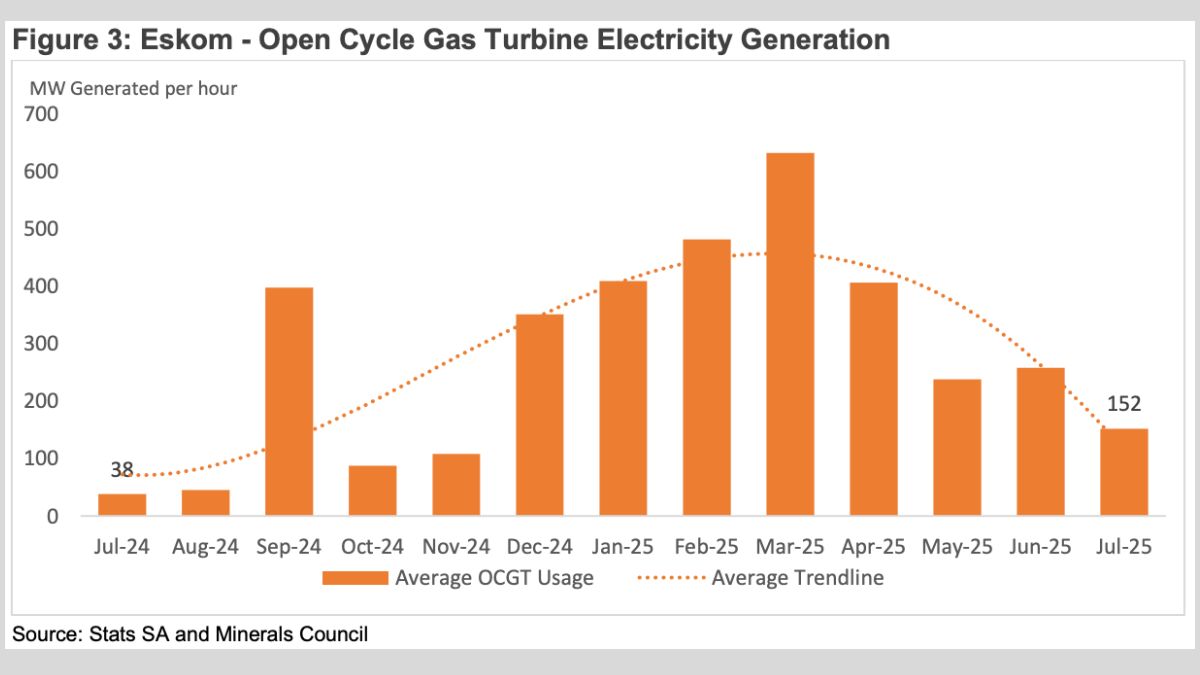
However, Lourens cautioned that this stability hinges in part on continued heavy use of OCGTs to cover peak demand periods.
Between 1 April and 24 July, Eskom spent R5.616 billion on fuel for its OCGTs, almost half the R11.432 billion it spent over the entire 2024/25 financial year.
Although OCGT use declined in July compared to June, Lourens said the load factor and electricity output from the OCGTs are higher than in the same period in 2024, meaning Eskom is still leaning on diesel far more than it did a year ago.
Eskom insists that its diesel spend is within budget for the 2025/26 financial year. However, this budget is based on its own forecasts, which now look conservative.
In its May 2025 winter outlook presentation, the utility modelled a worst-case scenario in which unplanned outages exceeded 15,000 MW.
This would have forced 21 days of up to stage 2 load shedding and the consumption of R4.8 billion of diesel.
However, by late July, actual diesel spending had already exceeded this figure by roughly R460 million.
South Africans could pay the cost
While the higher-than-forecast diesel burn has helped keep the lights on and provided South Africans with a rare period of uninterrupted supply, some experts warn that it comes with a delayed financial sting.
Eskom’s reliance on diesel in recent years has already been one factor behind its aggressive tariff hike requests.
The National Energy Regulator of South Africa (Nersa) approved an average electricity tariff increase of 12.74% for 2025/26, far below the 36.15% Eskom applied for.
Energy expert Matthew Cruise from Impower explained late last year that the steep application was partly an attempt to claw back the billions Eskom had spent on diesel during the height of the energy crisis.
“They’ve cited a range of reasons why the current cost of electricity is not reflective of their costs,” Cruise said. “One of the factors is that they’ve been spending a lot on diesel. R15 billion has been spent on diesel over the last financial year.”
Cruise noted that Eskom’s earlier tariff applications didn’t fully account for these diesel costs.
“There was very high diesel use during the energy crisis, which incurred debt and needs to be addressed,” he said.
The implication is that while current diesel spending may be budgeted for, it still contributes to Eskom’s long-term financial strain, which inevitably feeds into tariff increases.
Apart from diesel, Cruise also warned that the cost of Eskom’s main fuel source, coal, is also rising, further driving up the expense of generating electricity.
“There was very high diesel use during the energy crisis, which incurred debt that needs to be addressed.”
The current spending pattern suggests that while the crisis may have eased, the financial and structural costs remain.















 Loading ...