

South Africans are kissing Eskom goodbye


The Nedbank Group Economic Unit’s latest energy tracker shows that South Africa’s power supply remains constrained, despite improvements in stabilising Eskom’s grid.
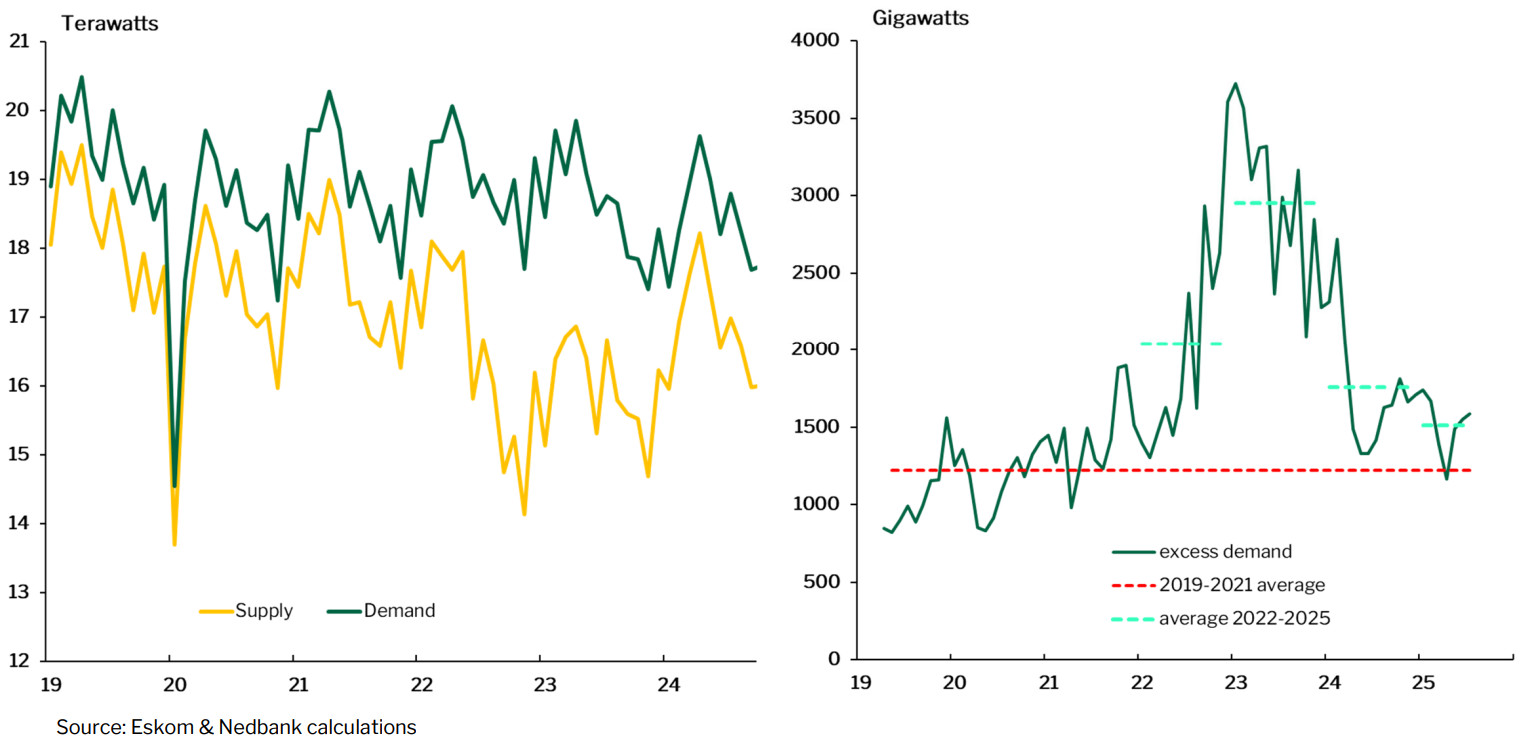
The group’s analysis shows that power demand in South Africa still far outstrips available supply by as much as 24% versus the 2019-2021 average.
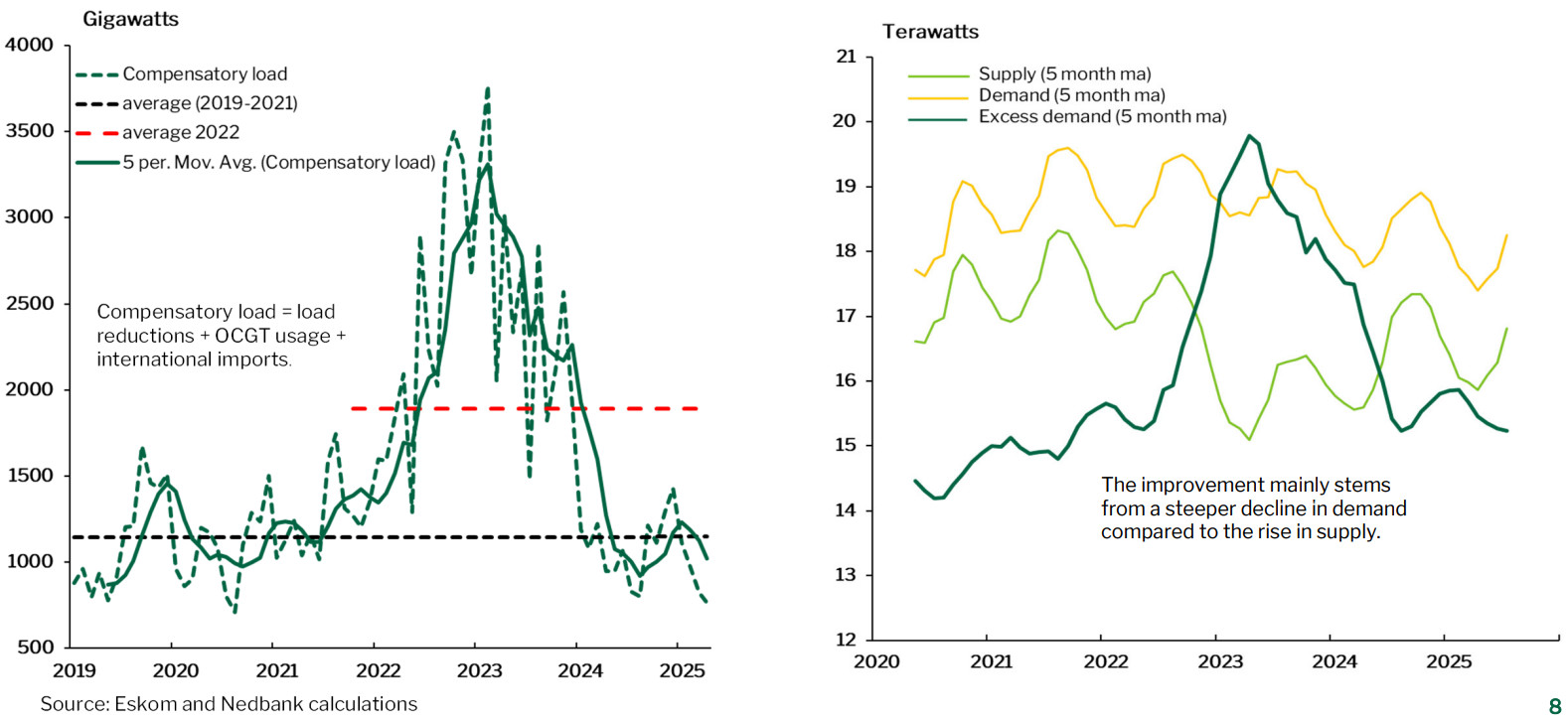
This has forced the national power utility to compensate through load reductions, Open Cycle Gas Turbine usage and international imports.
A positive data point is that Eskom’s dependence on this “compensatory load” has eased significantly since peaking in 2023. However, this isn’t necessarily due to improvements at Eskom.
According to Nedbank, the reduced pressure on Eskom has been made possible by improvements in excess demand, or South Africans moving away from the national utility.
“Demand for energy continues to decline, signifying a structural break from reliance on Eskom. Only modest improvements have been made on the supply front,” the bank said.
The economists pointed to a sharp uptick in investment into renewable and alternative energy post 2022, when the government scrapped licensing requirements for private generation.
This led to a surge in renewable investment in particular, where the country saw a spike in machinery and equipment investment related to these sources, including solar PV and batteries.
While investment stalled in 2023 and 2024, 2025 has seen a resurgence, with around 7,000MW of renewable energy installed on the grid.
Yet, despite this positive movement, South Africa’s energy security remains compromised, Nedbank said.
This is evident in the fact that Eskom is still relying on compensatory measures to meet South Africa’s needs.
It is also evident in the “extraordinarily high” levels of breakdowns and the constant risk of load shedding.
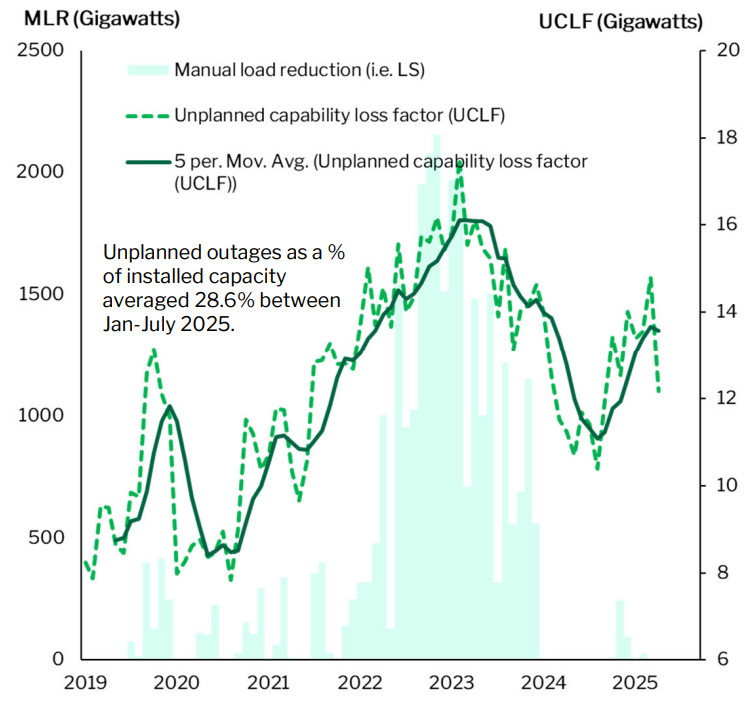
While Eskom and the government have boasted about driving up the grid’s energy availability factor (EAF) and reducing breakdowns to under 13,000MW, the reality is that these levels are incredibly bad.
For wider context, unplanned losses (breakdowns) were well below 10,000MW before 2021, and even lower pre-2019.
Plotted out on a timeline, current breakdown levels are as bad as in 2022. Eskom’s latest data shows a positive move in this direction, but outages are still above 10,000MW.
With energy supply not much different from that time, it’s only lower demand and Eskom’s use of OCGTs, load reduction and imports that are saving the day.
Breakdowns and manual reductions
Supply and Demand and Excess Demand
Eskom too dependent on compensatory load
Historically, Eskom’s use of OCGTs has been extremely low, with a utilisation rate or load factor of less than 1% between 2016 and 2019.
Due to the high cost of OCGTs, energy experts point to an average utilisation rate of 1% as the typical utility-scale standard for this energy supply.
However, during Eskom’s load shedding, the OCGT load factor pushed upwards of 20%, forcing energy regulator Nersa to relax the limit to 6% in 2023/24.
Eskom’s latest power update shows that OCGT use is currently sitting around 1.2%, down from 6% the week before.
Nedbank said that South Africa’s electricity supply won’t be stable until this, and the reliance on load reduction and imports is cut back further.
“The achievement of stable electricity supply requires a sustained improvement in generative capacity and less dependence on the compensatory load,” Nedbank said.
“Despite the year-on-year improvements in the EAF and load shedding, energy supply is still insecure given the poor state of infrastructure.”
The group said that a more dramatic shift towards renewable energy is required to reduce the pressure on the national grid.
“The crisis has spurred the establishment of multiple plans and programmes. Implementation of these plans are underway, but progress remains slow.”
OCGTs, Load Reduction and Imports

















 Loading ...