

Be careful of last year’s top shares


The story of the duck and the scorpion illustrates how we as humans tend to act a certain way, even if it’s not in our best interest, said Schalk Louw, portfolio manager at PSG Wealth Old Oak. The duck hesitantly offered to help the scorpion to safety after he got stranded in a flood.
Shortly before reaching the shore, however, the scorpion stung the duck, which eventually lead to the death of both of them. Although the scorpion knew that his actions would kill them both, he simply found it too difficult not to give in to his natural instincts.
Investment figures published monthly for both shares and unit trusts can easily place investors in the scorpion’s position. It’s in our nature to want to choose last year’s winners for our future portfolio, but historically, it’s been proven that this could land you in very deep waters.
Let’s use local unit trusts as an example. Investors can easily be persuaded to limit their research to funds that performed the best in the previous year, but in my opinion, this may hold more poison than the scorpion’s stinger.
If you were lucky enough to be invested in last year’s five best performing General Equity unit trust funds, your investment would have grown by an average of 36% during a time when SA General Equity unit trust funds grew by just over 3% in total over the same period, while the FTSE/JSE All Share Index grew by a mere 2.6%.
Most of the top five funds mainly included resource-based exposure, but it still shows that it was possible to achieve excellent growth for those who were willing to take the risk, in a relatively difficult investment environment.
The five weakest- performing unit trust funds would have treated you much worse, as you would have lost more than 10% of your capital. True to our nature, most investors would have chosen the top five best performers of the previous year at the beginning of this year, simply because they delivered amazing returns in 2016.
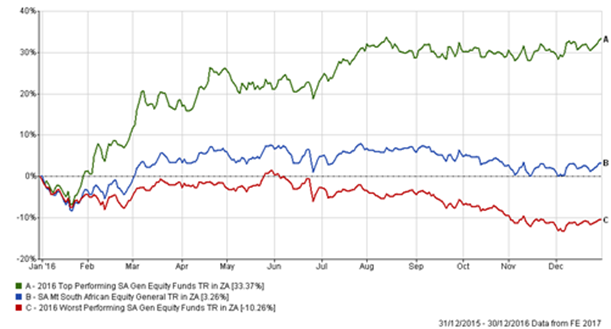
Graph 1: Top 5 best and worst performing SA General Equity unit trust funds for 2016 (source: PSG Old Oak & Financial Express)
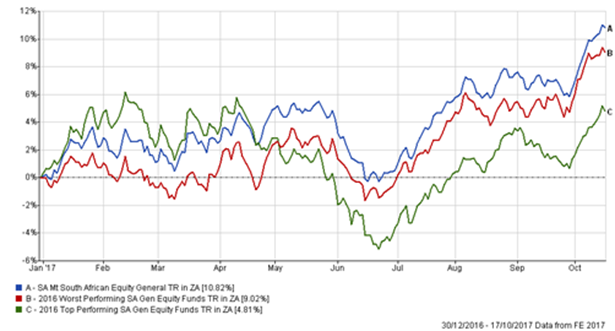 Graph 2: Top 5 best and worst performing 2016 SA General Equity unit trust fund returns in 2017 to date (source: PSG Old Oak & Financial Express)
Unfortunately, managing risk and investments isn’t quite so simple, because the top five performers of 2016 wouldn’t even have provided you with half of both the SA General Equity Fund sector or the JSE’s returns for 2017 to date (17 October 2017).
An even more interesting fact emerges when you take a look at the five worst performing funds for 2016. These five funds didn’t only perform better over the same period so far, but also managed to deliver double the returns of the five best performing funds.
I definitely don’t recommend choosing the five worst performing unit trust funds (or even shares) for your portfolio each year, and I also don’t recommend that you only limit your choices to who and what appeared to be doing well in the past, even if it’s in our nature.
Always consider the following criteria when choosing funds: the underlying costs attached to funds, the quality and history of the management team, the fund managers’ abilities to deliver constant (not limited to a one-year period) above-average risk-adjusted returns, as well as the size (in Rand value) of the underlying funds. These four factors, in my opinion, are far more important investment aids than to limit your choices to past-performing funds.
When it comes to choosing funds, it is always advisable to consult an investment professional to ensure that your natural instincts don’t get the better of you, leaving you to drown because you ended up on the wrong side of the scorpion’s stinger.
- By Schalk Louw, portfolio manager at PSG Wealth Old Oak
















 Loading ...