

Things are looking up for South Africa


Fund managers believe that South Africa’s economy, inflation and load shedding are heading in a positive direction.
According to the most recent South Africa Fund Manager Survey from the Bank of America (BofA), the fear of South Africa entering a recession is decreasing significantly, with the outlook for the economy turning positive.
The research, which took answers from 14 fund managers in July, shows that a net 21% of respondents expect the economy to strengthen in the next 12 months, which is the highest reading in 15 months.
Overall, 50% of respondents said that they expect the economy to get a little stronger in the next 12 months, with 21% expecting it to stay the same.
The number of respondents that said the economy would get a little weaker decreased from 50% in June to 21% in July; whilst the number of respondents who expected it to get weaker dropped from 17% to 7%.
Responses to the question “How do you think the economy will develop over the next 12 months?” are found below:
| Response | May | June | July |
| Get a lot stronger | 0% | 0% | 0% |
| Get a little stronger | 7% | 28% | 50% |
| Stay the same | 14% | 6% | 21% |
| Get a little weaker | 64% | 50% | 21% |
| Get a lot weaker | 14% | 17% | 7% |
| Don’t Know | 0% | 0% | 0% |
| Net Stronger or Weaker | -71% | -39% | +21% |
Inflation
Moreover, the number of respondents who expect inflation a decline in the next 12 months grew, going from a net -89% in June to a net -93% in July.
The number of respondents who expect inflation to be a lot lower in the next 12 months also increased from 17% in June to 36% in July.
No respondents in July survey said that they expect to increase in the next 12 months, with only 7% expecting it to remain unchanged – a decline from 11% in June.
News in South Africa regarding inflation has been positive recently, following a difficult start to the year.
According to recent data from Stats SA, Consumer Price Inflation dropped from 6.3% in May to 5.4% in June – which is in the South Africa Reserve Bank’s target range of 3% to 6%.
Investec Chief Economist Annabel Bishop said that CPI should also lower to near 4.5% – the SARB’s midpoint target – for July, and 2024’s average.
In the BofA research, responses to the question “How do you think the core inflation rate will change in the next 12 months?” are below:
| Response | May | June | July |
| A lot higher | 0% | 0% | 0% |
| Slightly higher | 7% | 0% | 0% |
| Unchanged | 14% | 11% | 7% |
| Slightly lower | 64% | 72% | 57% |
| A lot lower | 14% | 17% | 36% |
| Don’t Know | 0% | 0% | 0% |
| Net Stronger or Weaker | -71% | -89% | -93% |
Load shedding
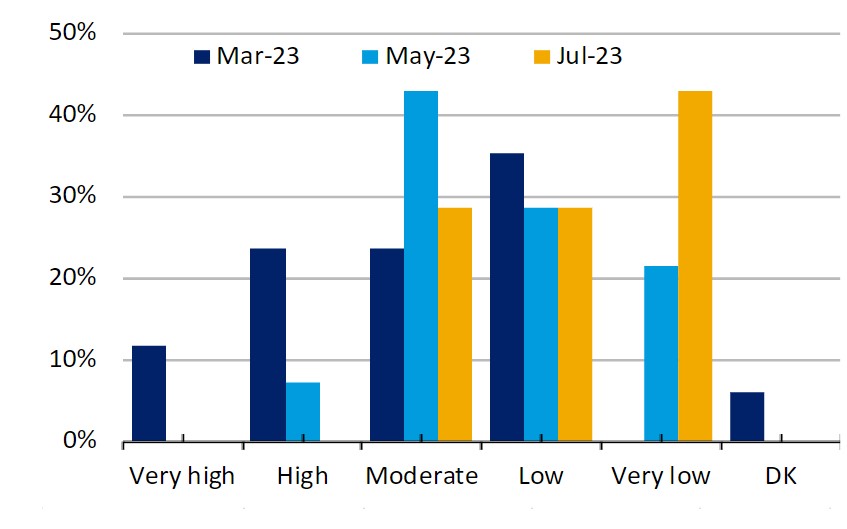
The load shedding outlook has also improved, with fears of a total grid collapse among the fund managers declining.
All fund managers said that the potential for grid failure was low or very low, with none of them saying that the risk of grid failure was high or very high.
These fears have decreased over the last few weeks, with Eskom’s General Manger System Operator Isabel Fick saying that South Africa is unlikely to see a grid collapse – but admitted that the company does have a capacity generation problem.
“The probability of a national blackout is extremely low. A number of other areas across the world…did have national blackouts. Nowhere will you see that [these] were because of a lack of capacity that caused a national blackout,” Fick said.
“In all those cases, it was a cascading event starting in the transmission space.”
In addition, South Africa Strategist for Merrill Lynch John Morris, who compiled the report, said that corporate interest in renewable energy is growing steadily, with projections suggesting the country will add 5,000 MW – equating to five stages of load shedding – in renewables by 2025.
The surge in interest follows a decline in load shedding winter fears, with Eskom mostly keeping load shedding at lower stages, despite subjecting the country to stage 6 last week following a cold front.
Below are the responses to the national grid collapse fears:












 Loading ...