

When South Africa will finally turn the corner


South Africa’s fiscal position is expected to improve, but not in the next two years.
2024 is set to be a busy year for South Africa, with the general election coming up this year – even if it experiences a minor delay.
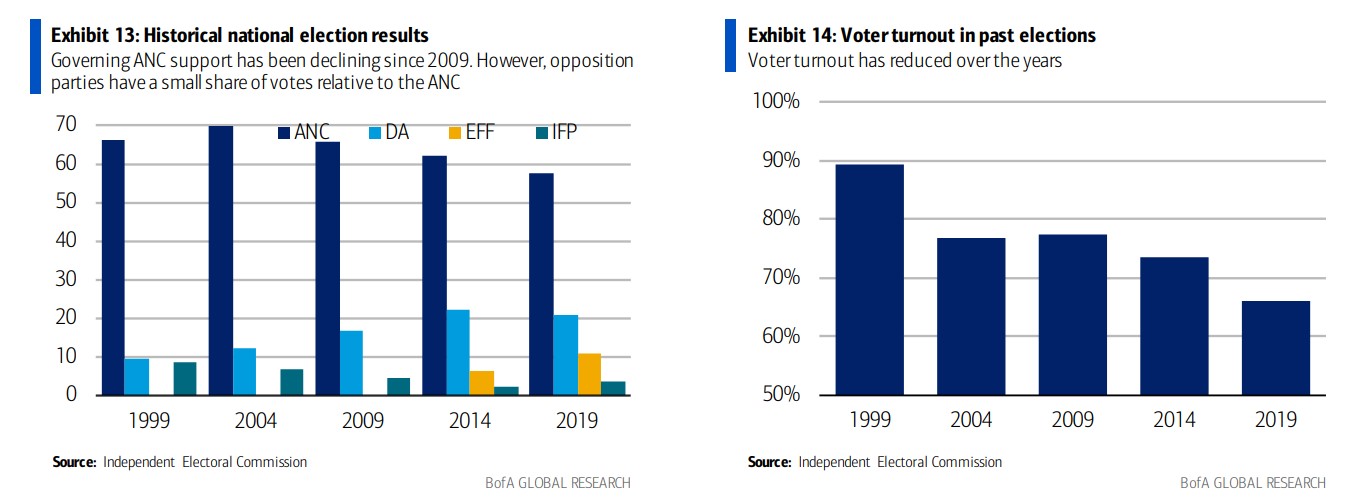
Polling suggests that the ANC is unlikely to win an outright majority and will require a coalition to remain in power.
Although the risk of the ruling party losing power remains small, Bank of America (BofA) said that the slim possibility means that the upcoming elections will be uncertain, turbulent, and noisy.
However, with the ANC staying in power with the help of smaller partners, the status quo on economic policy is expected to be maintained.
In addition, the fiscal outlook remains weak, largely due to expenditure containment pressures, as well as Eskom support still being part of the fiscal framework until 2025.
The 2024 budget is set to take place in 2024, and besides no new taxes, it is unlikely to contain much good news.
BofA said that weak state-owned enterprises will likely receive higher transfers, especially Transnet, whose port and rail failures are expected to result in widespread job losses.
National Union of Mineworkers (NUM) said that close to 10,000 jobs could be lost by the end of this month as mining companies start to give retrenchment notices amid falling commodity prices and the inability to export their goods.
The social relief grant is also expected to be made permanent beyond 2025 despite questions over its affordability.
Wage bill spending is also expected to hurt the government’s purse strings. According to Stats SA, the public wage bill rose from R513.5 billion in 2014/15 to R799.8 billion in 2021/22 (37.5% of total government expenditure).
However, near-term improvements in revenue collection and moderating expenditure growth will likely keep the fiscus in a healthier state.
The budget framework has R15 billion in additional tax revenue in the baseline, which is likely due to the bracket creep – less inflation adjustment on tax brackets.
Overall, the National Treasury is targeting a headline main budget deficit of -4.3% of GDP (BofA -4.8%).
“We think there will still be disappointments in the pace of expenditure containment, while we pencil in new allocations to Transnet in 2024,” BofA said.
2026 hopes
The bank expects the nation’s fiscal position to finally improve in 2026.
“We pencil in improvements in the fiscal path in 2026 – when our forecasts start to align with the Treasury’s, Eskom support falls off, there is a strong primary surplus (over 1% of GDP) and debt to GDP could stabilise at just below 80% of GDP,” BofA said.















 Loading ...