

How every R100 in tax you pay is spent in South Africa


Since 2017, South Africa’s budget allocation for debt repayment and interest has surged, surpassing expenditures on education, social grants, health, and community development. As a result, spending in these social wage areas had to be reduced to fund debt servicing.
Finance Minister Enoch Godongwana, while presenting the 2026 budget to Parliament, declared that South Africa has “turned a corner” and that government debt is becoming stable.
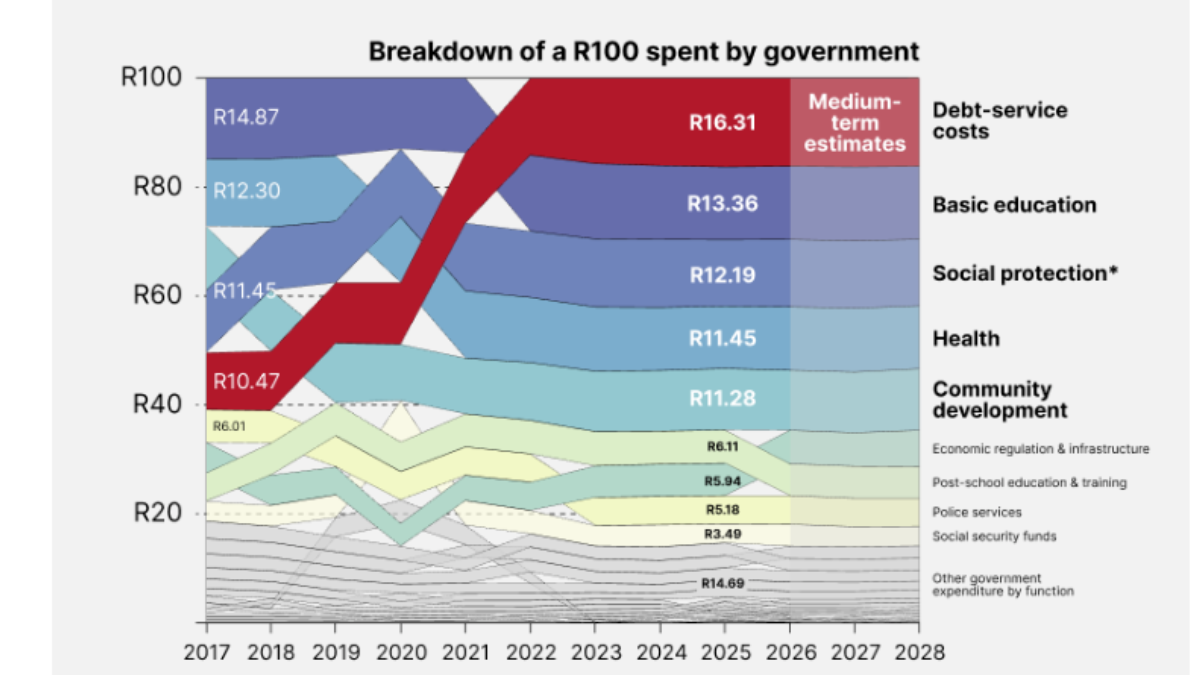
A chart compiled by The Outlier indicated that for every R100 the government spends:
- R16.31 is used towards debt-service costs
- R13.36 towards basic education
- R12.19 towards social protection
- R11.45 towards health
- R11.28 towards community development
- R6.11 towards economic regulation and infrastructure
- R5.94 for post-school education and training
- R5.18 for police services
- R3.49 for social security funds
- R14.69 for other government expenditure by function
Debt costs have increased for several reasons, one of which is the low economic growth in South Africa, averaging 0.6% (accounting for inflation) between 2017 and 2023, which led to lower tax revenue.
GroundUp said the Covid-19 pandemic had long-term economic effects, leading the government to increase spending on emergency relief and social grants. This resulted in a significant budget deficit, which the government covered through borrowing.
Debt costs rose further amid rising global interest rates and a weaker rand. Additionally, state-owned entities such as Eskom required substantial bailouts, which reduced government revenue.
Over the past few years, the government has tightened its belt to find funds to repay debt and pay interest on it.
Meanwhile, tax revenue is increasing as investments in electricity generation and improvements to port export infrastructure pay off, and the economy grows.
The economy is projected to expand by 1.6% in 2026 (inflation-adjusted) and by 2% in 2028.
South Africa’s debt remains above 78% of its annual economic output (Gross Domestic Product or GDP). However, the Treasury believes this ratio will decline from 2026 onwards.


















 Loading ...