

Is the ANC heading for a split?


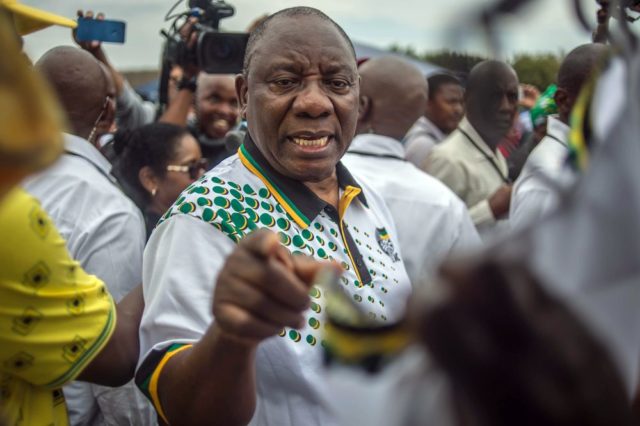
With municipal elections planned for some time in 2021, and an ANC elective conference coming in 2022, investors have raised concerns that the political landscape could be shifting underneath the feet of president Cyril Ramaphosa, and that more radical, nationalist elements within the ruling party are mobilising to take control.
This was highlighted in a column by African National Congress (ANC) National Executive Committee (NEC) member Joel Netshitenzhe this week, where he laid out concerns around a ‘radical economic transformation’ (RET) faction within the party, allegedly emerging from the office of secretary general, Ace Magashule.
According to Intellidex analyst Peter Attard Montalto, this sparked interest and concern from investors, who are reading news headlines thinking that this so-called RET faction within the ANC is becoming a big political play by remnants of the era of former president Jacob Zuma.
It has further spurred talk of a possible split in the party – giving rise to yet another political movement vying for control of government.
However, Attard Montalto says this is largely over-blown, and serves as more of a distraction than anything else.
“Markets need to separate noise from reality,” he said in a note. While South Africa has room for a more centrist political movement to rise up, given the financial and ‘grass roots’ requirements to do so, it is unlikely that one will emerge – least of all from within the ANC itself.
“We take a very stark view on this – we call the RET faction the ‘Zuma-rump end’ because it is exactly that – relatively small, isolated, lacks money, distracted by the NPA and courts, and lacks grass roots support or strategic and cohesive leadership,” he said.
“This is not to say it can’t create meaningful noise, distraction for investors and headline risk – they will. It also doesn’t mean that they won’t distract Ramaphosa and his government – they will. But they are not going to be able to stage a successful campaign into the 2022 elective conference with the resources required.”
Attard Montalto said that the only real threat to Ramaphosa comes from those who helped him win the presidency in the first place, noting that the president’s support base inside the ANC itself is quite small, with ‘the provinces’ holding real sway over who gets put in power.
But even here, he said, the ANC lacks any centrist leaders who hold wide popularity within the party.
New parties rising
The analyst said that there is room in the wider political landscape for a true ‘alternative’ to the ANC to arise – one which has a more centrist view – but nothing stands out among the parties that have made attempts to enter into this sphere.
Former DA leaders in Mmusi Maimane, Lindiwe Mazibuko and former Joburg mayor Herman Mashaba have all launched their own political ‘movements’, but lack the funding needed to really contest the ANC, he said.
Cosatu, meanwhile, has threatened to contest elections independently of the ANC, but does not represent a centrist ideology, Attard Montalto said.
“The centre lacks a leader with the political wherewithal, the advice, the funding, and the ground network – and we do not see this emerging,” he said. “There is also a sizeable majority within (the ANC) that wants to save the party regardless, and would not back an alternative.”
Despite this, he said markets have for some time been continually studying the risk of such a “centrist entity” emerging in the coming years, precisely because a vacuum at the centre can create sparks that catalyse the underlying ingredients that are present – “for instance, a strong young leader who is as yet unknown”.
However, “such a person does not yet exist”, the analyst said. “There is no Macron moment – yet.”
Read: Ramaphosa vs Magashule battle heats up inside the ANC: report


















 Loading ...