

Ramaphosa sends a warning to major mafia in South Africa


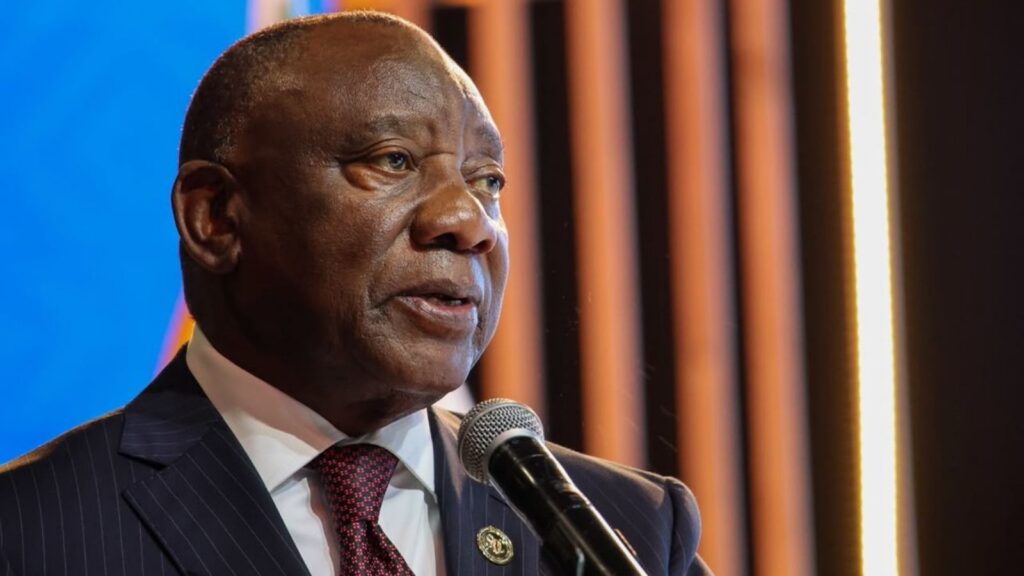
President Cyril Ramaphosa recently announced that the government is cracking down on the water tanker mafia as part of its plan to address South Africa’s water crisis.
He said that progress is being made in the fight against corruption and criminality in the sector, which includes efforts to address the water tanker mafia.
Water tanker mafias are organised criminal syndicates in South Africa that deliberately sabotage municipal water infrastructure to profit from artificial water shortages.
These criminals damage water pipes, valves, and pump stations to disrupt the supply of regular tap water.
They threaten municipal workers to prevent them from repairing the damaged water systems.
As a result, they force local governments to sign costly emergency contracts with private water-trucking companies, or to sell water directly to desperate residents at inflated prices.
The Department of Water and Sanitation (DWS) has stated that various failures at the municipal level have allowed criminal groups, such as water tanker mafias, to emerge and thrive.
The president mentioned that the National Water Action Plan, released in July, is expected to help combat these mafias.
The National Water Action Plan (NWAP) comprises a series of actions to ensure a reliable supply of quality water for all South Africans.
The plan addresses the underlying causes of water supply challenges faced by many municipalities.
It outlines strategic interventions to tackle the water crisis in the short, medium, and long term.
The NWAP presents a strategy to boost infrastructure investment, including encouraging private-sector participation.
It enacts legal and regulatory reforms to improve municipal service delivery and to combat corruption and criminal activities in the water sector.
The NWAP was developed by WATERCOM, which was established following the 2026 State of the Nation Address in response to increasingly severe water supply interruptions in several parts of the country.
“We’re also combating corruption and criminality in the water sector, including dealing with the whole challenge of the water tanker mafia,” Ramaphosa said.
He explained that the progress being made gave the government confidence that the new National Water Action Plan would help resolve the water crisis.
“It will address many of the immediate water challenges communities face. This is what we aim to achieve,” he said.
“It is not the responsibility of the DWS to reduce illegal supply disruption”

Earlier this year, in response to a parliamentary Q&A from Umkhonto Wesizwe MP Mandlenkosi Matutu, DWS Minister Pemmy Majodina said it was not the department’s responsibility to take on these water tanker mafia syndicates.
Instead, she said that municipalities are tasked with ending these disruptions.
“It is not the responsibility of the DWS to reduce illegal supply disruptions or provide an uninterrupted water supply in municipalities,” she said.
“This is the responsibility of municipalities as Water Services Authorities (WSA), in terms of both the Constitution and the Water Services Act.”
Many municipalities in South Africa, including major metros, have come under siege from water-tanker mafias—organised crime groups that intentionally disrupt public water systems to create water shortages.
These syndicates have become a significant and entrenched issue, especially in KwaZulu-Natal, Gauteng, and the North West province, often functioning as a form of “localised state capture.”
On top of this, the unclear separation between the Water Services Authority (WSA) and Water Services Provider (WSP) functions, along with the diversion of water revenues for other municipal priorities, has compromised accountability and financial sustainability in some municipalities.
To address these issues, the Department said it would implement reforms this financial year, with a particular focus on metropolitan municipalities.
The Water Services Amendment Bill in Parliament seeks to clarify the roles of the WSA and WSP, improving accountability in operations and revenue collection.
The National Treasury said it would introduce a R54 billion performance-based Trading Services Grant for metropolitan municipalities, effective in the 2025/26 financial year.
Access to this grant is contingent upon these municipalities executing approved turnaround plans and showing measurable advancements in key performance indicators, which include:
- Separating water revenue within metropolitan trading services
- Creating accountable WSP business units
- Reducing non-revenue water
- Increasing service reliability
“All metropolitan municipalities are required to implement water and sanitation turnaround strategies with defined targets and timelines,” said Majodina.
















 Loading ...