

South Africa’s richest city is falling behind its biggest rivals


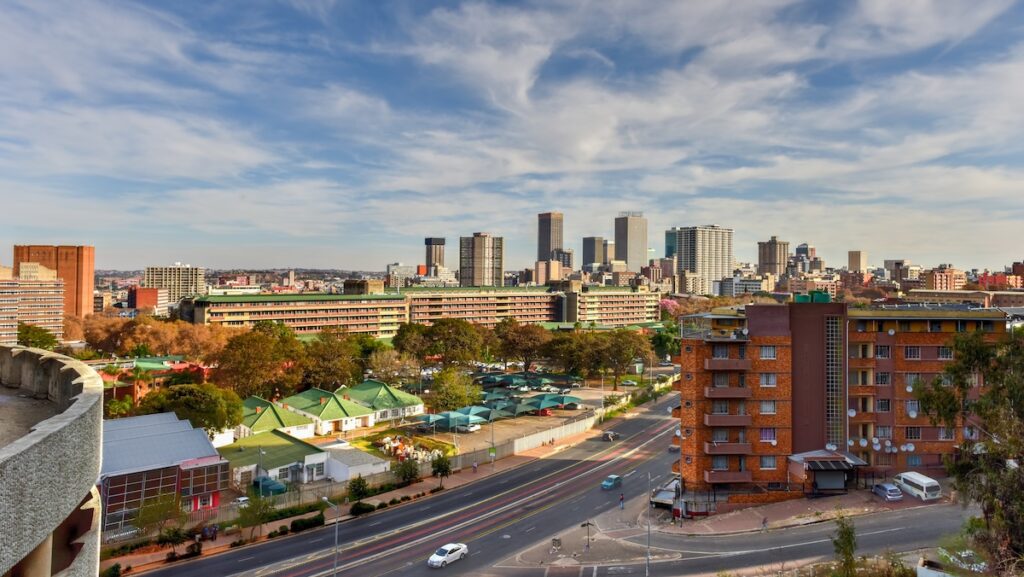
Despite its strong overall contributions to South Africa’s economy, Johannesburg’s unemployment rate is significantly higher than that of other African economic hubs.
In the second quarter of 2026, Johannesburg recorded an unemployment rate of 35.9%, higher than the national average of 33.6%.
In comparison, Egypt’s unemployment rate is currently 5.8%, and Morocco’s urban unemployment rate stands at 11.9%.
Nigeria has the lowest unemployment rate among the analysed countries, with the rate dropping sharply after a revision of its calculation methods.
While these countries do not provide specific unemployment rates for individual cities, the economic contributions of cities such as Cairo, Lagos, and Casablanca can be compared with those of Johannesburg.
Johannesburg contributes roughly 16% to South Africa’s GDP, which was approximately $427 billion at the end of 2025.
Lagos, Nigeria’s largest metropolitan area, accounts for approximately 30% of the country’s GDP, which was $290 billion that year.
Cities such as Casablanca and Cairo contribute larger shares to their countries’ economies, with Cairo accounting for 42% of Egypt’s GDP and Casablanca accounting for 32% of Morocco’s GDP.
While this may seem to be a poor reflection on Johannesburg, South Africa’s GDP is the largest in Africa, making the city’s total output larger by comparison.
South Africa’s GDP in 2025 was $427 billion, with Johannesburg the area with the largest contribution to this total.
In comparison, Cape Town is South Africa’s second-largest economic contributor, accounting for roughly 10% of the country’s GDP.
Johannesburg also has a smaller population than other major African cities, such as Lagos, with an estimated 14.9 million residents, and Cairo, with 9.8 million.
The city has an official population of roughly 4.8 million, according to 2022 national census data, but this number has likely increased in the last four years.
Data on major economic hubs in South Africa
| City | Country | Share of the country’s GDP | Population | Unemployment rate |
| Johannesburg | South Africa | 16% | 4.8 million | 35.9% |
| Cape Town | South Africa | 10% | 4.8 million | 21.9% |
| Cairo | Egypt | 42% | 9.8 million | 5.8% |
| Casablanca | Morocco | 32% | 3.2 million | 11.9% |
| Lagos | Nigeria | 30% | 14.9 million | 4.3% |
Johannesburg’s struggles
Johannesburg has faced increasing challenges in service delivery, with frequent water and power outages alongside issues such as poor refuse removal.
The city has also struggled with significant debts to service providers, such as Eskom and Rand Water, for bulk service purchases.
The city recently settled its debt with Eskom, paying the energy supplier R5.25 billion in overdue payments for bulk electricity purchases.
Unemployment in the city has also been a major challenge, with the unemployment rate being above 30% since 2021.
The city has followed a similar pattern to South Africa’s unemployment, with the rate consistently high in recent years.
Despite the city’s challenges, Johannesburg continues to be the driving force behind South Africa’s economy.
Households in the metro earn an average salary that is 57% higher than South Africa’s average and 9% higher than Gauteng’s average.
The city is also home to some of the country’s largest businesses, with many located in Sandton’s “richest square mile in Africa.”
The city’s high concentration of wealthy businesses is a major factor in its overall economic contribution to the country.
The metro is also home to the Johannesburg Stock Exchange (JSE), with many of the companies listed on the exchange being based in the city.
African cities such as Lagos, Cairo, and Casablanca also contain a high number of businesses, and are each home to their countries’ stock exchanges.
While all cities are major economic contributors to their respective countries, Johannesburg has a far higher unemployment rate than any other.

















 Loading ...