

Meeting targets with PETCO


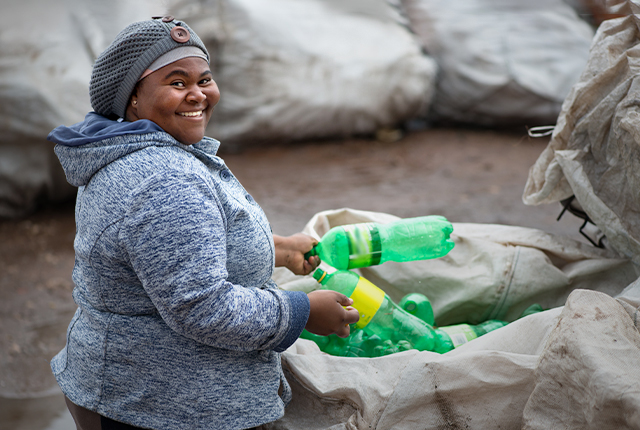
For 17 years, PETCO has served its members by growing the collection and recycling of PET bottles and advancing local rPET capacity.
PETCO aims to continue providing this service, keeping members compliant while also supporting their environmental, social and governance objectives.
Target-driven success
For our members, the most important outcome is full compliance with all relevant regulations and the primary way we can achieve this is by meeting the specified collection and recycling rates.
The five-year recycled content targets for beverage bottles are 10%, 12.5%, 13% 15% and 20%; for flexible packaging they are 50%, 55%, 60% 70% and 80%; and for single-use products (PS, HD and PET) they are 8%, 12% 14%, 17% and 20%.
Collection and recycling targets for beverage bottles will increase from 60% to 70% and from 54% to 65% respectively over the five-year period, while for oil bottles the collection targets will escalate from 7% to 39% and recycling targets from 6% to 35%.
For thermoformed trays the collection targets will grow from 9% to 35% and the recycling targets from 8% to 30%, while for flexible packaging collection, targets will increase from 10% to 50% and recycling targets from 9% to 45%.
For single-use products, the collection targets will rise from 60% to 80% and recycling targets from 30% to 50%.
PETCO has always used a target-driven approach to establish its business plans and for this reason, we are confident that we can continue to deliver for our members.
Optimising the reporting process
Our contract-based approach to collection and recycling has enabled us to report accurate collection and recycling statistics and demonstrate how our actions as a PRO, using our members’ contributions, are enabling the collection and recycling that we report.
In terms of interactions with our members, we’ve reviewed how we raise our EPR fees and tried to simplify the process to create options that work for our diverse membership.
The majority of our members appear to be well informed and committed to the EPR concept.
We know that globally, EPR policy development is an iterated process and that there will be teething problems between industry and government as we work through the intention of the regulations and clarify things.
In this regard, I think all PROs are concerned as there at times appears to be duplication and potentially unnecessary reporting. However, I’m sure we can simplify things significantly to help producers, PROs and government.
Challenges and opportunities
For the industry, the roles of various supply chain elements have been the biggest challenge, with different parties and PROs interpreting things differently.
In terms of opportunities, the regulatory reporting required will bring new insights into the packaging market that we haven’t had in the past.
Over the years, our estimates of packaging placed on the South African market have largely been informed by data supplied by the local packaging industry and brand owners.
However, the impact of imports and exports has been hard to estimate accurately.
Additionally, from our Project Up BanQu data, it’s evident that product design has a major impact on the prices paid for collected materials.
The higher the value of the material, the lower the net cost of collection and the higher the collection rate.
We will keep encouraging our members to continue improving the designs of their products to assist us in reaching our collection targets and reduce the cost to themselves.
Finally, while estimates vary, informal collectors are responsible for a significant portion of recyclable collections in South Africa and will remain so – so this sector needs to be supported effectively.
Making changes
As per the regulations, our collection rates will need to improve over the next few years and for some materials, this will require changes.
PETCO believes that increasing separation at source will be a critical part of this improvement journey and that solutions combining separation at source by residents with both formal and informal collection systems need to be considered.
The organisation has also expanded its portfolio to include the labels and closures that are sold with the PET bottles to simplify members’ interaction with PROs.
We have been able to do this because we have built great relationships with our contracted recyclers over the years.
While expanding the portfolio as a PRO has obvious benefits, it’s important to remember that as a PRO, the more materials you take on, the greater the challenge and responsibility.
Therefore, we’ve been careful only to take on materials for which we can continue to deliver for our members.
Moving forward
The policy that allows producers to choose between PROs or establish a scheme introduces an increased burden on both PROs and standalone schemes.
In a competitive environment, both must demonstrate a clear link between what they do and the numbers they report – this helps to differentiate between the efforts and performance levels of different PROs and EPR schemes.
Without this, there is a clear incentive for producers to simply join the cheapest PRO or set up a scheme, while claiming the results achieved by the more established PROs that enable collection and recycling.
By Cheri Scholtz, CEO of PETCO.


















 Loading ...