

Why asset management needs more Black leaders now


By Ola Leepile
South Africa’s asset management industry is measuring progress on Black economic empowerment using a metric that has lost much of its significance to the general population – ownership.
According to the latest Transformation Report from the Association for Savings and Investment South Africa (Asisa), Black South Africans now hold 49% of voting rights and 43% of economic interest in asset managers, comfortably above the 25% target. That suggests a sector transformed.
However, employment equity, particularly in top roles, continues to progress slowly – and it is in the ranks of portfolio managers, CIOs, and investment committees where it matters most.
Without leadership teams that reflect South Africa’s demographics, the industry risks making skewed investment decisions, losing credibility with trustees, and failing to deliver for the majority of savers.
The Asisa report highlights the contradiction. At the board level, Black representation in asset managers has exceeded the 50% target since 2020, reaching 55% in 2024.
Yet, at the executive level, transformation lags behind. Black executive directors accounted for 46% of boards, below the 50% goal, while Black representation in executive management stood at 50%, short of the 60% target.
Black women in executive management rose from 15% in 2018 to 22% in 2024 – an improvement, but still eight percentage points shy of the goal.
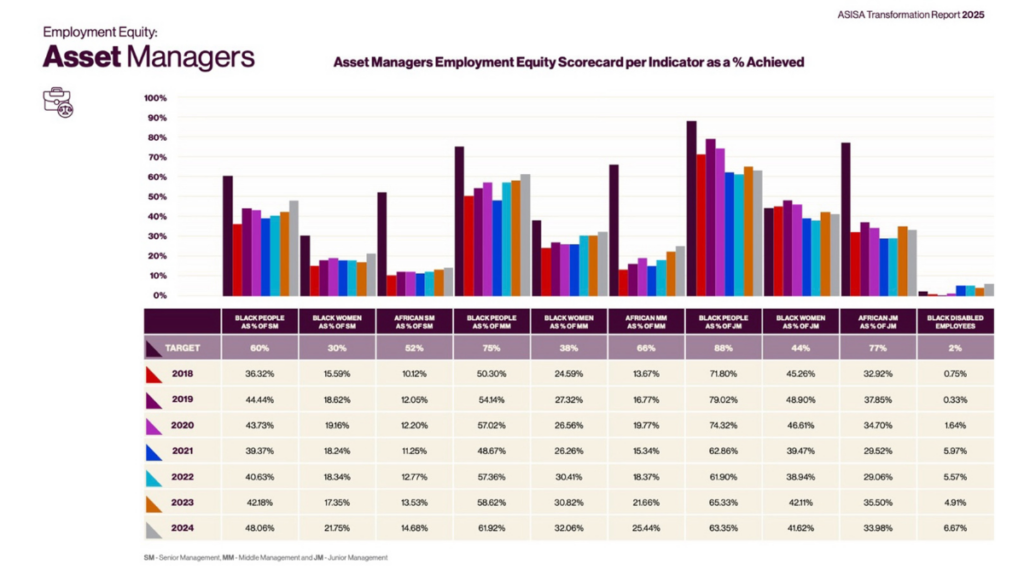
It is worth drilling deeper into the numbers. While Black people accounted for 54% of senior management, still shy of the 60% target, Black Africans made up only 23% – far short of the 52% objective set under the Financial Sector Code (FSC).
At junior management level, the picture has deteriorated: Black representation slipped from 72% in 2018 (and 79% in 2019) to 63% in 2024.
Again, Black Africans stood at 34% (barely up from 33% in 2018 and a peak of 38% in 2019) against the FSC target of 77%.
In middle management, Black Africans held only a quarter of the jobs (vs the 66% objective), while junior management was not even halfway to target. For Black women, the challenge is just as stark.
This distinction matters given that 81% of South Africa’s population is Black African, 8% coloured, 7.3% white and 2.7% Indian/Asian, according to Statistics South Africa.
This slow progress, stagnation in some areas and backsliding in others, is worrying.
It means that while Black investors may have their names in shareholder registers, the everyday investment decisions that determine where capital flows – choices about risk, allocation and stewardship of client savings – are still largely being made by teams that do not reflect the society they serve.
For pension fund trustees, this should be deeply troubling. They are responsible for ensuring that the managers they appoint act in the best interests of members.
That responsibility extends beyond short-term returns to governance, representation and long-term legitimacy.
Trustees must be able to look at their managers and see decision-making teams that are diverse, representative and grounded in the lived realities of their members. Without this, trust in the industry erodes.
The case for employment equity is not only moral or political; it is financial. There is no evidence to suggest that diversity will result is worse outcomes for investors.
If anything, the opposite is true. Research by McKinsey & Co., published under the title Diversity Matters Even More, shows that companies in the top quartile for ethnic diversity on executive teams are 39% more likely to outperform peers on profitability.
A paper published in April 2024 on the Harvard Law School Forum, titled Diversifying Demographics of Assets Under Management, made a similar point in the US context.
Researchers from Boston-based FCLTGlobal found that white male–owned asset management firms oversee 98.6% of assets under management, while minority-owned firms account for less than 2%.
“The notion that the best managers are overwhelmingly white males, who make up at most 30% of the US population, defies logic, highlighting substantial untapped potential,” FCLTGlobal associate director Victoria Tellez and senior research associate Jessica Pollock wrote in the report.
They argue that too much of the diversity debate in finance has focused on headcount rather than who actually controls the money.
Their recommendations: measure diversity by assets under management, not just staff numbers; reward inclusive investment teams in manager selection; and build long-term partnerships with diverse managers.
“Capital allocation to diverse managers emerges as the most impactful strategy for long-term investors,” they concluded.
Beyond the numbers, employment equity has multiplier effects across society.
According to Stats SA’s General Household Survey, many households remain multi-generational, and the country’s dependency ratio – the number of children and elderly relative to the working-age population – sits at around 48%.
That means for every person with a job, as many as two to three others rely on that income.
Each appointment of a Black professional is not only an act of fairness but also a driver of economic resilience for households and communities.
One professional role in asset management sustains entire families, funds education, pays for healthcare and creates ripples of dignity and stability.
Critics of transformation often point to South Africa’s broken education system and the shortage of Black actuaries, CFA Charter holders and so forth.
These constraints are real. But they cannot excuse the industry’s inertia. The solution is not to lower expectations but to invest deliberately in training, mentorship and pathways into leadership.
Encouragingly, initiatives are underway. Asisa has committed to commissioning a skills-gap study to align training with industry needs.
Trustees and asset owners must push harder. They should demand clarity on who sits on investment committees, what proportion of portfolio managers are Black, and how firms are mentoring and promoting the next generation of leaders.
These are not side questions – they go to the heart of fiduciary duty.
Regulators are also tightening the screws. The Employment Equity Amendment Act, signed into law in 2025, empowers the labour minister to set sector-specific numerical targets.
Asset managers that cannot show credible progress may find themselves excluded from state contracts and, more importantly, exposed to reputational risks that trustees cannot ignore.
The logic is clear. If asset managers are to steward the savings of South Africa’s workforce, they must reflect that workforce.
The industry has met and even exceeded ownership targets, and that is an achievement worth noting. But ownership without authority is insufficient.


















 Loading ...