

More trouble for domestic workers in South Africa


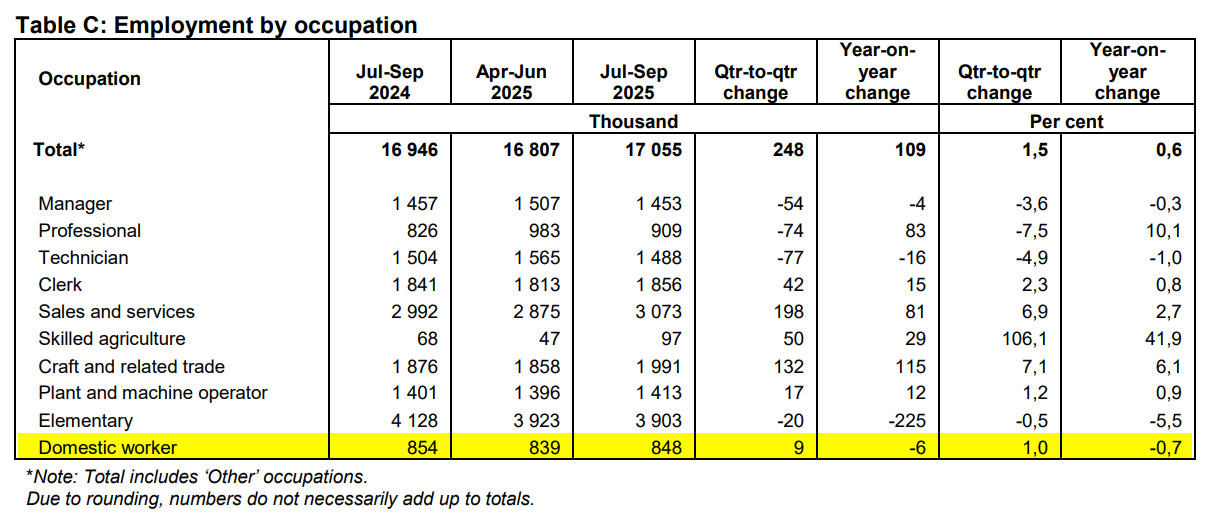
The latest employment data from Stats SA show that domestic worker jobs in the country continue to decline annually, despite a slight increase in the number of positions filled over the past three months.
The latest Quarterly Labour Force Survey (QLFS) shows that unemployment reduced in the third quarter of the year as 248,000 more people were employed, totalling 17.1 million.
The largest increases in employment were recorded in the Construction industry (+130,000), followed by the Community and social services (+116,000) and Trade (+108,000) industries.
However, decreases in employment were recorded in Manufacturing (-62,000), followed by Finance (-54,000), Utilities (-30,000) and Transport (-3,000) industries.
Employment in private households—the primary employer of domestic workers—increased by 5,000 or so jobs over the quarter, a rise of 0.5% from Q2.
However, year-on-year, the total number of jobs declined by 1.5%, resulting in a 17,000 position decrease.
Looking at domestic worker jobs specifically, the number of domestic workers increased by 9,000 since the second quarter, but the annual data still shows a decline of 0.7%.
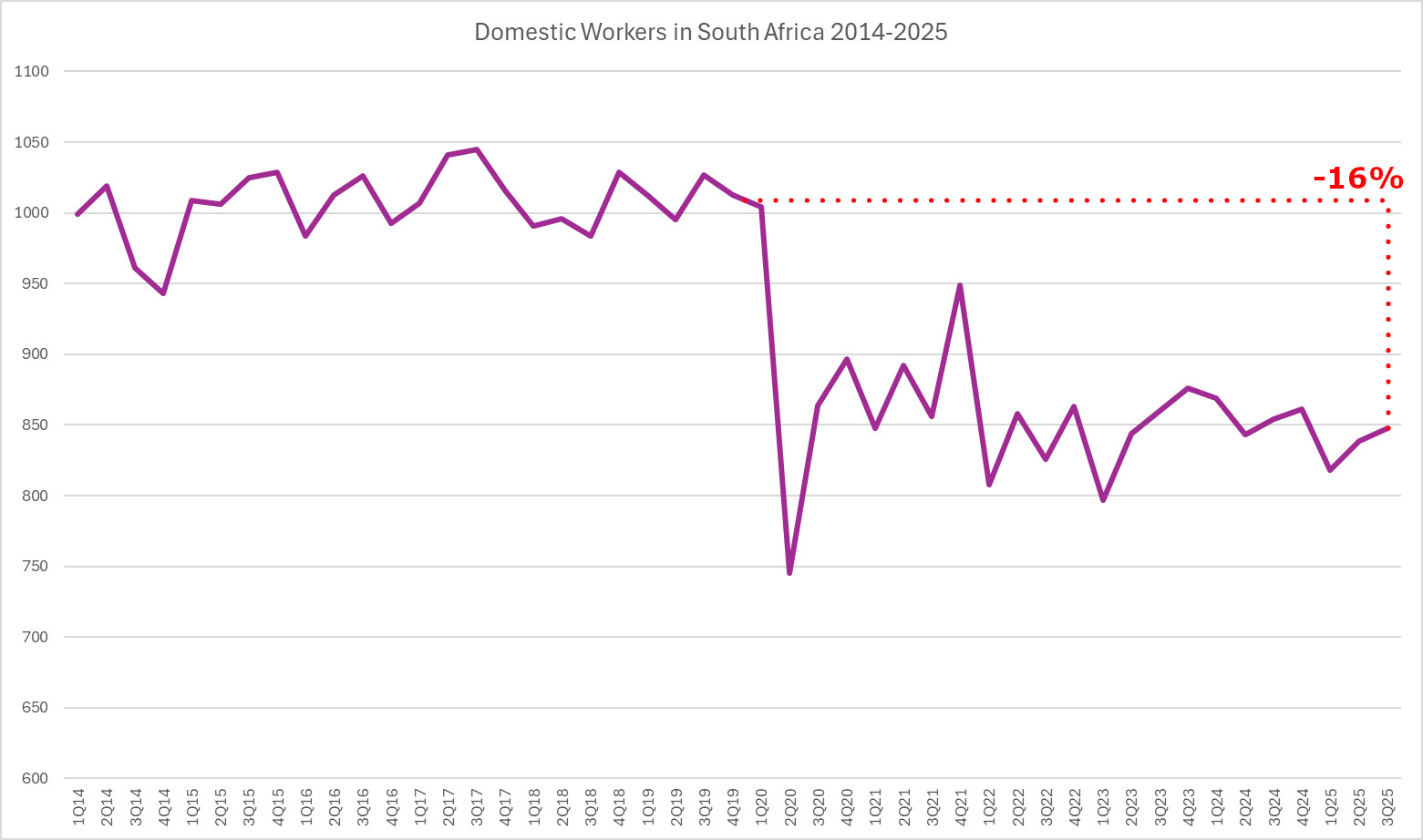
Tracking the jobs data over a longer period, domestic worker positions haven’t moved higher than the 880,000 mark in almost four years.
This reflects a permanent loss of around 150,000 domestic worker jobs in the country since the COVID-19 pandemic.
Pre-pandemic (Q4 2019), figures fluctuated around 1 million domestic workers. When factoring in the seasonal variations and potential base, groups like SweepSouth put the figure closer to 1.2 million.
However, since lockdowns ended and the pandemic was declared over, the sector simply never recovered.
There have been various reasons and explanations given to account for this: from stressed household finances to emigration.
The latest SweepSouth Domestic Worker Report for 2025 shows that 19% of domestic workers lost their jobs in the past financial year alone.
About 16% of job losses in 2025 were because employers could no longer afford to pay; however, a significant number of losses were attributed to emigration and semigration, with domestic helpers left behind.
However, another challenge is rising and feeding into the affordability factor.
National minimum wage bite coming
SweepSouth CEO Lourandi Kriel noted that whenever wages are increased to help workers keep pace with rising living costs, employers often respond by cutting back on domestic work.
“Any attempt to raise pay for domestics led to a decline in hiring. This means either the number of days a week is cut or a full-day engagement becomes a half-day job,” she said.
“For some families, it is just not affordable. Then they drop the service in its entirety.”
Households who are on the fence about whether or not to keep using domestic help services in 2026 may soon find themselves pushed over, with the National Minimum Wage increase for the year under deliberation.
Consultations on the NWM for 2026 were held in September, with the NWM Commission expected to table its recommendations to the Department of Labour in December. The official changes will be announced in the new year.
Over the past three years (including 2025/26), the commission has stuck to a minimum hike in line with CPI – though some years have seen increases far higher than this.
As a baseline, the National Minimum Wage could be increased by at least 3% in 2026.
In real terms, the increases tend to be higher, with SweepSouth noting a 16% increase in median earnings between 2024 and 2025, with the caveat that its data shows employees still earning below minimum wage.
The rising NWM, however, adds pressure to households with already strained budgets, which means domestic workers—one of the first things households cut when cutting costs—might get the chop.
This has been a concern raised by various groups, including worker unions that represent domestic workers in corporate employment.
Earlier this year, the United Association of South Africa (UASA) said that the real-world impact of the NMW may be making life more challenging for domestic workers, contrary to its intentions.
Echoing SweepSouth’s assessment, the union said it is worried that some employers may reduce working hours, opt for part-time help, or discontinue domestic worker services altogether in light of the hikes.


















 Loading ...