

More pain for braai lovers in South Africa


While food inflation in South Africa continues to cool, the latest Braai Index shows prices are still rising under continued pressure from higher energy costs.
The index, which tracks a basket of food items used for hosting a braai, increased by 1.3% between May and June 2026, reflecting rising price pressure.
This is a second-round effect from the Iran War, which caused a massive surge in energy and fuel prices between April and June 2026.
As the war appears to be simmering down—tensions and uncertainty aside—and oil prices drop sharply, inflationary pressures are expected to ease going forward.
However, the ripple effects of the initial shock are still playing out in pricing.
This is also reflected in the month-on-month basket price, which was up 0.8% between May and June 2026.
The Braai Index is compiled monthly by BusinessTech using pricing data from the Pietermaritzburg Economic Justice and Dignity (PMBEJD) group. The index’s methodology originated with Bloomberg.
The PMBEJD’s data reflects real “on the ground” pricing across South Africa’s major provinces and includes the items found in the shopping baskets of the majority of South African households.
The index, in turn, tracks the prices of a selection of essential items typically used for a South African braai, offering a more focused view of inflation at the grill.
The basket includes meat (beef, wors, chicken portions), vegetables (spinach, carrots, tomatoes, potatoes, onions, green pepper) and others (samp, maize, curry powder, salt).
Because the index is based on PMBEJD data and the group excludes other protein types such as pork or lamb, these alternatives are not included in the analysis.
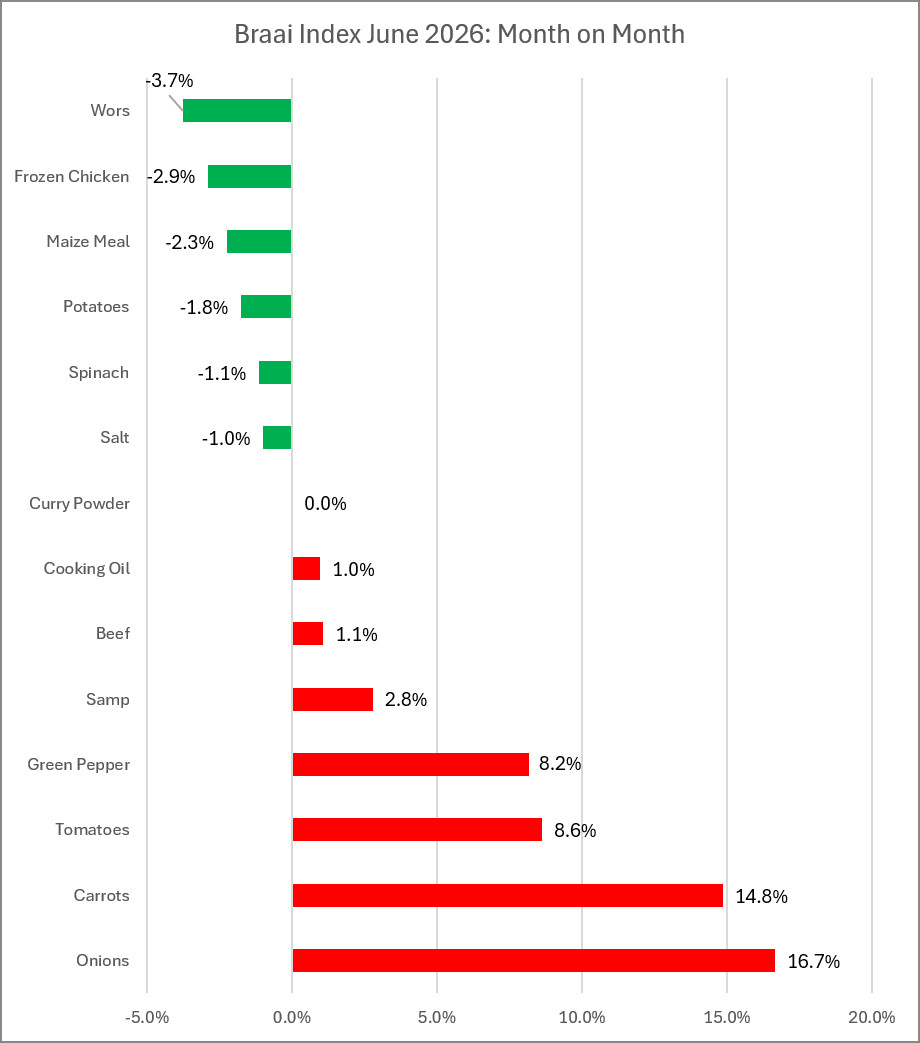
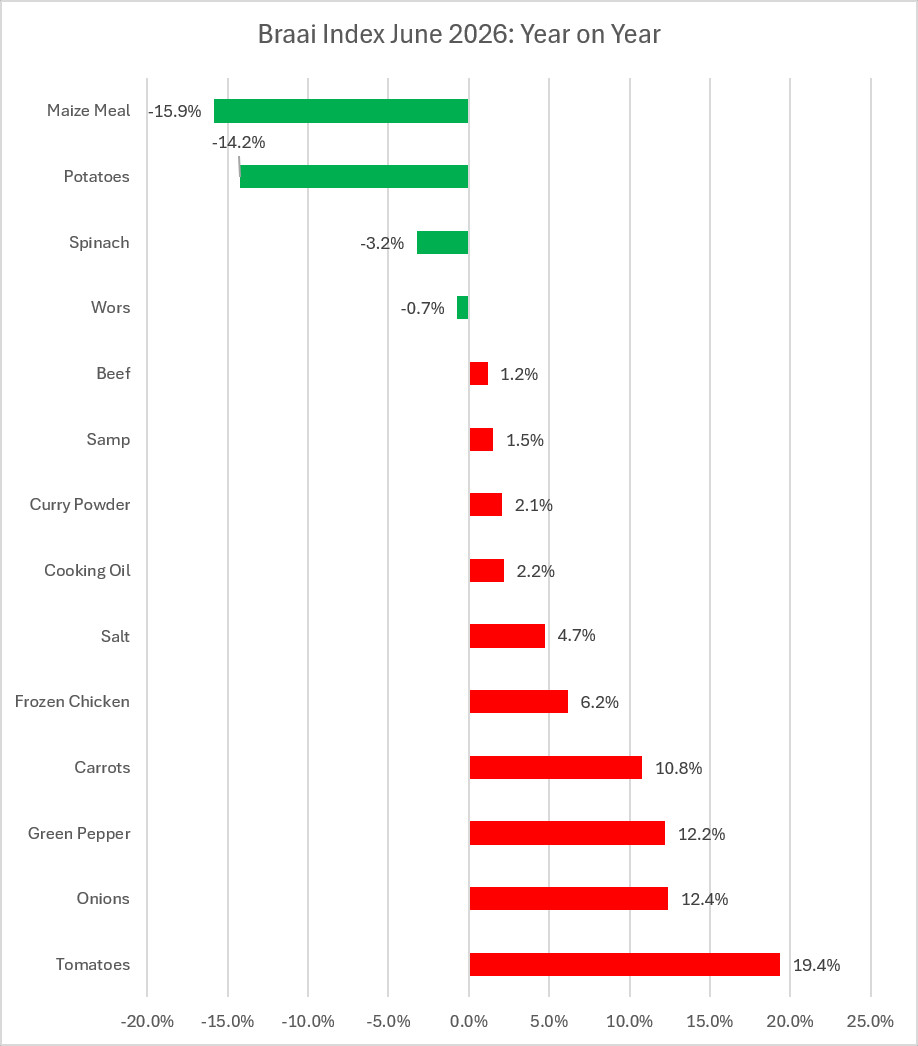
The index shows that the main driver of inflation in the basket is higher vegetable prices, with meat prices finally cooling—but not yet reversing.
Braai Index June 2026 Month-on-Month [+1.3%]
Braai Index June 2026 Year-on-Year [+0.8%]
It should be noted that Stats SA’s inflation data lags the PMBEJD pricing by around a month.
Headline inflation in May spiked to 4.5%, driven primarily by higher fuel prices.
Positively, inflation for food and non-alcoholic beverages (NAB) continued to subside, declining to 1.9% from 2.9% in April. This was down from the peak of 5.7% recorded in July 2025.
The Food NAB reading for May was close to the year-on-year reading of the previous Braai Index for May (1.7%), underscoring its value as a precursor data point.
Meat inflation cooled in May, recording an annual increase of 7.3% compared with April’s 9.4%.
The monthly rate was -0.8%. Stewing beef prices dropped by 3.0% and beef mince by 2.4% between April and May.
The annual increase for these two products was 2.8% and 10.6%, respectively.
Inflation for individual quick frozen (IQF) portions also decelerated, declining to 6.7% in May from 7.3% in April.
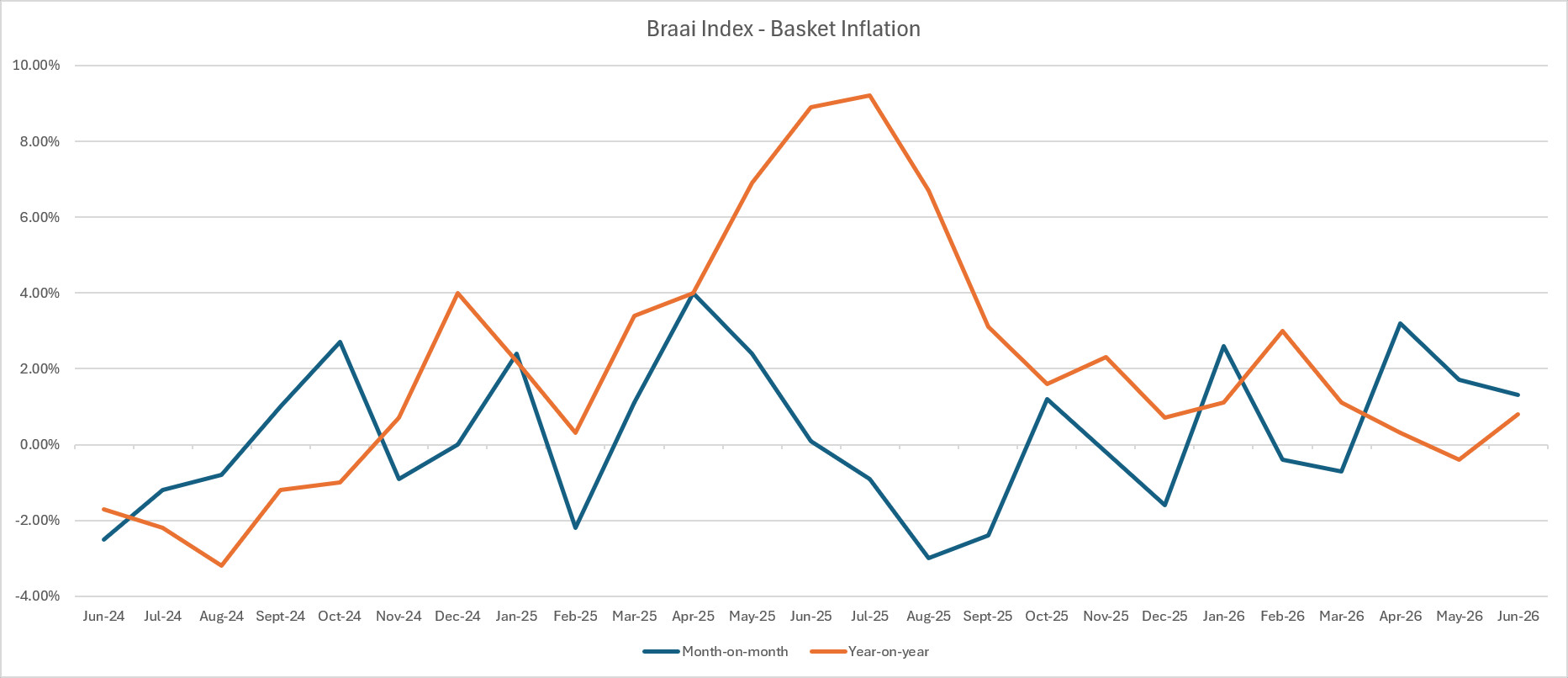
Looking at the longer-term tracking of the index, month-on-month inflation is currently trending higher, reflecting the continued inflationary pressure from the past few months.
Year-on-year, food inflation remains well within the Reserve Bank’s 3% target and is down significantly from the peaks seen in 2025.















 Loading ...