

The most expensive city on the African continent is now in South Africa


Cape Town has officially overtaken other major African cities to become the most expensive place on the continent to buy property, with prime real estate now averaging R102,750 per square metre.
This is according to the latest Africa Wealth Report, compiled annually by Henley & Partners in collaboration with New World Wealth, which tracks private wealth trends across the continent.
The report places Cape Town firmly at the top of Africa’s luxury property market, with prices of prime apartments between 100m² and 200m² now higher than anywhere else in Africa.
Since 2010, property prices in the city have surged by 160%, far outpacing Johannesburg, where values have grown by less than half of that over the same period, according to Statistics South Africa.
The city’s combination of natural beauty, lifestyle appeal, and growing concentration of wealthy residents has drawn both local and international buyers, making it the continent’s new benchmark for high-end real estate.
According to the wealth report, South Africa remains the largest wealth market on the continent, home to 41,100 millionaires, 112 centi-millionaires, and eight billionaires.
This accounts for 34% of Africa’s total millionaire population, roughly equal to the combined tally of the next five wealthiest nations.
At the city level, Johannesburg still holds the top spot in total resident wealth, with 11,700 millionaires calling it home.
The city’s Sandton business hub and emerging Waterfall–Midrand district contribute heavily to the city’s wealth profile.
However, Cape Town, with 8,500 millionaires, is closing the gap quickly. It already leads the continent in centi-millionaires, individuals worth more than $100 million, with 35 residing in the Mother City.
Analysts project that Cape Town could overtake Johannesburg in total private wealth by 2030.
Other African cities still play a prominent role in the continent’s wealth landscape. Cairo ranks third, with 6,800 millionaires and the highest concentration of billionaires, five in total.
Nairobi, East Africa’s economic hub, is fourth with 4,200 millionaires, almost half of Kenya’s total.
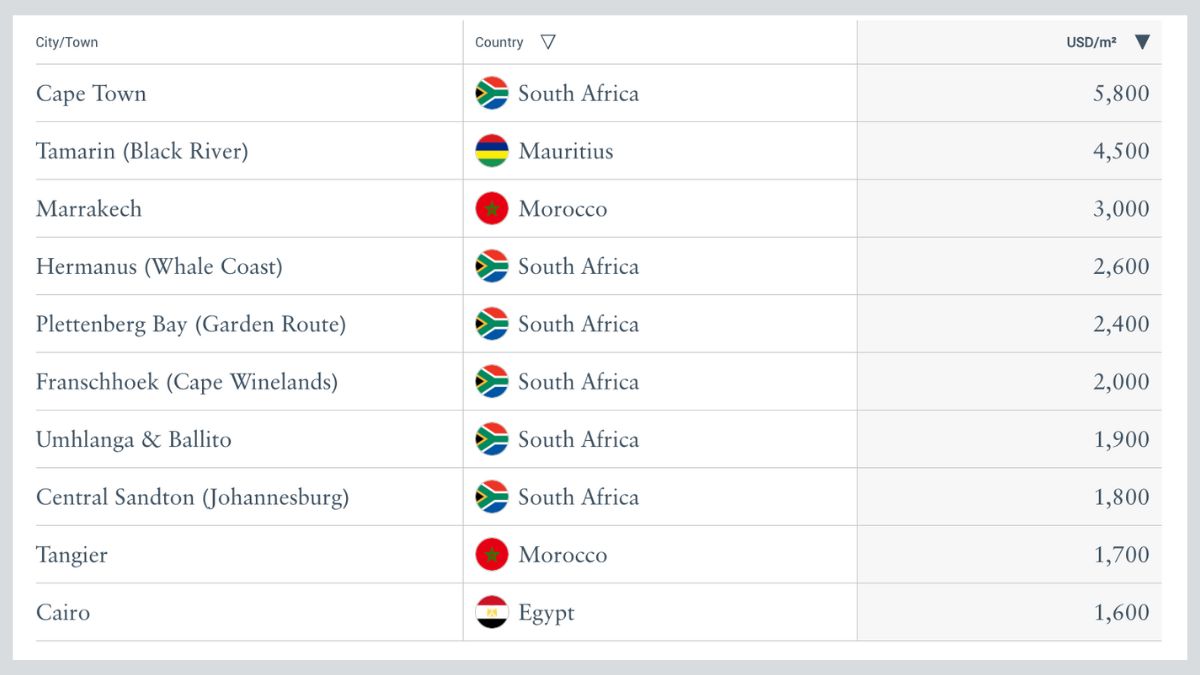
Cape Town’s property market is pulling away
The report also highlighted the broader growth of private wealth across Africa despite global economic uncertainty. The continent is now home to 25 billionaires, 348 centi-millionaires, and 122,500 millionaires.
Cape Town’s appeal is particularly strong among foreign buyers. Data from the Lightstone Group shows that the Western Cape accounted for around 40% of all property purchases above R10 million in 2024.
The broader South African housing market is also showing signs of recovery. According to the latest Pam Golding Residential Property Index, national house price inflation reached 4.4% in July 2025, with real (inflation-adjusted) growth at 0.9%, the sixth consecutive month of positive real growth.
Properties priced above R3 million showed the strongest momentum, with growth of 6.2%, followed by homes between R2 million and R3 million at 6%. Properties below R1 million grew more modestly, at 3.4%.
The Western Cape once again leads the pack, with house price growth climbing to 7.2% year-on-year in July. KwaZulu-Natal followed at 3.2%, slightly ahead of Gauteng at 2.5%.
Andrew Golding, chief executive of the Pam Golding Property Group, said Cope Town continues to outperform, with strong investment demand.
“Investment demand in the Western Cape remains robust, accounting for 31.1% of all ooba Home Loans applications received in July,” he said.
He also pointed out that coastal property prices continue to outpace inland markets, rising 6.7% versus 4.5% in non-coastal areas, widening the coastal price premium to 2.3%.
Lightstone’s data reinforces this trend, showing Cape Town significantly outperforming other metropolitan markets with an annual growth of 7.4% in July.
Sectional title properties have also seen renewed momentum, with price inflation climbing to 4.5%, while freehold properties rose 5.2%.














 Loading ...