

Pain for homeowners in South Africa’s richest province



Gauteng homeowners still show signs of financial distress, while coastal provinces are showcasing greater property market stability and resilience.
The latest FNB Estate Agents Survey has revealed domestic residential property market shifts over the last year.
Comparison data from Q3 2024 to 2025 has helped to transition from distress-driven sales to motivations rooted in lifestyle and demographic changes, with variation between demographics.
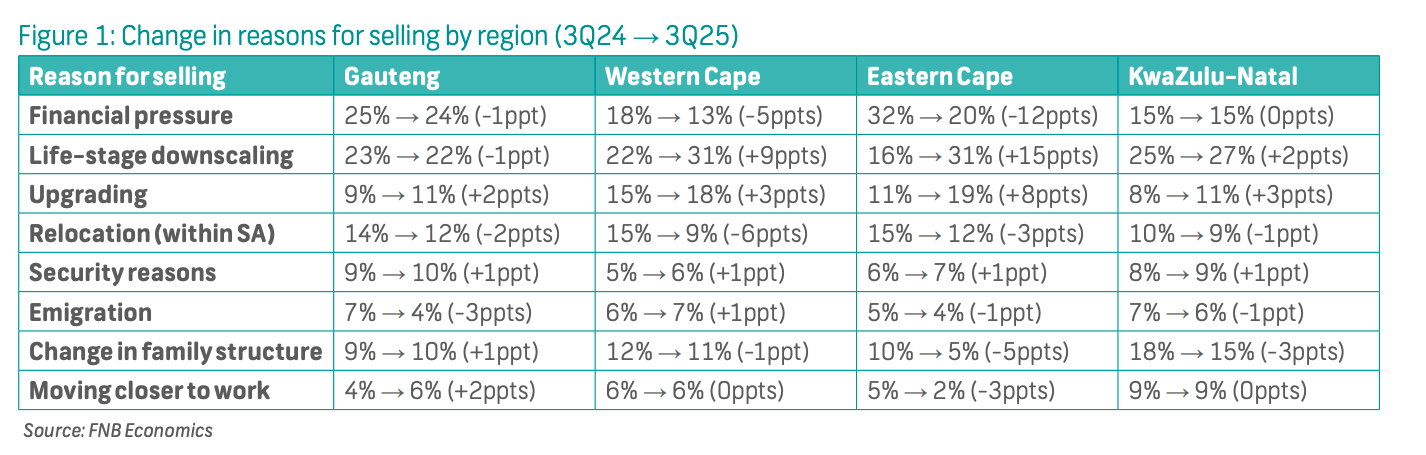
Despite being the nation’s financial powerhouse and the most significant contributor to GDP, Gauteng is the province most affected by economic stress, even if this pressure is slowly easing.
Financial pressure is still the leading factor for selling, standing at 24% of sales in Q3 2025, dropping slightly from 25% in Q3 2024.
Positively, there was a modest increase in sellers upgrading from 9% to 11%, and those citing security concerns, rising from 9% to 10%.
Emigration-driven sales also declined from 7% to 4%, which FNB said suggests that there is improved local sentiment or reduced global mobility.
On the other end of the country, the Western Cape has seen a marked shift towards lifestyle-driven sales.
Downscaling due to life-stage rose from 22% to 31%, with financial pressure as a selling reason declining from 18% to 13%.
Upgrading also increased from 15% to 18%, with semigration becoming less common from 15% to 9%.
“These trends point to a maturing, affluent market where discretionary moves and retirement transitions are increasingly dominant,” said FNB.
The Eastern Cape saw the most dramatic change, with financial pressure-driven sales dropping sharply from 32% to 20%.
The life-stage downscaling rose from 16% to 31%, while upgrading increased significantly from 11% to 19%.
This suggests improved economic stability and a growing influence of demographic factors on market activity, including ageing and retirement.
KwaZulu-Natal remains a relatively stable market, with only minor shifts in reasons for selling.
Life-stage downscaling increased slightly from 25% to 27%, while financial pressure remained at 15%.
Security and changes in family structure still play a large role, highlighting the ongoing need for secure and flexible housing options in the region.
What this means for the market

“The decline in distress-driven sales, particularly in the Cape provinces, signals greater market stability and resilience,” said FNB.
“Fewer homeowners are being forced to sell due to financial pressure, enabling more discretionary, lifestyle-driven moves.”
“This shift significantly improves the negotiating position for sellers, as they are less pressured to accept lower offers.”
FNB said that the trend is closely linked to demographic changes, as the surge in life-stage downscaling increases demand for smaller, low-maintenance homes and retirement-focused developments.
The regional differences are also becoming more noticeable, with the Cape provinces increasingly shaped by lifestyle and demographic factors.
FNB said that Gauteng remains more sensitive to affordability and security concerns, which is leading to more segments and a regionally diverse housing market.
“The residential property market is evolving towards greater stability, with lifestyle and demographic factors broadly overtaking financial distress as the main reasons for selling,” said FNB.
“These pronounced regional nuances require tailored strategies from developers, agents, and policymakers to meet shifting demand and support a healthy, inclusive housing market.”


















 Loading ...