

These are the most popular smartwatches in the world right now


Apple continues to dominate the smartwatch market with a 41% share, while the majority of smartwatch makers are looking to add cellular connectivity as 90% of smartwatches shipped today are not cellular capable.
That’s according to the latest research from Counterpoint’s Global Smartwatch Tracker which found that global smartwatch shipments grew 37% year on year in Q2 2018.
Commenting on the major shift in the market, Counterpoint research analyst, Satyajit Sinha, noted that Apple stepped up its strategy in the smartwatch segment at the end of 2017 by enhancing the features of smartwatches into broad-based functionalities -including some health and fitness tracking capabilities.
“Moreover, Apple is catalysing the trend of ‘smartwatch as a standalone wearable device’ with adoption of cellular connectivity, which is driving the new wave of cellular connected wearables globally, great news for mobile operators,” he said.
Sinha added that battery-life is a constant concern with smartwatches, given their tiny batteries.
“However, Apple, Samsung and Huawei are consistently working to optimise the software and the overall design and adding components such as eSIM to make space for bigger batteries,” he said.
“Moreover, the adoption of cellular Low Power Wireless Access (LPWA), technology especially LTE-M in smartwatches will also drive core use-cases in a smartwatch while boosting battery life,” he said.
Most popular
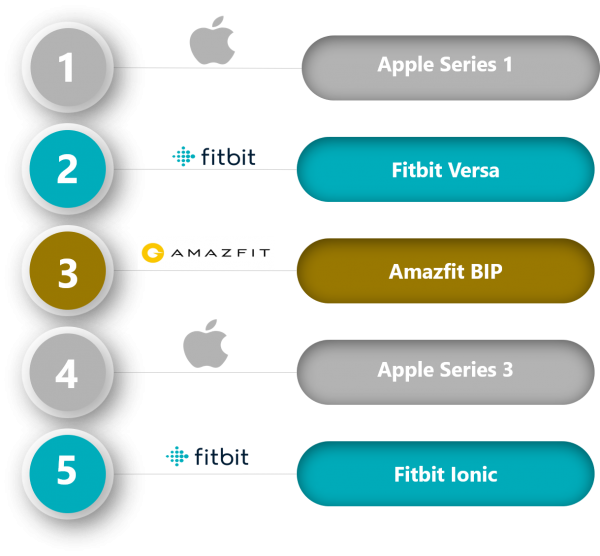
Apple and Fitbit dominated the best-seller’s list, with two models each out of the top five rankings.
However, the Chinese brand Amazfit’s smartwatch BIP remained popular globally as it ramped sales and popularity across the top 50 countries in the first half of this year.
“Despite initial hype and traction of cellular-based Apple Watch Series 3 in the first two quarters, Apple iPhone users are actually choosing the Series 1 as a non-cellular option over Series 3 non-cellular model which is surprising to many industry watchers,” said research director Neil Shah.
“This also shows, Apple users are choosing Series 3 preferably if they want to add cellular connectivity, else Series 1 remains the most popular model contributing to almost nine out of ten Apple Watch sold in Q2 2018.
“While this is great for Apple from an ecosystem perspective, from an ASP perspective it is not the same bump as Apple would expect with newer iPhone models every year.”
ASP is a benchmark of how much customers are willing to spend acquiring an iPhone from Apple or their carrier. The figure is worked out by dividing the total revenue Apple received for the product by the number of units sold to customers, with the number changing each quarter depending on consumer trends.















 Loading ...