

Africa lags on globalisation


While Africa is making progress in becoming a more globalised continent, it still lags when compared to the rest of the world, according to the Visa Africa Integration Index.
The index, released on Wednesday (5 June 2012), looks at a number of selected sub-Saharan African countries to measure their global and regional integration based on recent data.
“The [African] continent’s low level of integration – with the rest of the world and, more importantly, with one another – points to an opportunity for large and sustainable gains in prosperity,” noted Professor of Economics at the Gordon Institute of Business Science (GIBS), Adrian Saville.
“Africa needs to trade and become more integrated in global value chains if it is to harness its natural potential and stimulate wealth and prosperity.”
“This also means improving integration within Africa: building economies of scale and competitiveness in global markets, and weighing in alongside the likes of Asia,” Saville said.
The report, jointly produced by the African Development Bank, the World Bank and the World Economic Forum, said closer regional integration would be crucial in addressing underlying weaknesses in Africa’s long-term competitiveness and ensuring that the continent delivers on its massive growth promise.
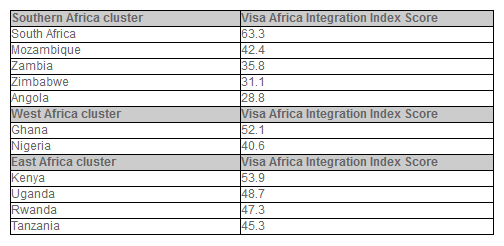
Visa integration index
Globalising Africa
According to the report, Africa is still the least integrated region in the world, but there are signs of change.
“While improving off a modest base, the countries that make up the Index have undergone positive structural transformation over the past decade,” Saville said.
“The Index offers both recent and robust evidence of this: all 11 countries show improvements in economic integration over the period measured, namely the four half-year periods that make up 2011 and 2012.”
South Africa has the highest score on the Visa Africa Integration Index, improving from 61.1 at the start of 2011 to 63.3 at the end of 2012.
In terms of Global integration, South Africa scored of 39.1 out of 50.0 and a regional integration score of 24.2 out of 50.0, producing a final index of 63.3 out of 100.
“South Africa’s impressive global depth and breadth components are indicative of the country’s focus on liberalization dating back to the mid-1990s, higher levels of industrialization, economic diversification, and pursuit of trade agreements and preferential market access arrangements around the globe,” the report said.
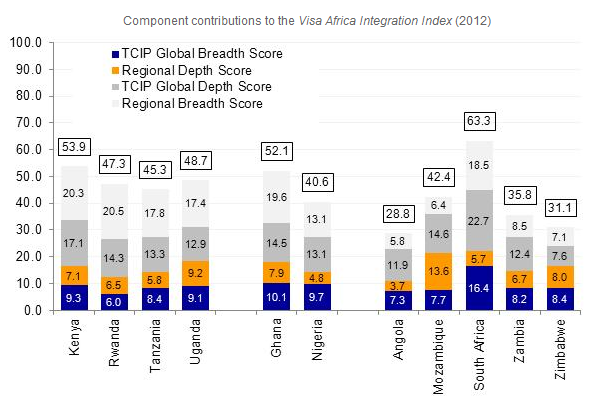
Visa integration index – components
Methodology
The Afrian Integration Index study was carried out in conjunction with Professor Adrian Saville and Dr Lyal White, Director of the Centre for Dynamic Markets and a Senior Lecturer at GIBS.
Four key metrics to measure integration were used: the flow of goods and services or trade, financial integration and the movement of capital, the flow of information and knowledge and the movement of people.
More on South Africa
What the world thinks of South Africa
The richest city in South Africa
SA’s dismal entrepreneurial record














 Loading ...