

9 months of salary pain comes to an end in South Africa


South African salary earners have seen their first monthly real salary increases following a period of heightened inflation, but the yearly figures still make for grim reading.
This is according to the PayInc Net Salary Index, which tracks the take-home pay of approximately 2.1 million South African salary earners.
PayInc said that salary earners saw a further modest improvement in nominal net salaries in July 2026, but warned that ongoing economic pressures continue to exert strain on salary growth.
“The average nominal net salary increased further to R21,642 in July, 0.2% higher than in June, and up by 2.2% compared to a year ago,” said Shergeran Naidoo, Head of Stakeholder Engagement at PayInc.
Nominal net salaries increased by only 1.6% during the first seven months of 2026, compared to the 3.7% increase for the full year in 2025, highlighting the strain in the labour market.
“While the continued increase in nominal net salaries is encouraging, the broader picture shows that salary growth remains subdued,” said Elize Kruger, Independent Economist.
“South African households continue to navigate a challenging economic environment, making the recovery in purchasing power particularly important for consumer confidence and spending.”
Consumer inflation also moderated to 4.3% in July from 5.0% in June, which was the first decline in five months. The war in Iran has caused massive increases in fuel prices across South Africa.
However, large reductions in fuel prices during July contributed to the improvement and provided some relief to consumers. This lower inflation was also a positive for real net salaries.
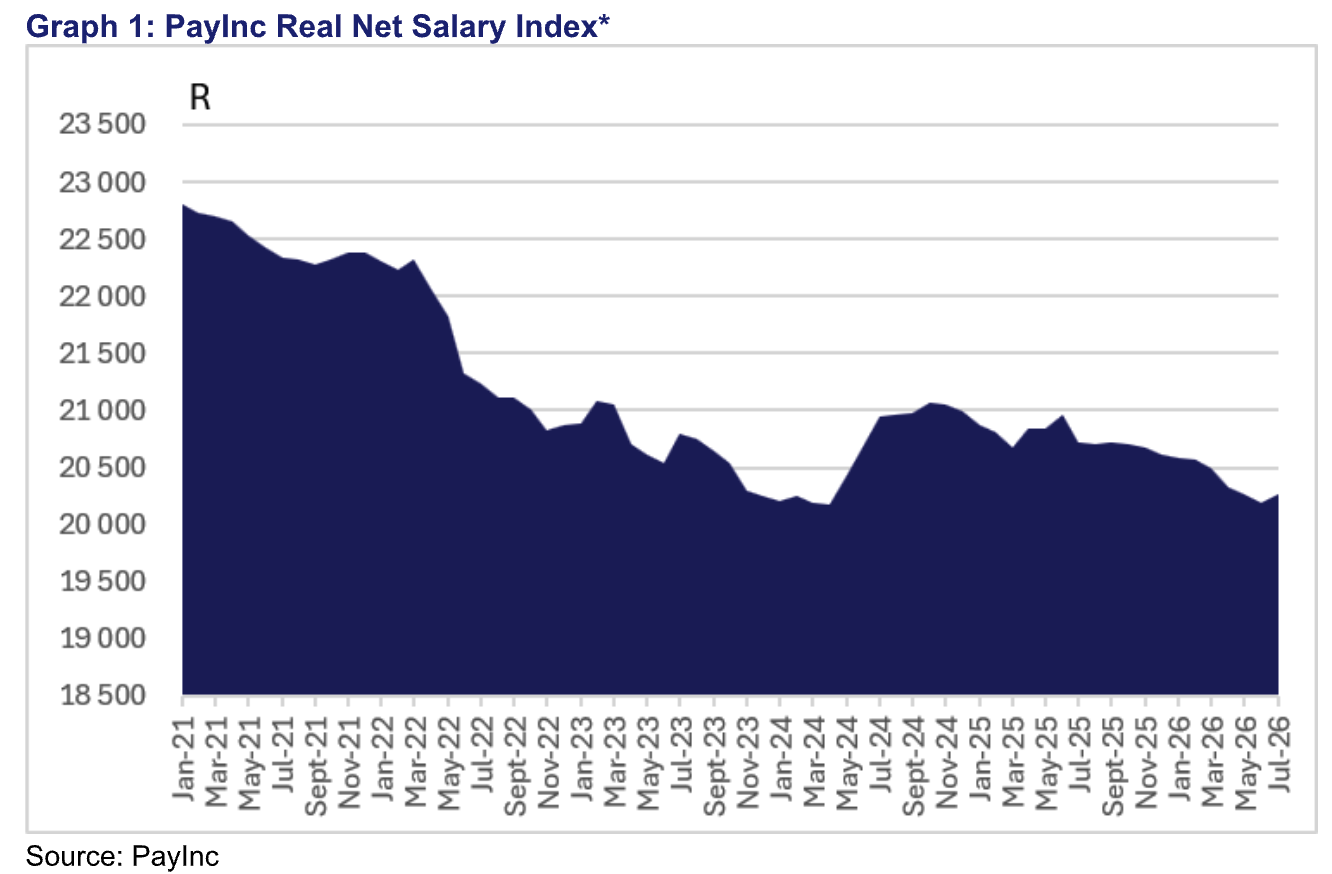
The PayInc Net Salary Index increased by 0.4% month-on-month in real terms in July, which was the first monthly increase in nine months.
Nevertheless, at R20 269 in July, the index remained 2.2% below year-ago levels, while year-to-date statistics suggest that net salaries are down by 2.1% in real terms.
“The moderating inflation provided some breathing room for salary earners in July and contributed to the first monthly improvement in real net salaries in nine months,” said Kruger.
“However, purchasing power remains weaker than a year ago, and this continued erosion has implications for household spending and consumer confidence.”
More pain on the cards

The monthly relief could also be temporary, with renewed geopolitical tensions in the Middle East placing upward pressure on international oil prices.
This raises the chances of higher domestic fuel prices and renewed inflationary pressures. Salary trends also continue to reflect the challenging operating environment facing South African businesses.
Salary trends also continue to reflect the challenging operating environment in South African businesses.
The impact of weaker economic conditions, higher input costs, and pressure on company profitability has constrained salary expectations, although wage outcomes differ considerably across sectors.
According to the South African Reserve Bank (SARB), average private-sector salary increases moderated to 4.0% in 2025, down from 4.1% in 2024, compared with an average of 5.4% in both 2022 and 2023.
Wage growth also varied considerably between industries. In Q4 2025, nominal remuneration growth per worker also ranged from 4.6% in manufacturing to 8.8% in gold mining, reflecting uneven salary growth.
“Salary growth cannot be viewed separately from the health of the broader economy and labour market,” noted Kruger.
“Businesses facing pressure on profitability tend to postpone investment decisions, while there is less scope for meaningful salary increases in a strained environment.”
Public sector remuneration remains incredibly high, rising by 8.6% in 2025 and 9.1% in 2024, as per South African Reserve Bank data.
However, when including private-sector remuneration, average nominal remuneration growth of 5.0% and 5.2% was recorded in 2025 and 2024, respectively.
Unionised employees have also typically secured higher wage increases than their non-unionised counterparts.
Looking ahead, 2026 looks set to be another challenging year for South African salary earners. Nominal salary growth is tracking below 2025 levels, while inflation has eroded the real value of said earnings.
“July represents a welcome improvement, particularly after nine consecutive months without monthly real salary growth, but the pressure on households has not disappeared,” said Kruger.
“A sustained recovery in purchasing power will depend on stronger salary growth, contained inflation and, importantly, an improvement in the broader economic and employment environment.”

















 Loading ...