

Rand eyes R14 vs the dollar


The rand firmed in midday trade on Friday, pushed by risk appetite following disappointing data statistics out of the United States.
By 12h30, the rand traded 0.70% firmer against the dollar, at R14.17 after data showed that economic growth in the US was at its slowest level in two years, Reuters reported.
The local unit was also firmer against the pound at R20.65, and R16.14 against the euro.
Locally, the North Gauteng High Court ruled on Friday that a decision to drop 783 corruption charges against President Jacob Zuma should be reviewed.
The court found that the former National Prosecuting Authority chief, Mokotedi Mpshe, acted impulsively and irrationally when he decided to drop the charges of corruption laid against president Jacob Zuma in 2009.
The court ruled that the NPA should review its decision and set it aside, saying that Zuma should face the charges as set out on the indictment in which the president was facing 783 charges of corruption.
“The currency seems exceptionally sensitive to the political situation. We have seen that broad reaction in December with the change of the finance ministers, we saw that reaction which was swift,” Global Trader head of trading Nilan Morar told Reuters.
“The rand rally is getting going again, but to accelerate it needs ongoing support from the dollar, larger capital flows and a break through key levels,” said Rand Market Bank currency strategist John Cairns in a note.
“The dominant issue in the rand outlook remains the dollar. Today’s event risk on this front comes from US personal income and spending data this afternoon.”
Annabel Bishop, Investec chief economist noted that the US left interest rates unchanged again, as expected, and the Federal Open Market Committee (FOMC) maintained its dovish tone. That allowed the rand to strengthen from R14.61/USD to 14.39/USD on Thursday.
Bishop said that commodity prices have risen from a low point in November 2015, lifting particularly in March and April, which has also assisted the domestic currency stronger, as South Africa is a substantial commodity exporter.
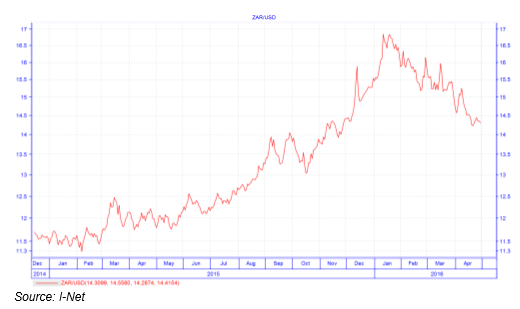
“Along with global risk-on into emerging market assets over this period, the rand pulled back from close to R17.00/USD in January, to R14.15/USD recently. It then rebounded slightly weaker to R14.20/USD, which is a key resistance level. Global events continue to be the main driver of domestic currency strength,” Bishop said.
The economist said that from a credit rating perspective the country continues to await Moody’s outturn on its current assessment of South Africa’s creditworthiness, which is widely believed will be a downgrade to align its ratings closer to S&P and Fitch’s sovereign ratings of SA.
“S&P remains likely to downgrade SA this year on the local currency front (currently BBB+, to BBB) not the hard currency one (now BBB-) to bring greater alignment – and equate with Fitch’s ratings.”
This could occur on 3 June 2016, and is not expected to deliver a sub-investment grade outcome, although one is always possible, Bishop said.
More on the rand
Rand trading at strongest levels in four months
What a ratings downgrade means for the rand
Why the rand punches above the weight of South Africa’s economy

















 Loading ...