

Android takes a malware beating


According to F-Secure‘s mobile threat report for 2012, Android malware has been strengthening its position in the mobile threat scene.
The quarterly F-Secure reports detail the mobile threats seen across various mobile operating systems, and analyze the statistics gathered by the F-Secure Response Labs during the given periods.
“Every quarter, malware authors bring forth new threat families and variants to lure more victims and to update on the existing ones,” the report said. “In the fourth quarter alone, 96 new families and variants of Android threats were discovered, which almost doubles the number recorded in the previous quarter.”
According to the report, a large portion of these new threats were from “PremiumSMS” – a family of malware that generates profit through shady SMS-sending practices – which unleashed 21 new variants.
PremiumSMS-type malware It is a popular method for making direct monetary profit on mobiles. The malware quietly sends out SMS messages to premium rate numbers or signs up the victims to an SMS-based subscription service.
Any tell-tale messages or notifications from these numbers and/or services will be intercepted and deleted; therefore, the users will be completely unaware of these activities until the charges appear on their bills.
In addition to SMS-sending malware, some malware authors or distributors make profit through banking trojans which steal the mobile Transaction Authentication Number (mTAN) that banks send via SMS to customers to validate an online banking transaction.
Using this number, it can transfer money from the victims’ account and the banks will proceed with the transaction because it appears to be coming from the rightful account owner.
Such trojans were found infecting not only devices running on Android, but also Symbian and BlackBerry operating systems.
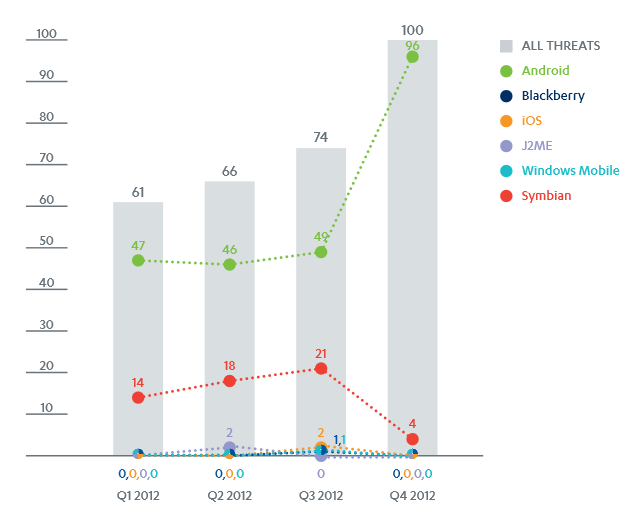
Mobile threats
Android attack
According to the report, the number of malware attacks on the Android platform boils down to market share.
“The rise of Android malware can be largely attributed to the operating system’s increasing foothold in the mobile market,” the report said.
“Android’s market share has risen to 68.8% in 2012, compared to 49.2% in 2011. On the threat side, its share rose to 79% in 2012 from 66.7% in 2011. Symbian on the other hand, is suffering from the opposite fate.”
According to the report, this rise and fall is logically tied to each operating system’s slice of market share – as market share declines, so does malware authors’ interest in the platforms – as is the case with Symbian, which Nokia halted.
As such, Android is seen as having the greatest number of mobile threats.
“As for the other platforms, i.e., Blackberry, iOS, Windows Mobile – they may see some threats popping up once in a while. But most likely, the threats are intended for multiple platforms.”
While Android devices account for the most mobile security threats, it’s interesting to note that this is the first report to indicate threats on the iOS platform since 2010 – indicating that malware distributors are becoming more successful in targetting the platform.
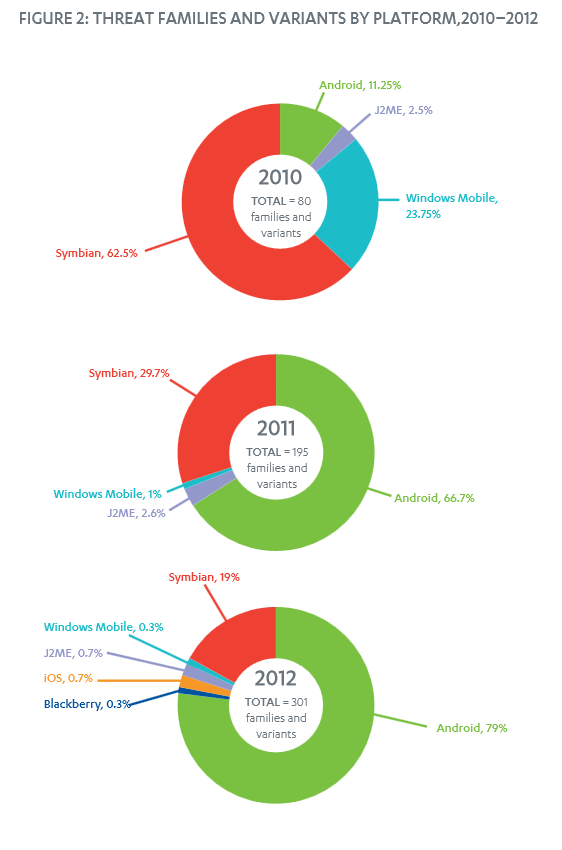
Mobile threats year-on-year


















 Loading ...