

How much people in Cape Town earn – based on where they live and work


The National Treasury has published a series of new reports for its Cities Support Programme (CSP), detailing the wages of taxpayers in South Africa’s major metros.
The reports are based on spatial data mined from anonymised administrative tax data, documenting employment and firm-level statistics at a sub-municipal level.
The data used for this specific analysis was primarily built from the IRP5 and IT3(a) tax forms.
These certificates generally include a wide variety of employer/employee relationships such that financial service companies paying out pension fund or retirement annuity income might be included, as well as consulting fees for contracted work.
However, the researchers cautioned that there are still employment opportunities that would be missing from the data related to sole-proprietors or self-employed individuals.
As the data is based on taxpayer submissions, it also only accounts for the formal sector in firms and individuals. In the South African context this means that a large portion of economic activity is missing from the data.
Income trends
The data shows that approximately a quarter (25%) of Cape Town’s employment opportunities are being paid between R3,200 and R6,400 per month – taking into account inflation in the 2017 tax year.
This is the largest wage band for all other metros in South Africa.
However, Cape Town’s distribution is slightly right-skewed relative to some of the other metros, indicating a larger percentage of the employment opportunities existing in the higher wage bands.
“This is to be expected considering that there are multiple head offices in Cape Town, as well as the fact that the general cost of living, according to the Consumer Price Index, for the Western Cape is higher than other provinces, suggesting that there should be higher earning potential there,” the researchers said.
“The real income trends associated with each wage band show that there has been a shift in the earning power of the workforce in Cape Town, so not only are there more jobs year-on-year but people are generally earning more with the only wage bands that are have a decreasing or stagnant number of employees associated with them being the lower bands between R800 and R3,200 monthly income.”

Income at a suburb level
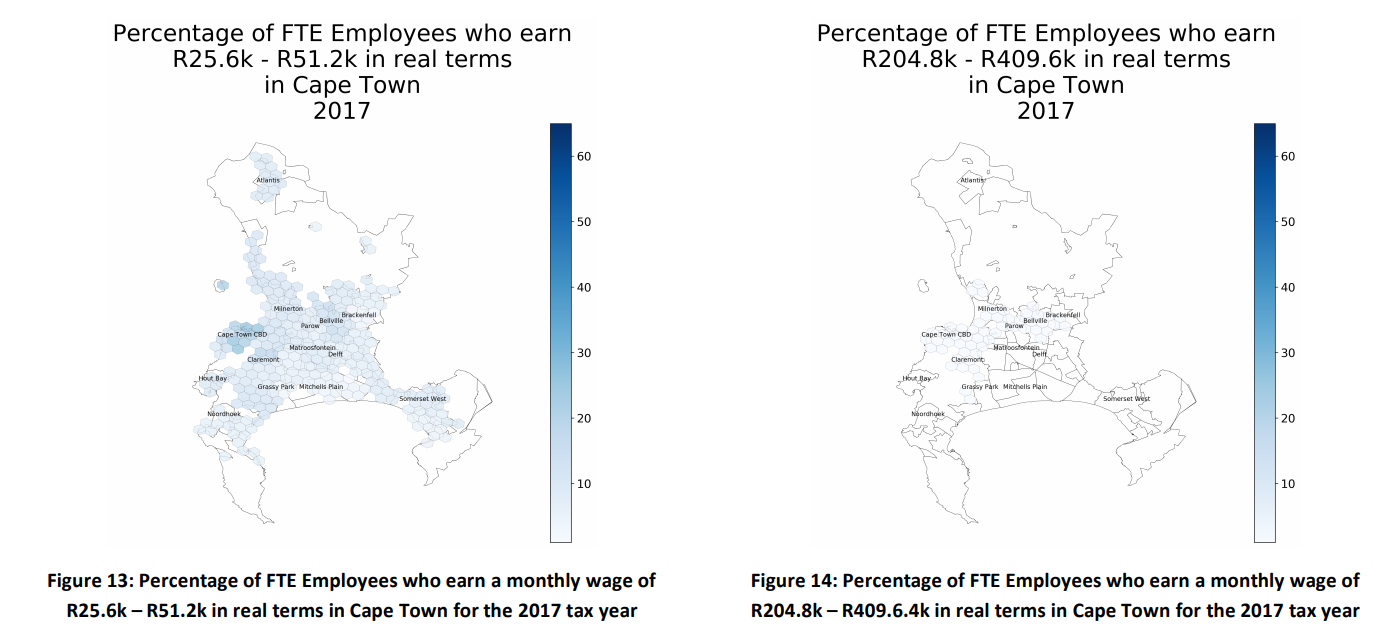
The data shows that the concentrations of employment opportunities below R6,400 are generally located in parts of Mitchells Plain, Khayelitsha, Brackenfell and to some extent parts of Somerset West and Noordhoek and surrounds.
Moving up the wage band ladder, these opportunities are distributed more evenly across the municipality, with some concentrations towards Epping, Ottery, Atlantis and Kuils Rivier – well-known industrial areas with a certain level of skilled labour required.
“However, once you increase beyond the R12,800 mark there is a noticeable shift towards the city bowl, the N1 Corridor and parts of Claremont and Kenilworth and this is further compounded towards the CBD above this,” the researchers said
“This correlates to what we would expect with head offices and high skilled jobs located in the city bowl and along the N1 corridor.”
By comparison, the low-income jobs are concentrated in areas known to have lower economic activity, the researchers said.
“It should also be noted that upon further inspection of the concentration of low-income jobs in Brackenfell it was discovered that this was an instance where a firm – a major retailer – submitted most of the IRP5s with the work address designated as the head office.
“This may explain why there is a higher concentration of lower-income opportunities there than anywhere else.”
*Full-time equivalent employees or FTE employees is a weighted metric measuring jobs/opportunities relative to the time an employee worked according to an IRP5 submission.
Suburbs where full-time employee (FTE) earn between R1,600 – R6,400 a month

Suburbs where full-time employee earn between R6,400 – R25,600 a month

Suburbs where full-time employees earn R25,600 and upwards a month
Median income
The report identifies Robben Island as the area with the highest median income. This can be attributed to the low number of overall jobs located there and the higher-earning capacity of these jobs.
The city bowl and Rondebosch/Claremont follow closely behind with high concentrations of relatively skilled/high earning jobs.

The lowest median incomes are located in parts of Brackenfell, likely due to the erroneous tax submissions of a single firm, as well as Mitchells Plain and Khayelitsha.
“However, when viewing the changes to median income since 2013, one can see more localised increases and decreases all around the city with notable increases in Durbanville, Blouberg, and parts of Rondebosch, while there are notable decreases in parts of Milnerton, the Atlantic Seaboard, Atlantis and parts of the Cape Flats.
“These could be further investigated by reviewing the median income per industry and how these have changed over time to better explain why these changes may be occurring,” the researchers said.
Read: South Africa will spend more than R195 billion in the next year – paying 18 million grants a month

















 Loading ...